

What is the best VR simulator available? If you are searching for a shooting vr simulator, comparing vr simulator price points, or evaluating which vr simulator machine to deploy in your venue, you have probably already noticed the problem: every manufacturer claims their product is the definitive answer. The racing simulator brand says racing is the future. The cinema pod brand says immersive cinema maximizes ROI. The arena brand says multiplayer is the only format that matters. They cannot all be right — but they are not all wrong, either. They are answering a question you did not ask.
There is no single “best VR simulator.” There is a best VR simulator for YOUR venue type, YOUR customer demographic, and YOUR revenue model. A vr car simulator that generates strong revenue in a shopping-mall FEC may underperform in a theme park. A multiplayer shooting arena that anchors an Urban Entertainment Hub’s weekend revenue may be overkill for a hotel lobby. This article maps six commercial VR simulator categories against the operational realities that determine which machine earns and which one sits idle. You bring your venue. The framework finds your answer.
The Commercial VR Simulator Landscape — 6 Categories Defined
Before evaluating which vr simulator machine fits your operation, we need a clear taxonomy. The commercial VR simulator market consists of six distinct categories, each engineered for a different operational purpose, revenue profile, and audience segment.
Category 1: VR Racing Simulators — The Social Competitive Engine
What It Is
The VR racing category spans two distinct formats. Fixed-base motion simulators — a cockpit with triple-screen display, force-feedback steering, and 3DOF motion platform — deliver a premium individual racing experience with strong spectator draw from visible physical motion. Mixed-reality (MR) karting — trackless, lithium-battery-powered chassis that physically move through real space with augmented-reality overlays, network multiplayer, and NPC competitors — represents the next generation. A single open floor area becomes six selectable virtual worlds (Egypt Oasis, Jurassic Park, Polar Fantasy, Sky City, Undersea World, Cat City). One physical investment. Infinite replay value.
Who It’s For
MR Go-Kart is the highest-impact product for Urban Entertainment Hubs — hybrid social venues where young-adult customers film experiences and post to Douyin (TikTok) and Xiaohongshu (RED). Physical karts in motion on a neon-lit digital track generate the highest spectator visibility in commercial VR, visible from 30+ meters across the venue floor. This converts passersby into queued players at zero marketing cost. The format also anchors large-format FECs and theme parks with 100+ square meters of contiguous floor space, where the six-theme replay value sustains repeat visitation far beyond what a single-layout physical track can deliver.
Category 2: VR Shooting Simulators — The Group-Booking Revenue Anchor
What It Is
A shooting vr simulator in the commercial context is not a single-player arcade cabinet. It is a free-roam, untethered multiplayer arena supporting 1 to 20+ simultaneous players in a software-defined space with millimeter-level spatial positioning and enterprise-grade headsets (PICO 4UE). No fixed grid. No physical track. The arena boundaries are defined in software — conforming to your venue’s specific floor dimensions. Players run, dodge, aim, and communicate in shared physical-virtual space. The system ships with a curated title configuration spanning competitive sci-fi PvP shooters, family-friendly cooperative defense, and immersive cinematic team-viewing experiences.
Who It’s For
The free-roam multiplayer arena is the premium group-booking anchor for amusement parks, large-format FECs, corporate team-building facilities, and Urban Entertainment Hubs. A fully-booked 10-player Saturday afternoon slot generates more revenue than a solo racing simulator generates across an entire operating day — because the per-session revenue multiplies by group size while staffing requirements stay roughly constant. Group bookings (birthday parties, corporate events, e-sports tournaments) further amplify per-slot economics. Beyond direct revenue, the competitive multiplayer format is a social media content engine: players film their squad, post scores, and tag teammates — generating organic customer acquisition that no paid advertisement replicates.
Category 3: VR Driving Simulators — The Competitive Spectator Magnet
What It Is
A vr car simulator with a 3DOF motion cockpit combines triple-screen immersive display, 360-degree rotational motion platform, and force-feedback steering with pre-loaded racing titles spanning Formula circuits, street racing, and off-road terrain. The physical motion — banking through corners, vibrating over rumble strips — is visible to everyone within a 20-meter radius, converting passersby into queued players at zero incremental marketing spend. The unit functions simultaneously as a revenue generator and a venue-wide billboard.
Who It’s For
Shopping-mall FECs, standalone VR arcades, and entertainment zones with moderate floor space are the natural fit. The demographic skews toward teens and adults, with broad cross-gender appeal in markets with strong car culture. The 3DOF motion platform delivers perceived value that stationary VR cannot match — premium per-session pricing (above cinema experiences, competitive with shooters) is justified by the physical sensation. Session durations of 5-8 minutes support 7-10 complete ride cycles per hour at full occupancy. On-screen race feeds and leaderboard displays create a natural spectator gallery, turning every session into a live advertisement for the next player in line.
Category 4: 9D VR Cinema Simulators — The Family Volume Driver
What It Is
A 9D VR cinema simulator is a motion-synchronized immersive cinema pod seating 2 to 9 players. Guests sit in an enclosed cockpit, put on VR headsets, and experience a 5-minute film — a roller coaster, a space exploration, a deep-sea dive — while the motion platform delivers synchronized pitch, bank, heave, and vibration. Surround audio and environmental effects (wind, scent on select models) complete the sensory envelope. Zero player skill required. Zero learning curve. A family of four walks in, sits down, and completes their session inside the runtime of a single song.
Who It’s For
The 9D cinema pod is the widest-demographic-coverage product in commercial VR, serving ages 3 to 80. It is the volume engine that captures everyone the racing simulators and shooting arenas miss: families with young children, couples on dates, casual visitors who have never tried VR, and elderly guests. Primary deployment venues include shopping malls, cinema lobbies (5-minute session = perfect pre-show window), family entertainment zones, resort lounges, and amusement park entrances. Two LEKE VR form factors serve different spatial requirements: the Space Shuttle 2.0 (dual-seat, 5.59 sqm, 80+ titles, DEEPOON E3S headsets) as the premium family anchor, and the 360-degree VR Chair (2-player rotational, ~4-6 sqm) for high-turnover placement near entrances or in narrow lobby spaces.
Category 5: Self-Service VR Kiosks — The Zero-Staff Volume Filler
What It Is
A self-service VR stand station occupies just 2.46 square meters — roughly the footprint of a vending machine — and operates fully unattended. The guest approaches, selects a game on the Pico Neo 3 Pro headset, pays via coin, card, or QR scan, and plays. No staff interaction. An automated mechanical headset lift prevents damage and theft; integrated voice guidance handles onboarding. With 80+ built-in solo-play games, the kiosk converts idle waiting time into continuous incremental revenue.
Who It’s For
This is not a headline attraction. It is the operational glue that prevents revenue leakage. Deploy kiosks in corridors, near cash-wrap counters, beside popular ride queue lines, or along venue walls — locations that would otherwise generate zero revenue. In a multi-attraction venue, when the racing simulators are occupied and the shooter arena’s next group-booking slot is 20 minutes away, waiting guests have two options: leave, or play the kiosk. On slow weekday afternoons, kiosks sustain baseline income when staffing full attractions is uneconomical. Multiple units can be deployed across a venue with a single staff member overseeing all of them alongside other duties.
Category 6: VR Simulator Games — The Content Layer That Powers Everything
Why Content Is a Separate Category
The most overlooked dimension in VR simulator selection is not hardware — it is vr simulator games. Industry surveys consistently identify “the games never change” as the number-one reason VR venue customers do not return. Over 70% of lapsed visitors cite content stagnation as their primary deterrent. This means content is not a secondary spec on a datasheet. It is the primary driver of the most important revenue metric in commercial VR: repeat visitation rate.
The Two Content Models — And Why They Define Your Repeat Business
Model A (Industry Standard): Buy hardware → receive bundled third-party games → that is your library permanently. Content is treated as a one-time fill for the hardware. The operator’s most important retention tool is frozen in time from the date of purchase.
Model B (LEKE VR): In-house game development studio → proprietary cloud OS → quarterly OTA content updates → library that grows across the equipment’s lifespan. 700+ title back-catalog. 18-title X-Space premium configuration (12 original in-house + 6 continuously updated MR titles). 80+ cinema titles for 9D systems. Content is not a feature. Content is the product. When evaluating any supplier, the most revealing question is: “Can I meet your game developers?”
At-a-Glance: Six Commercial VR Simulator Categories Compared
The table below maps each category against the operational factors that matter to venue operators. Use it as a starting point — your specific venue characteristics will determine the optimal weighting.
★☆☆☆☆ = Lowest in category | ★★★★★ = Highest in category. Ratings compare commercial VR simulator categories against each other, not against absolute benchmarks.
Two Scenarios: Amusement Park vs. Urban Entertainment Hub
The comparison table produces different answers depending on which operational factors a venue weights most heavily. Here is how two common venue types apply the framework:
Priorities: Broad demographic coverage (families, teens, adults) → high per-capita premium spend → spectator-driven organic promotion.
Recommended Mix: X-Space VR Arena (premium group anchor in rear zone) + 9D Cinema pods (volume driver near entrance, capturing all age brackets) + Self-Service Kiosks (queue-line monetization beside popular rides).
Why: An amusement park cannot afford to serve only one demographic. The 9D cinema catches every guest who walks through the gate with zero skill barrier. The X-Space Arena converts the competitive/adventure segment into premium per-capita spend. The self-service kiosks monetize idle waiting time across the park.
Priorities: Repeat rate (community-driven loyalty) → spectator draw (Douyin (TikTok) / Xiaohongshu (RED) content engine) → TCO (operator margin for continuous reinvestment).
Recommended Mix: MR Go-Kart (social competitive engine with maximum social media content value) + X-Space VR Arena (group-booking weekend anchor) + Self-Service Kiosks (off-peak weekday revenue filler).
Why: Urban Entertainment Hub customers are predominantly young adults who create and share content online. MR Go-Kart — physical karts on a digitally-augmented track — and X-Space Arena — squad-based competitive shooter format — are the two highest-social-media-value products in the portfolio. Quarterly content refresh via LEKE VR’s OTA pipeline is structurally essential to sustaining repeat visitation in this venue type.
The LEKE VR Difference — One Factory, All Six Categories
The six categories above exist regardless of which manufacturer you choose. But there is a structural reality in the VR equipment industry: most manufacturers produce only 1-2 simulator types. An operator who wants MR Go-Kart, an X-Space Arena, and cinema pods typically sources from three or four different factories — each with its own support hotline, content update schedule (if any), and warranty terms. When a technical issue arises, each vendor points at the others. The operator manages a fragmented supply chain instead of a venue.
LEKE VR is the only Guangzhou-based manufacturer that produces all six VR simulator categories from a single factory campus — MR Go-Kart, X-Space VR Arena, 3DOF Racing Simulator, Space Shuttle 2.0, 360-degree VR Chair, and VR Stand Station. One production line. One content pipeline (in-house studio, 700+ titles, quarterly OTA via proprietary cloud OS). One after-sales team (dedicated engineer per venue, 48-hour parts shipment SLA). One accountable partner.
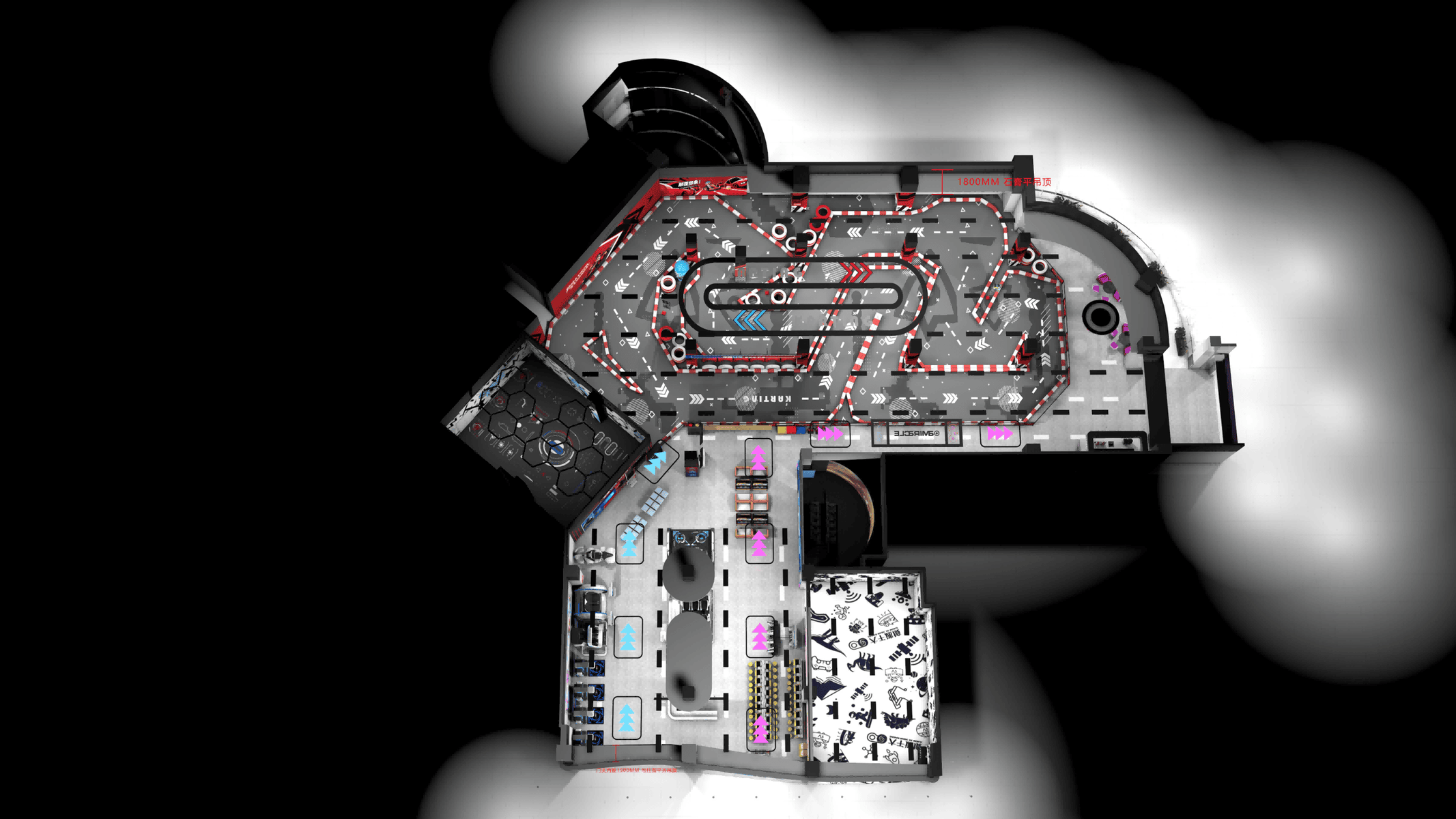
Every deployment includes a free custom CAD 2D floor plan and C4D 3D visualization — mapping the optimal simulator mix, circulation paths, power drops, and queuing zones for your specific venue dimensions. Factory-direct pricing. Zero franchise fees. 100% operator revenue retention. CE, TUV, RoHS, FCC, ISO 9001, and SGS certifications included as dated PDF documentation with every export shipment.
Find Your Venue’s Optimal VR Simulator Mix — Free CAD Design Included
The six categories and comparison framework above give you the decision dimensions. The next step is applying them to your specific venue. If you are evaluating a shooting vr simulator for an amusement park, a vr car simulator for a shopping-mall FEC, a vr simulator machine for an Urban Entertainment Hub, or a complete multi-category deployment, the conversation starts with your floor dimensions, target demographic, and revenue goals. Every inquiry includes a free custom CAD 2D floor plan, equipment mix recommendation, and factory-direct pricing proposal — with zero franchise fees, permanently.
Chat on WhatsApp — Get Your Free CAD Design & Simulator Mix
WhatsApp: +86-153 6087 7766 | Email: [email protected] | Response: 1 Business Day (GMT+8)