

Is there a growing demand for VR experiences in entertainment? Every investor, every venue operator, every commercial landlord evaluating a lease for a virtual reality experiences tenant asks some version of this question. They remember the 2016-2018 hype cycle. They remember the headsets that gathered dust. They want to know: is this time different?
The answer — backed by market data, not optimism — is yes. But the growth is not evenly distributed. The VR trend is not a single rising line on a chart. It is four distinct shifts happening simultaneously: from solo to social, from virtual-only to mixed reality, from static content to living libraries, and from franchise-heavy models to operator-first economics. The venues that align with these four shifts are capturing the growth. The venues that ignore them are competing on price in a maturing segment. This article maps the data, the trends, and the products built for where the market is going — not where it has been.
The VR Entertainment Market by the Numbers — Growth That Demands Attention
Before analyzing trends, let’s anchor the conversation in data. The global consumer VR experiences market reached approximately $16 billion in 2024 and is projected to exceed $18 billion by the end of 2025, according to Statista’s latest market outlook. The VR headset segment alone represents roughly $10 billion in annual revenue, growing at an 8.4% compound annual rate. These are not venture-capital projections. These are hardware shipments, software downloads, and consumer transactions that have already cleared.
Global Consumer VR Market
2024 → 2025 (Statista)
VR Headset Market
Annual Growth Rate (Statista)
VR Headset Hardware
Market Size 2024 (Statista)
Location-Based VR Growth
Outpacing Home VR
Critically, location-based entertainment (LBE) VR — the segment that includes the VR arcades, free-roam arenas, and mixed-reality attractions that commercial operators invest in — is growing faster than the consumer VR segment. After the COVID-era contraction of out-of-home entertainment, the return to social, shared experiences has created a demand surge that home VR cannot satisfy. You cannot replicate a 10-player competitive VR shooter match in your living room. You cannot replicate the physical thrill of a mixed-reality go-kart race through six virtual worlds on a sofa. The immersive vr experience that consumers now expect is inherently social, inherently physical, and inherently out-of-home.
The Core Insight
The question “Is VR demand growing?” has a two-part answer. Part one: yes, the overall market is expanding — $16B to $18B+ in a single year. Part two: the growth is not evenly distributed. Cinema-style solo VR — the 9D pod, the single-seat motion rig — is a maturing category. Social-competitive multiplayer VR and mixed-reality physical experiences are the accelerating categories. The operators who understand this distinction are positioning for the next five years. The operators who don’t are buying equipment for the last five.
Trend 1 From Solo Immersion to Social Competition
The Data Signal
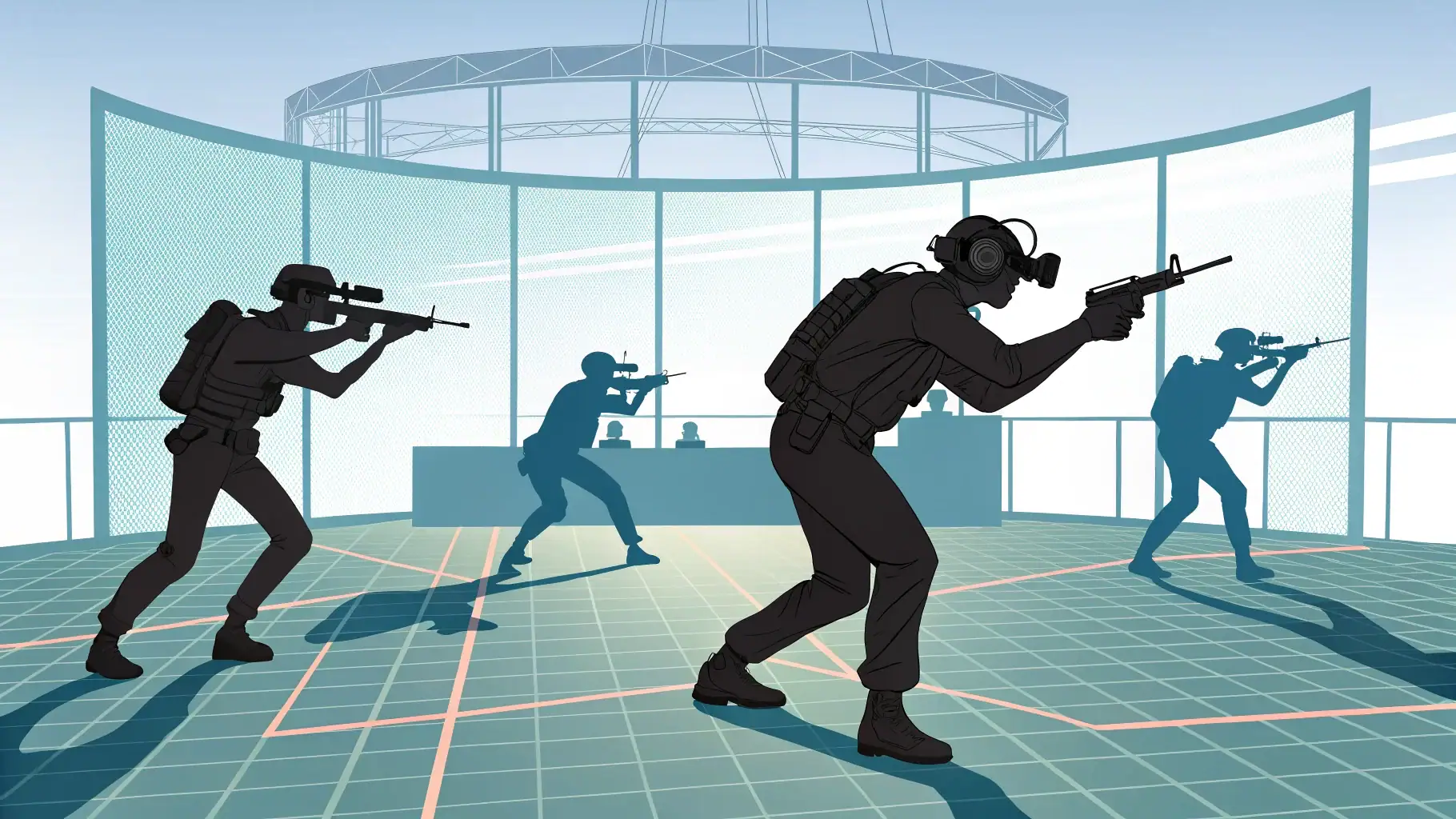
VR arcades and entertainment venues worldwide are reporting a consistent pattern: multiplayer VR experiences generate 2 to 3 times higher repeat visitation rates than solo VR experiences. A customer who visits a venue, puts on a headset alone, and experiences a 5-minute solo ride may or may not return. A customer who battles four friends in a competitive VR arena, sees their name on a leaderboard, and films the squad for social media has a fundamentally different relationship with the venue. The experience is not just consumed — it is co-created with their social group. That co-creation produces loyalty that no solo experience can match.
What This Means for Operators
The era of “one person in a headset” as the dominant VR entertainment format is giving way to groups competing, cooperating, and creating in shared virtual space. This shift has structural revenue implications. A solo VR cinema pod processes 8-12 individual sessions per hour. A 10-player VR arena processes 10 players simultaneously in the same time slot — with group-booking revenue (birthday parties, corporate team-building, e-sports tournaments) that multiplies per-slot earnings without multiplying staffing cost.
The Product Built for This Trend — X-Space VR Arena
LEKE VR’s X-Space VR Arena is a free-roam, untethered multiplayer platform supporting 1 to 20+ simultaneous players in a software-defined arena with millimeter-level spatial positioning and PICO 4UE enterprise-grade headsets. No fixed grid. No physical track. The arena boundaries are defined in software — conforming to your venue’s specific floor dimensions, not the other way around. The system ships with a curated 18-title premium configuration (12 original in-house developed + 6 continuously updated customized MR titles) spanning competitive sci-fi PvP, family-friendly cooperative defense, and immersive cinematic team experiences. This content is backed by LEKE VR’s 700+ commercial VR game library with quarterly OTA updates — a content pipeline no other Guangzhou manufacturer has independently built.
View X-Space VR Arena Full Specifications
Trend 2 From Virtual-Only to Mixed Reality
The Data Signal
Industry analysts tracking the VR trend are observing a clear divergence: mixed-reality (MR) experiences — where physical movement through real space combines with digital overlays — are growing faster than fully-immersive, stationary VR experiences. The reason is intuitive. A consumer sitting motionless in a chair wearing a headset is having a visual experience. A consumer driving a physical go-kart through a real space, dodging holographic obstacles, collecting digital power-ups, and competing against friends on the same physical track is having a full-body experience. The latter commands a higher ticket price, generates stronger word-of-mouth, and produces the spectator visibility that converts passersby into queued players.
The Go-Karting Evolution
Traditional go-karting has a fundamental constraint: the track. A physical rail or barrier system defines the experience and cannot change. The venue invests in one layout, one theme, one experience — and customers who have driven it once have no structural reason to return. The mixed-reality karting format eliminates this constraint. A single open floor area becomes six different virtual worlds — Egypt Oasis, Jurassic Park, Polar Fantasy, Sky City, Undersea World, Cat City — selectable per session. The physical karts are trackless and lithium-battery-powered. The obstacles, power-ups, and NPC competitors are digital, mapped onto the real space via spatial anchors. One physical investment. Infinite replay value.
The Product Built for This Trend — MR Go-Kart
LEKE VR’s MR Go-Kart is the physical embodiment of Trend 2. Trackless lithium-battery chassis. Network multiplayer with intelligent NPC racers for off-peak solo play. Six immersive virtual themes. Augmented-reality overlays with spatial-anchored digital obstacles, power-ups, and environmental effects. The kart’s physical movement through real space — combined with the digital layer — creates a virtual reality experience that fixed-base simulators cannot replicate. For venues with 100+ square meters of contiguous floor space, MR Go-Kart represents the highest-replay-value product in the commercial VR portfolio.
View MR Go-Kart Full Specifications
Trend 3 From Static Content to Living Content Ecosystems
The Data Signal
Industry surveys consistently identify “the games never change” as the number-one reason VR arcade customers do not return. Estimates suggest that over 70% of lapsed VR venue visitors cite content staleness as their primary deterrent. This is the silent killer of VR entertainment businesses: not the hardware, not the location, not the pricing — the content library that looked exciting on opening day and looks identical 18 months later.
The Old Model vs. The New Model
The dominant model in commercial VR — particularly among Guangzhou manufacturers — is: buy hardware → receive bundled third-party games → that is your library forever. Content is treated as a one-time fill for the hardware, not as an ongoing operational asset. The result: the operator’s most important retention tool is frozen in time from the date of purchase. The alternative model — the one LEKE VR has built its company around — is: in-house game development studio → proprietary cloud OS → quarterly OTA content updates → library that grows across the equipment’s lifespan. The 80+ titles a Space Shuttle 2.0 cinema pod ships with, the 18-title X-Space premium config, the 700+ back-catalog — all of it is connected to an update pipeline. Content is not a feature. Content is the product.
Company Philosophy — Content Is the Product
“Hardware is the door. Content is the reason people walk through it again.” LEKE VR is the only Guangzhou-based VR manufacturer that operates an in-house game development studio — not a reseller agreement with a third-party content aggregator. This structural difference means LEKE VR controls its content roadmap, delivers quarterly OTA updates across all product lines via a proprietary cloud OS, and can commission custom content for partner venues (destination flyovers, branded experiences, educational modules). Ask any other supplier you evaluate: “Can I meet your game developers?” The answer will tell you whether content is a core competency or an afterthought.
Trend 4 From Franchise Extraction to Operator-First Economics
The Data Signal
Traditional FEC and entertainment franchise models extract 8-15% of gross revenue in ongoing royalties, marketing fees, and mandatory content licensing charges. For a venue generating $500,000 in annual revenue, that represents $40,000-$75,000 per year that leaves the operator’s pocket — not for equipment, not for content, not for staff — but for the right to use a brand name. In a maturing market where margins increasingly determine who survives and who doesn’t, this extraction model is becoming structurally unsustainable.
The Operator-First Alternative
LEKE VR’s business model is a structural response to this industry problem. Factory-direct supply chain. No distributor markup. No regional reseller margin. Zero franchise fees. No royalty on revenue. No monthly license charge. 100% operator revenue retention. The operator who runs the venue every day keeps every dollar the venue earns. This is not a promotional offer. It is the company’s permanent commercial architecture — and it is designed to solve the binding constraint on VR entertainment industry growth: operator net margin. When the operator keeps more, the operator reinvests more — in content, in staffing, in marketing, in expansion. The industry grows from the bottom up, not the top down.
Company Philosophy — Operator Margin Is the Industry’s Binding Constraint
“The operator who runs the venue every day should keep every dollar the venue earns.” LEKE VR was founded on the conviction that the VR entertainment industry’s growth bottleneck is not technology adoption — it is venue-level profitability. When an operator’s net margin is squeezed by franchise royalties, content license fees, and distributor markups, there is no capital left for the content refresh, staff training, and equipment maintenance that drive repeat visitation. Removing the extraction layer — through factory-direct supply and zero recurring fees — is not a pricing strategy. It is an industry-level growth strategy.
Case Study Las Vegas VR Experience — The Global Entertainment Barometer
If you want to know where entertainment is going, watch Las Vegas. The Strip is the most competitive entertainment market on earth — every square foot of venue space competes for tourist attention and tourist dollars against casinos, shows, restaurants, nightclubs, and attractions with nine-figure budgets. Las Vegas does not adopt technology for novelty. It adopts technology for revenue per square foot.
Over the past three years, multiple Strip-adjacent and downtown venues have integrated las vegas vr experience attractions into their entertainment portfolios — and the format that is winning is not the solo cinema pod. It is the multiplayer competitive arena. Groups of friends, corporate teams, bachelor and bachelorette parties — the Las Vegas demographic is inherently social, and the VR experiences that succeed there are inherently social. The same pattern is visible in Dubai, in Shanghai, in London. The VR trend that Las Vegas validates is not “VR exists.” It is “social, competitive, repeatable VR out-earns solo, passive VR.”
The Las Vegas Lesson for Operators Worldwide
The Las Vegas VR market is telling the global entertainment industry something specific: demand for VR is growing — but the format matters. The VR experiences that command premium pricing, generate repeat visits, and produce organic social media content are the ones where people do something together. A multiplayer free-roam arena. A mixed-reality go-kart race. An experience where the customer is not isolated in a headset but connected to their group. This is not a regional preference. It is a structural demand characteristic, visible in every major entertainment market. The venues building for social-competitive VR today are building for the demand curve of 2027, 2028, and beyond.
The LEKE VR Thesis — What These Four Trends Mean for Your Venue
The products LEKE VR builds are not a random catalog. They are a coherent thesis about where the VR entertainment market is heading, expressed in hardware, software, and business architecture:
1-20+ players, free-roam, software-defined arena, 18-title premium config, 700+ back-catalog — designed for the group-booking revenue model that the market is rewarding.
Trackless, lithium-battery, 6 virtual themes on one physical floor, network multiplayer, NPC racers — designed for the replay value and spectator magnetism that fixed-base simulators cannot deliver.
700+ title back-catalog, quarterly OTA updates, proprietary cloud OS — designed so that the content library your venue operates with in year three is larger than year one, not identical to it.
No distributor markup. No royalty on revenue. 100% operator revenue retention. Designed so the operator who runs the venue has the capital to keep the venue competitive.
This is not a product pitch disguised as analysis. It is a reading of the market that happens to be expressed in products. The four trends — social, mixed reality, living content, operator-first economics — are visible to anyone tracking the data. The question is whether your venue’s equipment strategy aligns with them.
Five Questions to Ask Before Investing in VR Entertainment
The four trends above provide a framework for evaluating any VR equipment investment. Here are five questions that translate those trends into a supplier-assessment checklist:
If the answer is “we source from partners,” the content library you receive at purchase is the library you will have permanently. In-house development = quarterly OTA updates = content that grows across the equipment’s lifespan. Ask to meet the game developers. The answer is more important than any spec sheet.
Content stagnation is the #1 reason VR customers don’t return. If new titles require a USB drive shipped from the factory — or worse, an on-site technician — content will never be refreshed at the cadence your customers expect. Cloud OS + remote OTA delivery is the structural prerequisite for a living content ecosystem.
For every percentage point of gross revenue extracted by a franchisor, the operator loses the capital needed for content refresh, staff training, and equipment maintenance. LEKE VR’s factory-direct model charges zero franchise fees and imposes zero ongoing royalties. 100% operator revenue retention is the permanent commercial architecture, not a limited-time promotion.
Social multiplayer? Mixed reality? OTA-updatable content? Operator-first economics? A supplier whose flagship products are solo cinema pods and fixed-base racing sims is building for the market of 2019. A supplier whose flagship products are free-roam multiplayer arenas and mixed-reality karting is building for the market of 2027.
A venue with an X-Space Arena from one factory, a go-kart system from another, and cinema pods from a third has three support hotlines, three content update schedules (if any), and three vendors each pointing at the others when something goes wrong. LEKE VR is the only Guangzhou manufacturer producing the full VR entertainment ecosystem — X-Space VR Arena, MR Go-Kart, Space Shuttle 2.0, 360-degree VR Chair, 3DOF Racing Simulator, and VR Stand Station — from a single factory campus, with one accountable partner and one content pipeline. Every deployment includes a free custom CAD 2D floor plan and C4D 3D visualization.
Align Your Venue With Where the Market Is Heading
The data is clear: demand for VR experiences is growing — but the growth is concentrated in social, mixed-reality, content-rich, operator-first formats. If you are evaluating a virtual reality experiences investment for your FEC, theme park, resort, or entertainment venue, the next step is a conversation about your specific space, demographic, and business model. Every inquiry includes a free custom CAD 2D floor plan, equipment mix recommendation, and factory-direct pricing proposal — with zero franchise fees, now and permanently.
Chat on WhatsApp — Get Your Free CAD Design & Proposal
WhatsApp: +86-153 6087 7766 | Email: [email protected] | Response: 1 Business Day (GMT+8)