

How does immersive virtual reality work? Most explanations of what is virtual reality begin and end with the headset — a pair of screens strapped to your eyes, displaying stereoscopic 3D images. That description is accurate for consumer VR. A person sitting on their sofa playing a VR game through a Meta Quest or PlayStation VR2 is experiencing virtual reality systems at their simplest: a head-mounted display (HMD), two handheld controllers, and a defined play area in their living room.
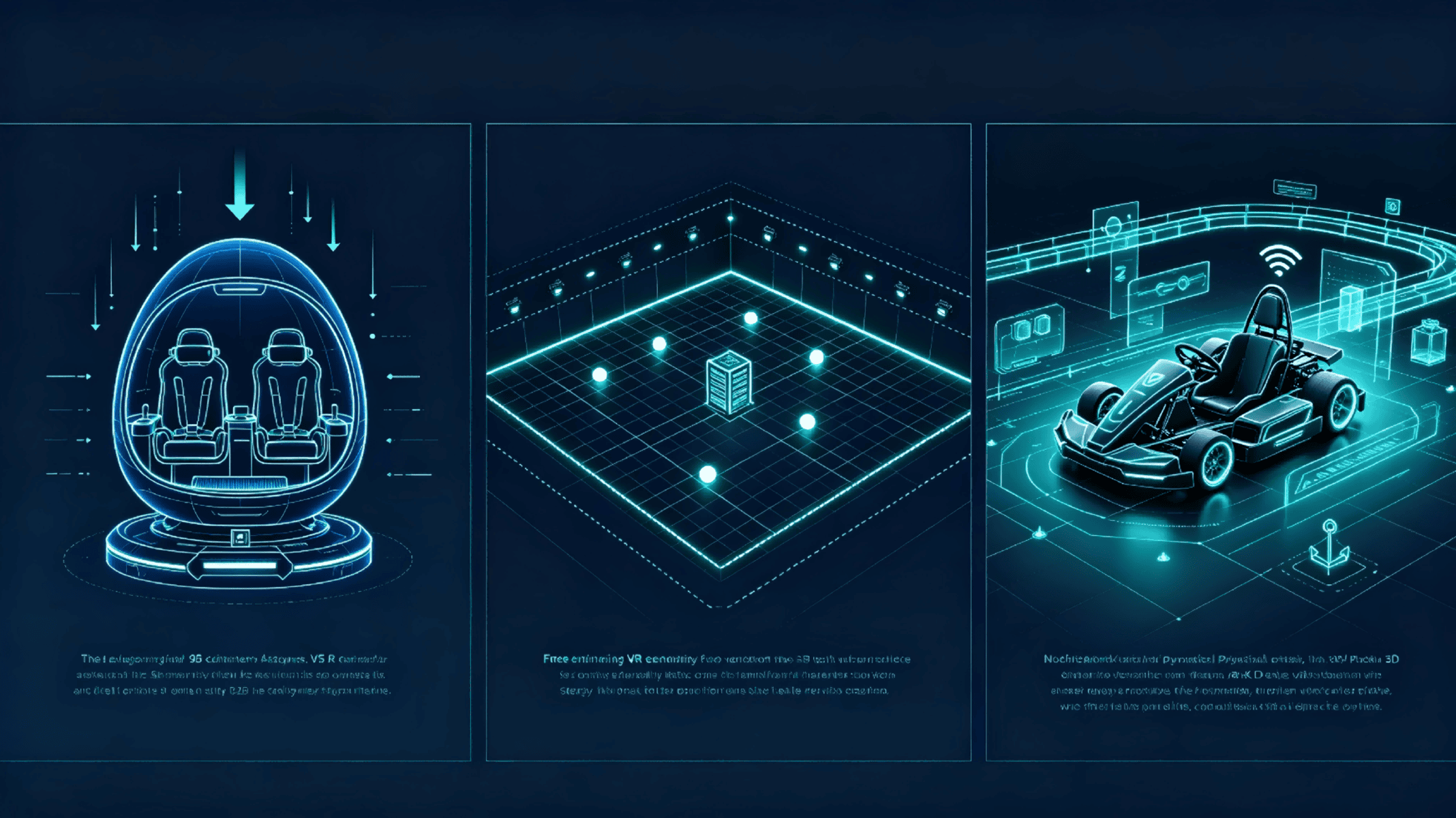
But commercial VR — the kind installed in theme parks, shopping-mall entertainment centers, Urban Entertainment Hubs, and amusement parks — is a fundamentally different engineering problem. A 9D cinema pod does not just show you a video; it physically moves you in synchronization with that video. A free-roam multiplayer arena does not just track one person in a 2m × 2m square; it tracks twenty people simultaneously across an entire room, at millimeter precision, updated one hundred times per second. A mixed-reality go-kart does not just simulate driving; it fuses a physical vehicle moving through real space with a digital world overlaid on top of it, in real time, for multiple human drivers and AI competitors sharing the same physical-virtual track.
This article explains how does virtual reality work at the commercial level — not the consumer headset, but the three engineered systems that power the VR attractions in venues across 40+ countries. We break down the technology architecture of each system, trace the evolution from the early tethered days to today’s wireless free-roam platforms, and situate commercial VR within the broader meta virtual reality ecosystem.
What “Immersive” Actually Means — The Three Illusions
Before dissecting specific systems, we need to define the word that every VR manufacturer uses and few explain: immersion. In VR engineering, immersion is not a marketing adjective. It is the measurable result of three distinct illusions working simultaneously. Break any one of them, and the brain stops believing.
Illusion 1: Visual Immersion — Convincing the Eyes
The human visual system is not easily fooled. To create a convincing sense of depth and space, a VR headset must deliver stereoscopic images — two slightly offset perspectives, one per eye — at a combined resolution high enough that individual pixels are not visible (the “screen-door effect”). It must maintain a field of view (FOV) of at least 90-110 degrees horizontally to approximate natural human vision. And it must do all of this at a minimum 90 frames per second with motion-to-photon latency under 20 milliseconds. If the image on the display lags behind the user’s head movement by more than 20ms, the brain detects the disconnect — and the result is VR sickness. Consumer headsets like the Meta Quest 3 achieve this through pancake lenses, Qualcomm Snapdragon XR processors, and inside-out SLAM tracking. Commercial VR systems use enterprise-grade equivalents (such as the PICO 4UE with its Snapdragon XR2 and higher thermal tolerance for continuous-duty operation) because a headset that overheats after 45 minutes is useless in a venue running 12-hour days.
Illusion 2: Physical Immersion — Convincing the Body
Visual immersion alone is not enough. The vestibular system — the balance mechanism in the inner ear — must receive signals that match what the eyes are reporting. When the eyes say “I am accelerating through a corner” and the inner ear says “I am sitting still in a chair,” the brain flags the discrepancy, and motion sickness follows. Commercial VR solves this with motion platforms: electro-mechanical actuators (servomotors, pneumatic cylinders, or hydraulic rams) that physically pitch, roll, heave, and vibrate the user’s seat or platform in precise synchronization with the on-screen action. A cinema pod that banks left in the video also banks the user’s entire body left. The vestibular signal matches the visual signal. Immersion holds. This is the core engineering difference between consumer VR — where the user’s body is stationary — and commercial motion-platform VR.
Illusion 3: Spatial Immersion — Convincing the Brain You Are “There”
The deepest layer of immersion is presence — the subjective sense that you are not watching a virtual world but occupying it. Presence requires 6DOF (six degrees of freedom) positional tracking: the system must know not just which direction the user is looking (3DOF rotational tracking — pitch, yaw, roll), but exactly where their head is in 3D space (X, Y, Z position) at every moment. If the user takes a step forward and the virtual world does not move with them, presence breaks. Commercial VR achieves this through one of two tracking architectures: outside-in tracking (external cameras or laser base stations mounted on walls track the headset and controllers) or inside-out tracking (cameras on the headset itself map the surrounding environment and compute position via SLAM algorithms). Consumer VR has largely converged on inside-out tracking for convenience. Commercial VR — especially free-roam arenas — still uses outside-in because it delivers higher precision at scale and can track multiple users simultaneously in a shared coordinate system.
The Technology Stack — What’s Inside a Commercial VR System
Every virtual reality system deployed in a commercial venue shares a common five-layer technology stack. Understanding these layers makes the three system architectures — cinema pod, free-roam arena, mixed-reality kart — legible as variations on a theme rather than as unrelated machines.
Dual OLED or fast-switch LCD panels, one per eye, delivering stereoscopic images through Fresnel or pancake lenses. Commercial-grade HMDs (like the PICO 4UE used in X-Space VR Arena) differ from consumer HMDs in three ways: enterprise thermal design for continuous multi-hour operation, centralized device management, and kiosk-mode software locking to prevent users from exiting the experience.
A combination of IMU (inertial measurement unit — accelerometer + gyroscope) sensors for fast rotational data, fused with optical tracking (infrared cameras, laser base stations, or inside-out SLAM cameras) for drift-free positional data. Commercial systems achieve millimeter-level precision by running sensor fusion algorithms at 100Hz or higher — computing each tracked object’s 3D position and rotation one hundred times every second.
This layer distinguishes commercial VR from consumer VR. Electro-mechanical actuators — servomotors, pneumatic cylinders, or hydraulic rams — translate digital motion commands into physical movement. A motion controller reads a synchronized motion data track encoded alongside the video file and actuates the platform in real time. The cinema pod pitches, banks, and vibrates. The racing simulator delivers force-feedback steering and G-force simulation. The kart moves through real space. This layer is the primary reason commercial VR commands premium per-session pricing.
The GPU renders two stereoscopic camera views of the 3D scene at 90+ fps, applying the tracking data to position the virtual cameras exactly where the user’s eyes are in the virtual space. In a multi-user free-roam system, the central server additionally runs network synchronization — ensuring that when Player A sees Player B move in the physical space, Player B’s avatar moves identically in the shared virtual coordinate system. This is computationally expensive: 20 players × 90fps × 2 eye-views = 3,600 rendered frames per second that must be positionally consistent across all participants.
The experience itself — built in a game engine (typically Unity or Unreal Engine), incorporating the 3D assets, physics simulation, networking code, audio spatialization, and motion-platform command scripts. In commercial VR, the content layer also includes cloud OS functionality for remote OTA (over-the-air) updates, content library management, and usage analytics. Without a content update pipeline, even the most advanced hardware becomes a static experience — and a venue’s repeat visitation rate declines accordingly.
The Evolution — From Tethered to Wireless to Free-Roam
The commercial VR systems operating today are the product of four distinct technology generations. Understanding what changed at each transition explains why venue-scale VR is commercially viable now — and was not ten years ago.
1990s–2015: Tethered, Single-User, Seated
Early commercial VR (Virtuality arcade pods, 1991; Sega VR-1, 1994) used HMDs tethered by heavy umbilical cables to external computers. Tracking was limited to 3DOF rotation — the user could look around but not walk. The experience was seated, solo, and isolated. These systems proved the concept but failed commercially: the hardware was expensive ($70,000+ per multi-pod setup), the graphics were primitive wireframe, and the content library was static. You bought the machine with 3-5 games, and that was your library permanently.
2016–2019: Room-Scale, Outside-In Tracking
The HTC Vive (2016) introduced consumer room-scale VR: two Lighthouse laser base stations mounted on walls tracked the headset and controllers within a defined play area (~5m × 5m). For the first time, the user could physically walk in a virtual space. But the system was still tethered — a cable connected the headset to a gaming PC — and it was single-user. The tracking technology, however, proved the core concept: laser-based outside-in positional tracking at sub-millimeter precision. This generation established the tracking architecture that commercial free-roam systems would later scale up.
2019–2023: Wireless Standalone + Inside-Out Tracking
The Oculus Quest (2019) eliminated both the PC tether and the external sensors. Onboard cameras performed inside-out SLAM tracking — the headset mapped the room around it in real time and computed its own position relative to mapped features. The Qualcomm Snapdragon XR2 chip (later generations) provided sufficient mobile compute power to render VR scenes without a PC. This generation made VR portable, affordable, and accessible — but the tracking was still designed for a single user in a small space (~10m × 10m maximum). Scaling inside-out tracking to 20 simultaneous users in a commercial arena required the next evolution.
2023–Present: Commercial Free-Roam + Mixed Reality
This is the current frontier. Enterprise-grade headsets (PICO 4UE, HTC Vive Focus Vision) combine inside-out tracking with external sensor fusion for multi-user, large-area deployment. Software-defined arena boundaries replace fixed physical grids — the venue operator configures the play area dimensions in software, and the system maps virtual obstacles to physical safety zones. Multi-user co-location — having 20 people in the same physical space, seeing each other in VR, and not colliding — is solved through a central server that synchronizes all player positions into a single virtual coordinate system at 100Hz. Mixed reality layers — digital overlays on the physical world via spatial anchors — enable experiences like MR karting where physical vehicles interact with virtual obstacles, power-ups, and environmental effects mapped to real-world coordinates. This generation is what makes today’s commercial VR venues commercially viable: wireless, multi-user, large-scale, with content delivered and updated remotely via cloud OS.
System 1: Motion-Platform Cinema VR — How a 9D Pod Works
The Architecture
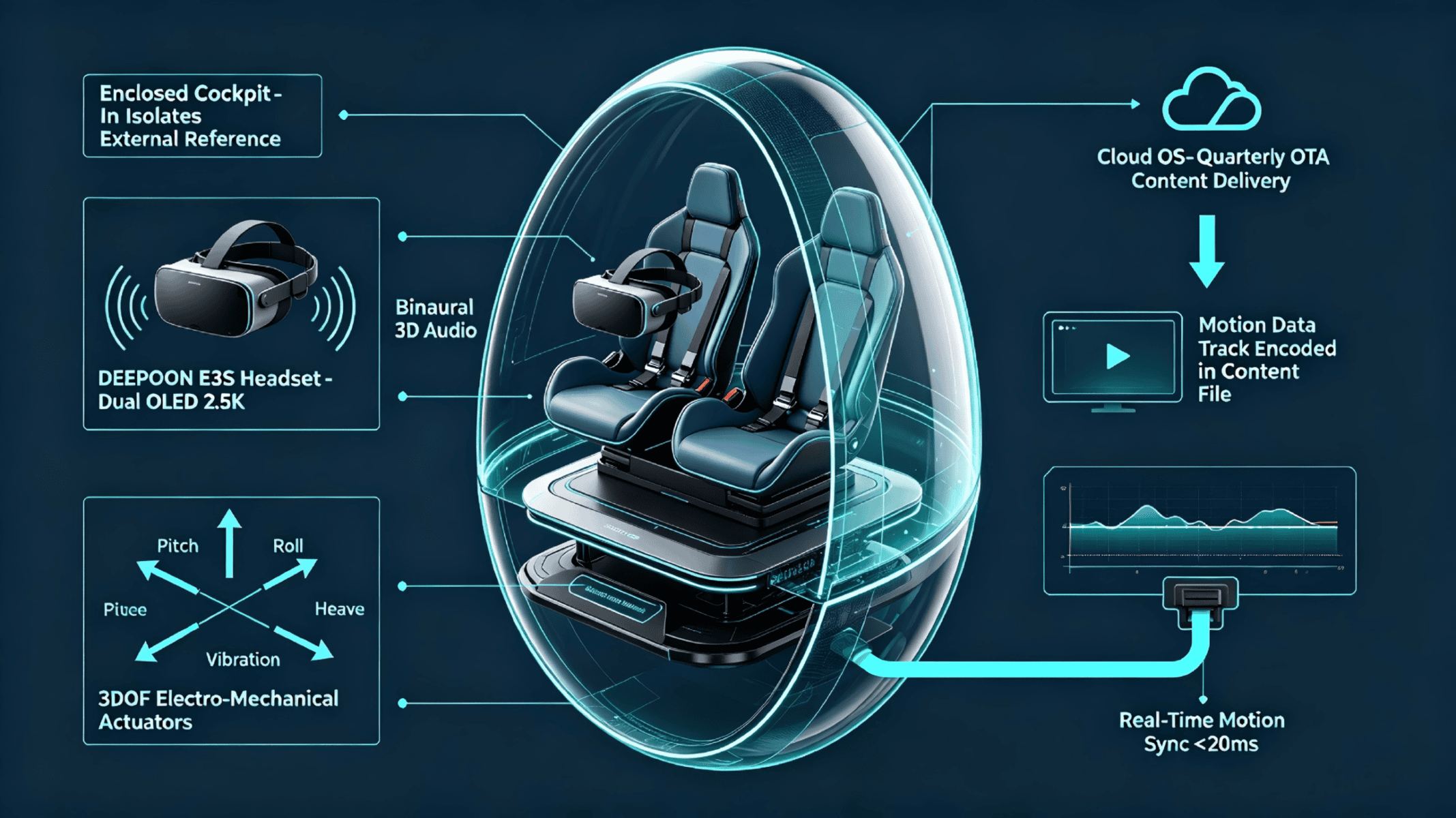
A 9D VR cinema simulator consists of four integrated subsystems: (1) an enclosed cockpit housing 2-9 seats, constructed from dual-layer fiberglass for acoustic isolation and structural rigidity; (2) enterprise VR headsets (one per seat) delivering stereoscopic 3D visuals and binaural spatial audio; (3) a multi-axis electro-mechanical motion platform beneath the cockpit floor, driven by servomotors or pneumatic actuators capable of pitch (forward/backward tilt), roll (side-to-side tilt), heave (vertical lift/drop), and vibration (high-frequency tactile feedback); and (4) a content delivery system — either local storage or cloud-connected OS — housing the library of 5-8 minute cinematic experiences and managing over-the-air updates.
How Motion Sync Works
The core engineering challenge of a cinema pod is motion-to-video synchronization. The solution is elegant: the cinematic content file is not just a video. It is a multi-track data container. Alongside the visual stream (what the headset displays) and the audio stream (what the headphones play), a third data track — the motion command track — encodes a timeline of physical movements: at second 0.50, pitch forward 12 degrees at velocity 0.8; at second 1.25, begin heave cycle with amplitude 40mm at 3Hz; at second 3.10, trigger left roll 8 degrees. The motion controller reads this track in real time, translates each command into electrical signals, and actuates the corresponding servos or cylinders. Because the motion track is time-coded to the same clock as the video, the physical movement is guaranteed to match the on-screen action — the pod banks exactly as the virtual roller coaster banks, the seat drops exactly as the virtual elevator drops. There is no AI interpreting the video. There is no lag compensation algorithm. There is a pre-authored, frame-accurate motion script.
The enclosed cockpit serves an additional, less obvious function: it eliminates external visual reference. One of the primary causes of VR motion sickness is vection — the conflict between what the eyes see (motion) and what the peripheral vision anchors to (a stationary floor, a wall, another person standing still). By enclosing the user in an opaque cockpit, the cinema pod removes all stationary visual anchors. The only visual input is the VR display, which is in perfect sync with the motion platform. The brain accepts the motion as real because it has no contradictory evidence.
In Practice — Space Shuttle 2.0
LEKE VR’s dual-seat 9D cinema pod (5.59 sqm, 651 kg, DEEPOON E3S headsets) carries 80+ cinematic titles delivered and updated quarterly via cloud OS. The dual-layer high-gloss fiberglass construction is engineered for commercial-duty cycles — the pod is designed to run continuous sessions across a 12-hour operating day, seven days a week, with the motion platform rated for the cumulative mechanical stress of thousands of actuation cycles per day.
System 2: Free-Roam Multiplayer VR — How a Shared Arena Works
The Architecture
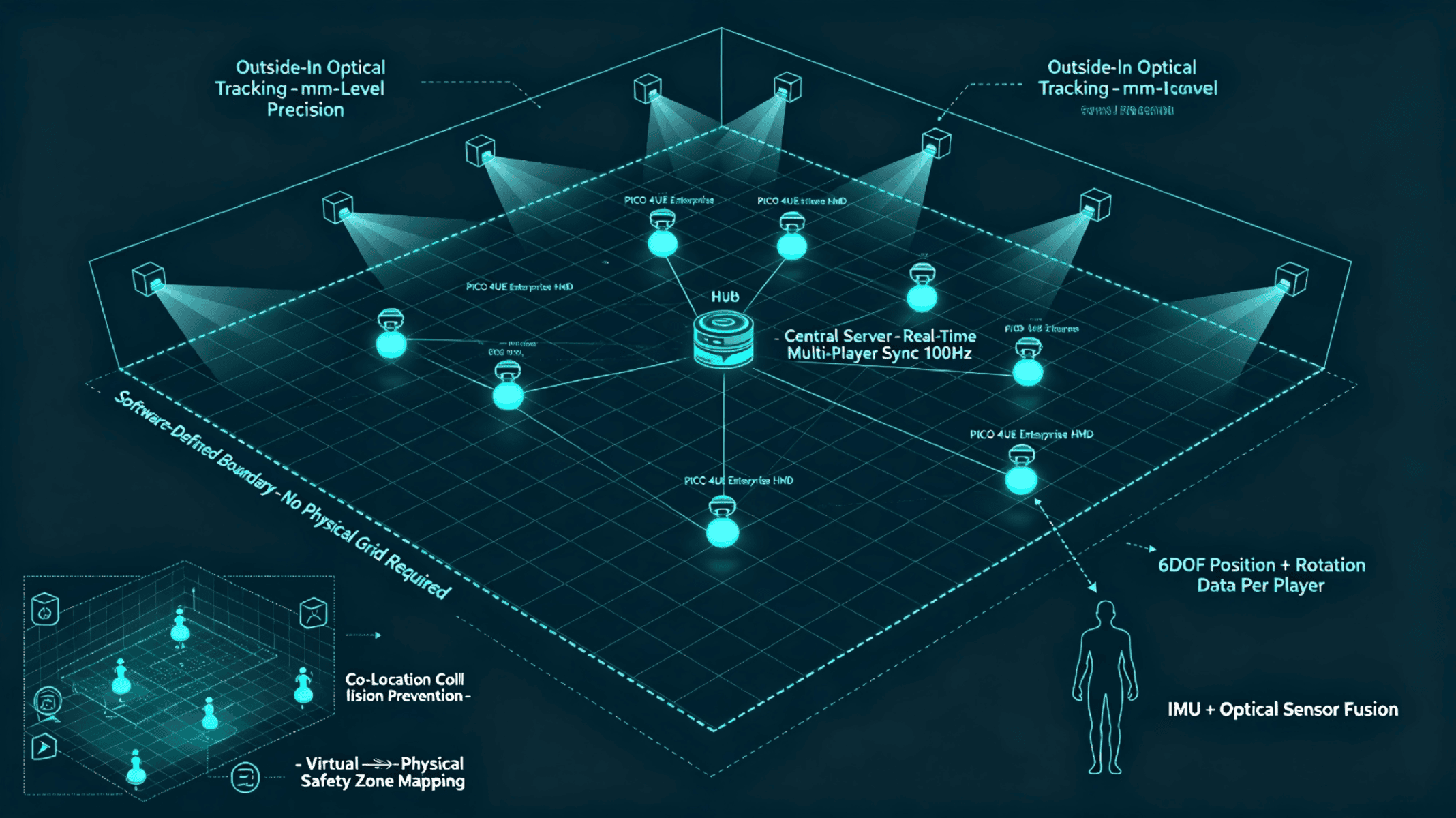
A commercial free-roam VR arena consists of five subsystems: (1) enterprise HMDs worn by each player — these include the display, onboard IMU, and inside-out tracking cameras, but also receive external tracking data; (2) an optical tracking array — infrared cameras or laser base stations mounted on walls and ceiling, covering the entire arena floor with overlapping tracking volumes; (3) a central synchronization server that receives position data from every player, fuses it into a single virtual coordinate system, and broadcasts the unified state back to all headsets; (4) software-defined arena boundaries — the play area dimensions, virtual obstacle placement, and safety zones configured entirely in software; and (5) the content engine — the multiplayer VR experience running on each headset and synchronized by the server.
How Spatial Tracking Works at Scale
Tracking one person in VR is a solved problem. Tracking twenty people simultaneously in the same physical room, at millimeter precision, without any of them colliding — that is the engineering challenge that defines commercial free-roam systems.
The solution uses sensor fusion across two tracking modalities. Inside each headset, an IMU (accelerometer + gyroscope) provides fast, low-latency rotational data — it can detect a head turn in under 2 milliseconds. But IMUs drift over time; after 30 seconds of use, the positional error from pure IMU tracking would be measured in meters. To correct for drift, the external optical tracking array provides absolute positional reference. Infrared cameras mounted around the arena perimeter capture the position of tracking markers or emitters on each headset and controller. The fusion algorithm — running on each headset’s onboard processor — combines the fast-but-drifting IMU data with the slow-but-precise optical data to produce a position estimate that is both fast (low latency) and accurate (sub-millimeter), updated at 100Hz or higher.
The central server’s role is multi-user co-location. Each player’s headset computes its own position in its own local coordinate frame. The server receives all 20 position streams, transforms them into a single unified coordinate system, and broadcasts the combined state back to all headsets. This is how Player A sees Player B’s avatar standing exactly where Player B is physically standing — not approximately, not with a half-second delay, but with the precision and latency required for competitive gameplay. The server also manages collision prevention: virtual obstacles are mapped to physical safety zones. If the virtual world contains a wall at coordinate (5.2, 3.1), the system ensures that no physical player can walk into that coordinate by rendering the wall as a visible, impassable object in every headset — and by maintaining a safety buffer zone between all tracked players.
In Practice — X-Space VR Arena
LEKE VR’s free-roam multiplayer platform supports 1-20+ simultaneous players with millimeter-level spatial positioning and PICO 4UE enterprise headsets. The arena boundaries are software-defined — conforming to the venue’s actual floor dimensions rather than requiring a fixed physical grid installation. The system ships with 18 curated titles (12 original in-house developed + 6 continuously updated MR titles) backed by a 700+ title library with quarterly OTA updates delivered via proprietary cloud OS.
System 3: Mixed-Reality Karting — How Physical-Digital Fusion Works
The Architecture
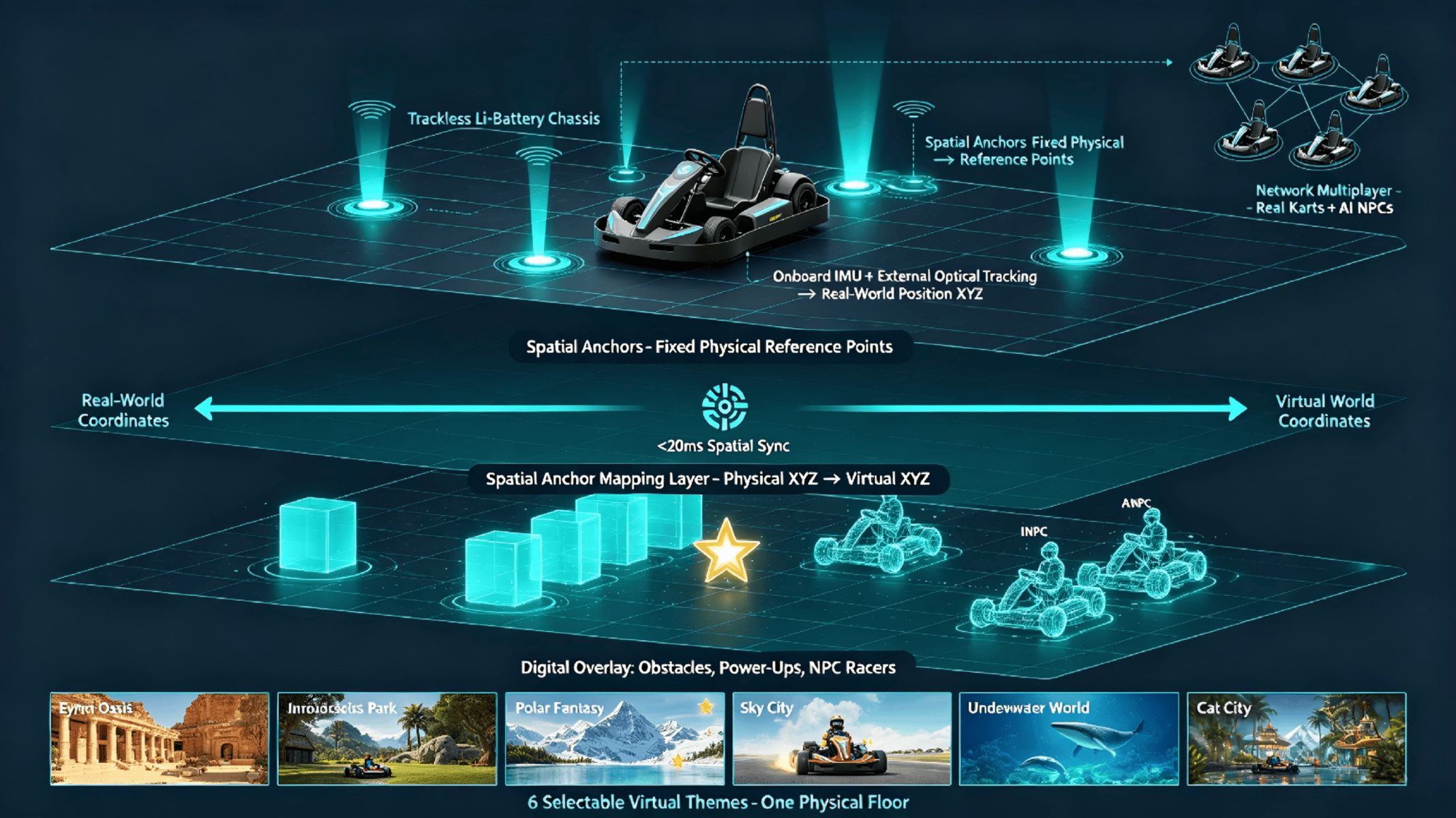
Mixed-reality karting is the most architecturally complex of the three commercial VR systems because it fuses a physically moving vehicle with a digital overlay in real time across multiple participants. The system consists of: (1) trackless lithium-battery chassis — the physical kart, which accelerates, steers, and brakes like a conventional electric kart but has no fixed rail or track; (2) onboard position sensors — wheel encoders, IMU, and external optical tracking markers that together report the kart’s real-world position, orientation, velocity, and acceleration continuously; (3) spatial anchors — fixed reference points in the physical environment (marked positions on the floor, walls, or ceiling) that the digital overlay is precisely mapped to; (4) a VR/MR headset worn by the driver, which renders the digital world — obstacles, power-ups, environmental effects, NPC racers — at the exact physical coordinates where they “exist” in the real space; (5) a network server synchronizing all human-driven karts and AI NPC racers into a shared race.
How Physical + Digital Fusion Works
The defining engineering challenge of MR karting is spatial registration — ensuring that a digital obstacle rendered at physical coordinate (12.3, 8.7) appears to the driver at exactly that location in the real world, and that the kart cannot physically pass through that coordinate without “hitting” the obstacle in the game. The solution uses spatial anchors: fixed reference markers in the physical environment whose positions are known to sub-millimeter precision. When the system initializes, it maps every spatial anchor to a corresponding coordinate in the virtual world. From that point forward, the kart’s onboard tracking reports its real-world position; the render engine transforms that position into the virtual coordinate system using the anchor mapping; and all digital objects — obstacles, power-ups, NPC karts — are rendered at their corresponding physical-world coordinates.
The critical insight is that the physical track does not change — the digital overlay does. A single open floor area with a set of spatial anchors can host six entirely different virtual worlds: Egypt Oasis (sandy terrain, pyramid obstacles, scarab power-ups), Jurassic Park (jungle floor, dinosaur hazards, electrified fences), Polar Fantasy (ice surface, snowdrift barriers, aurora environmental effects), Sky City (cloud platform, floating rings, wind-gust physics), Undersea World (coral reef, bubble streams, current drift mechanics), and Cat City (whimsical urban playground, yarn-ball obstacles, laser-pointer power-ups). The operator invests in one physical space. The content library provides infinite replay value.
The network layer adds a final dimension: human drivers share the physical-virtual race with AI NPCs. During peak hours, multiple human-driven karts compete on the same track, each seeing the others’ karts rendered as in-game vehicles at their correct physical positions. During off-peak solo play, intelligent NPC racers — controlled by the server’s AI engine — populate the track at adjustable difficulty levels, ensuring the experience remains competitive and replayable regardless of how many human drivers are present.
In Practice — MR Go-Kart
LEKE VR’s trackless mixed-reality karting system uses lithium-battery chassis with network multiplayer and AI NPC racers. Six selectable virtual themes are mapped onto one physical floor area via spatial anchors. The system’s highest-spectator-draw characteristic — physical karts visibly in motion — converts passersby into queued players across a 30-meter sight line, operating as a built-in venue-wide marketing engine. Content updates are delivered quarterly via cloud OS.
Where Commercial VR Fits in the Meta Virtual Reality Ecosystem
The term meta virtual reality is often conflated with Meta (the company formerly known as Facebook). But in the engineering literature, “meta” VR refers to something broader: the reality-virtuality continuum first formalized by Paul Milgram and Fumio Kishino in 1994. This continuum places all digital-visual technologies on a spectrum from purely real (unmediated physical reality) to purely virtual (fully computer-generated environment). In between lie augmented reality (AR — digital overlays on the real world), augmented virtuality (AV — real-world elements inserted into virtual environments), and mixed reality (MR — physical and digital objects coexisting and interacting in real time).
The three commercial VR systems described in this article each occupy a different point on this continuum. The 9D cinema pod sits at the pure VR endpoint: the user is fully enclosed, fully immersed, with no visual connection to the physical world. The free-roam arena sits at the VR with physical co-presence point: the virtual world is fully computer-generated, but the other players are physically real and co-located — you see their avatars rendered at their exact physical positions. MR karting sits at the mixed reality point: the physical kart, the real floor, and the human driver coexist with the digital obstacles, power-ups, and NPC racers. All three are valid, commercially deployed points on the continuum — and each serves a different audience, revenue model, and venue type.
The broader “metaverse” concept — persistent, shared, interoperable virtual spaces — is, in many ways, already operational in commercial VR venues. A free-roam arena where twenty strangers share a competitive virtual battlefield, see each other’s real movements rendered as in-game actions, and walk out of the venue having shared a physically co-present experience that no online game can replicate — that is a functional metaverse moment. The difference is that commercial VR delivers it with millimeter-precise spatial tracking, enterprise-grade hardware, and the social presence of people in the same room — advantages that purely online metaverse platforms have yet to match.
Want to See These Systems in Operation?
The three architectures described above — 9D cinema pods, free-roam multiplayer arenas, and mixed-reality karting — are operational daily in LEKE VR partner venues across 40+ countries. If you are researching virtual reality systems for a commercial project, a venue visit or factory tour is the fastest way to understand how the technology performs under real-world operating conditions. Every inquiry includes technical documentation, venue case studies, and a free custom CAD floor plan.
Chat on WhatsApp — Request Technical Documentation
WhatsApp: +86-153 6087 7766 | Email: [email protected] | Response: 1 Business Day (GMT+8)