

What are the common applications of a VR simulator in the market? If you are a commercial operator evaluating immersive entertainment equipment, this is the foundational question — and the answer is not one product. The term “VR simulator” describes an entire ecosystem of five distinct commercial applications, each with its own revenue mechanics, space requirements, target demographics, and operational model. A 9d vr simulator cinema pod and a free-roam vr shooters arena serve fundamentally different commercial purposes, and treating them as interchangeable is the fastest way to misallocate a six-figure equipment budget.
Below, we answer the question directly: the five most commercially common VR simulator applications in today’s market — from competitive racing to immersive cinema to multiplayer shooting — each mapped to the specific LEKE VR product lines, venue types, and revenue models where they perform best. Whether you are outfitting a shopping-mall FEC, launching a standalone VR arcade, or adding experiential attractions to a theme park or resort, this is your application-by-application operator’s reference.
What Are the Common Applications of a VR Simulator? Five Categories That Define the Commercial Market
The commercial vr driving simulator and vr racing simulator market has expanded far beyond the single-seat motion rigs of five years ago. Today’s operator can deploy a layered venue architecture where each common VR simulator category serves a specific revenue function — premium upsell, volume driver, group anchor, or idle-time filler. Understanding these five applications before purchasing a single piece of equipment is the difference between a venue where every square meter earns and one where expensive hardware sits idle.
Here are the five most common VR simulator applications in the commercial market today, organized by their primary revenue role:
VR Driving Simulators
Competitive spectator magnet, high per-session ticket
VR Racing Simulators
Next-gen social engine, multiplayer replay value
VR Shooters
Group-booking anchor, corporate event revenue
9D VR Simulators
Family volume driver, zero-skill mass appeal
Solo Self-Service VR
Zero-staff volume filler, idle-time monetization
Application 1: VR Driving Simulators — The Competitive Spectator Magnet
Commercial Logic — Why Driving Sims Command Premium Pricing
A vr driving sim occupies a unique position in the commercial entertainment ecosystem: it is simultaneously a high-thrill individual experience and a built-in spectator event. When a guest climbs into a 3DOF motion racing cockpit with triple-screen display and force-feedback steering, the physical motion — banking through corners, vibrating over rumble strips — is visible to everyone within a 20-meter radius. This visibility converts passersby into queued players without incremental marketing spend. For the operator, this means the vr driving simulator functions as both a revenue generator and a venue-wide billboard.
Driving simulators typically support 1-2 players per unit with session durations of 5-8 minutes, yielding approximately 7-10 complete ride cycles per hour at full occupancy. Per-session pricing tends to sit at the premium tier — higher than cinema experiences, competitive with free-roam shooters — because the physical motion platform delivers a perceived value that stationary VR cannot match. The demographic skews toward young adults and teens, but the racing theme has broad cross-gender and cross-generational appeal, particularly in markets with strong car culture.
Product Match — LEKE VR 3DOF Racing Simulator
LEKE VR’s 3DOF racing simulator features a triple-screen immersive display, 360-degree rotational motion platform, and force-feedback steering with five pre-loaded racing titles spanning Formula circuits, street racing, and off-road terrain. The unit is engineered for commercial-duty cycles with a reinforced steel chassis rated for continuous daily operation. On-screen race feeds and leaderboard displays create a natural spectator gallery, turning every session into a live advertisement for the next player in line.
View 3DOF Racing Simulator Specifications
Application 2: VR Racing Simulators — The Next-Gen Social Engine
Beyond Fixed-Base — The MR Karting Revolution
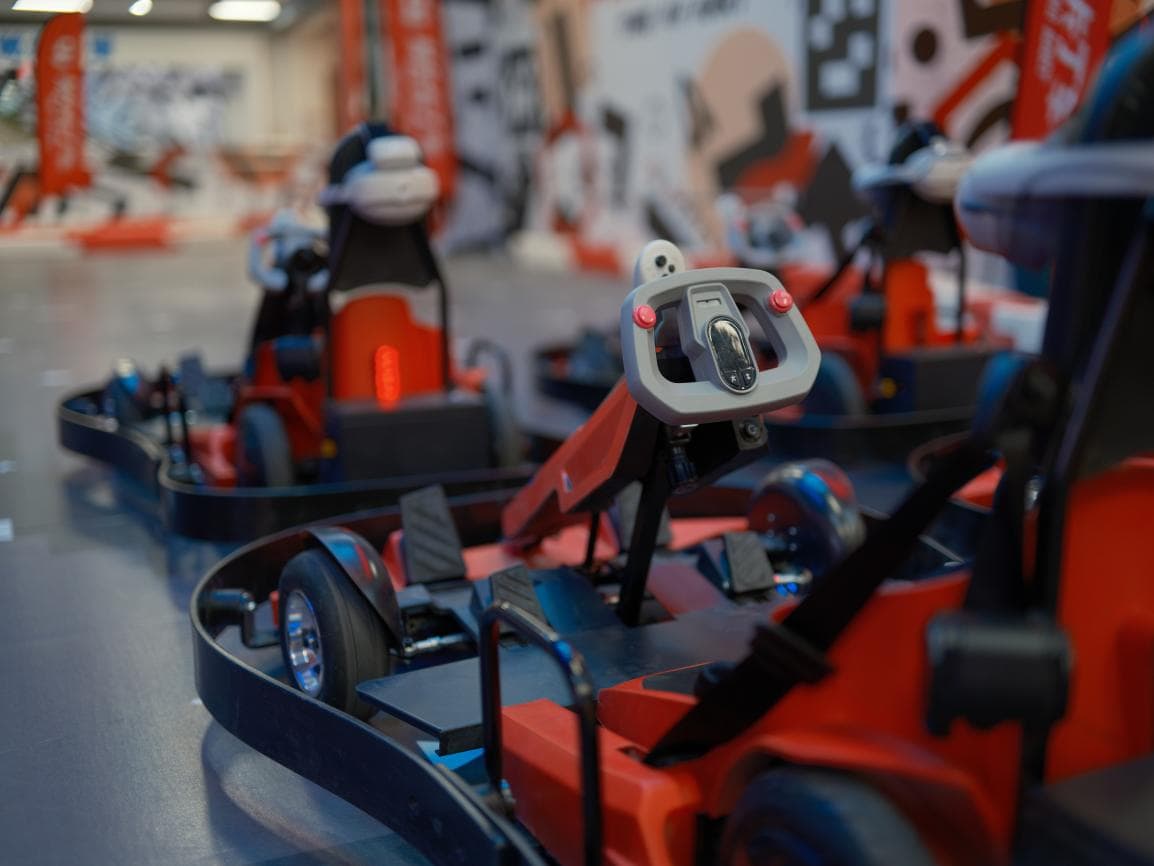
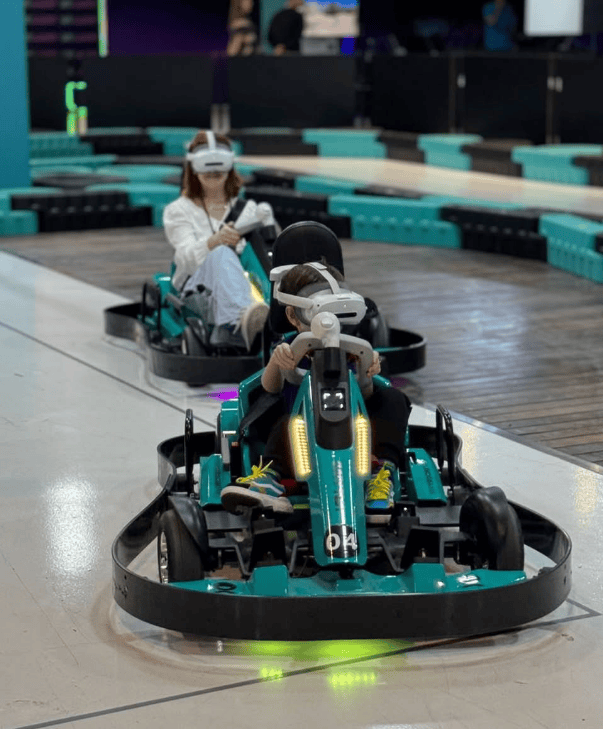
While a fixed-base vr racing simulator delivers a compelling individual experience, the category has evolved. The next generation is mixed-reality karting: trackless, lithium-battery-powered racing karts that combine physical driving with augmented-reality overlays and network matchmaking. This format transforms racing from a solo activity into a social competitive experience — friends challenge friends, leaderboard results display on external venue screens, and the competitive dynamic drives repeat visits and social media sharing.
Key Difference: Fixed-Base Racing vs. MR Go-Kart
Fixed-base simulators excel at individual thrill and spectator draw. MR Go-Kart adds network multiplayer, intelligent NPC competitors for off-peak solo play, and 6 immersive virtual themes (Egypt Oasis, Jurassic Park, Polar Fantasy, Sky City, Undersea World, Cat City) selectable per session. The kart’s physical movement through real space — combined with digital obstacles and power-ups mapped via spatial anchors — creates an experience that fixed-base racing cannot replicate. For venues with 100+ square meters of contiguous floor area, MR Go-Kart represents the highest-replay-value racing application available.
View MR Go-Kart Full Specifications
Application 3: VR Shooters — The Group-Booking Revenue Anchor
Commercial Logic — Why Multiplayer Arenas Deliver the Highest Per-Capita Revenue
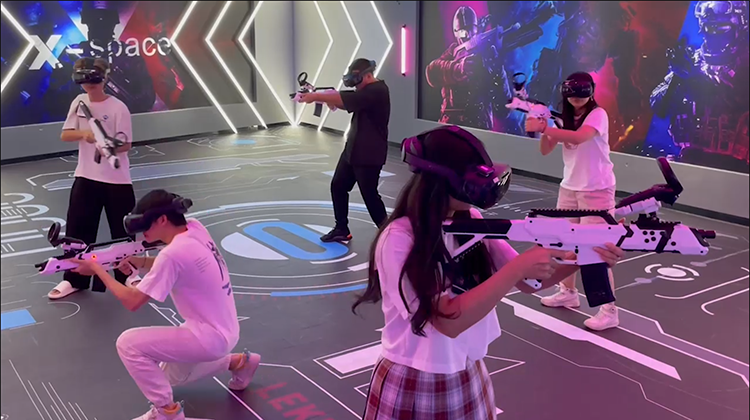
Free-roam vr shooters represent the highest per-session ticket tier in commercial VR entertainment — and for a structural reason. Unlike solo experiences, a multiplayer VR arena supports 1 to 20+ simultaneous players in a single booking slot, enabling group packages, corporate team-building events, birthday parties, and e-sports-style weekend tournaments. The per-session revenue multiplies by group size while the staffing requirement stays roughly constant. For an FEC operator, this means the arena can generate more revenue in a single fully-booked Saturday afternoon slot than a solo racing simulator generates across an entire operating day.
Beyond the group-booking economics, VR shooters serve as the venue’s social media content engine. Multiplayer competitive sessions produce organic social sharing — players film their squad, post scores, tag teammates — generating free customer-acquisition content that no paid advertisement can replicate with the same authenticity.
Product Match — X-Space VR Arena
LEKE VR’s X-Space VR Arena is a free-roam, untethered multiplayer competitive platform supporting 1 to 20+ players with millimeter-level spatial positioning and PICO 4UE enterprise-grade headsets. The system’s trackless design eliminates expensive physical grid installations — the arena boundaries are software-defined, conforming to your venue’s specific floor dimensions.
Core Content Asset — X-Space VR Arena
X-Space ships with a curated 18-title premium configuration — 12 original in-house developed games and 6 continuously updated customized MR titles — a focused high-replayability bundle spanning competitive sci-fi PvP shooters, family-friendly cooperative defense, and immersive cinematic team-viewing experiences. This content is backed by LEKE VR’s full 700+ commercial VR game library, with quarterly OTA updates delivered across the cloud OS platform that no other Guangzhou manufacturer has independently developed.
View X-Space VR Arena Full Specifications
Application 4: 9D VR Simulators — The Family Volume Driver
Commercial Logic — Why Cinema-Style VR Is the Mass-Market Entry Point
A 9d vr simulator — typically a motion-synchronized cinema pod seating 2 to 9 players — is the highest-throughput, lowest-barrier application in the commercial VR portfolio. The operational model is simple: guests sit in an enclosed cockpit, put on a VR headset, and experience a 5-minute immersive film — a roller coaster, a space exploration, a deep-sea dive — while the motion platform delivers synchronized pitch, bank, and vertical-drop movement. Zero player skill required. Zero learning curve. A family of four can walk in, sit down, and complete their session within the runtime of a single song.
This zero-barrier profile is what makes 9D cinema the volume engine of a multi-application venue. While the racing simulators and shooters attract the competitive and thrill-seeking demographics, the 9D cinema captures everyone else — families with young children, couples on dates, casual mall visitors who have never tried VR, and elderly guests who would never consider entering a free-roam arena. It processes high daily volume at modest per-session pricing, sustaining the venue’s baseline revenue on weekdays when competitive attractions see lower utilization.
Product Match — Space Shuttle 2.0 & 360-degree VR Chair
LEKE VR offers two 9D cinema form factors. The Space Shuttle 2.0 is a dual-seat, fully enclosed sci-fi cockpit with dual-layer high-gloss fiberglass construction (651 kg, 5.59 sqm), DEEPOON E3S headsets, and 80+ pre-loaded cinematic titles. It serves as the premium family anchor. The 360-degree VR Chair is a 2-player rotational simulator delivering a more compact, quick-thrill experience ideal for high-turnover placement near venue entrances. Both units draw from the same 80+ title library accessible via LEKE VR’s cloud OS, with content refreshed quarterly.
View Space Shuttle 2.0 | View 360-degree VR Chair
Application 5: Solo Self-Service VR — The Zero-Staff Volume Filler
Commercial Logic — Monetizing Idle Time When Staffed Attractions Are Full
In a multi-attraction venue, capacity bottlenecks are inevitable. When the racing simulators are occupied and the shooter arena’s next group-booking slot is 20 minutes away, waiting guests have two options: leave, or play something else. A self-service VR stand station — occupying just 2.46 square meters, running fully unattended, and pre-loaded with 80+ solo-play games — converts that idle waiting time into continuous incremental revenue. The guest approaches, selects a game on the Pico Neo 3 Pro headset, pays via coin, card, or QR scan, and plays. No staff interaction. An automated mechanical headset lift prevents damage and theft; integrated voice guidance handles onboarding.
For the operator, the self-service station is not a headline attraction. It is the operational glue that prevents revenue leakage during peak queues and sustains income during slow weekday afternoons when staffing full attractions is uneconomical. Multiple units can be deployed across a venue with a single staff member overseeing all of them alongside other attractions.
Product Match — VR Stand Station
LEKE VR’s self-service VR Stand Station features the Pico Neo 3 Pro headset, an automated mechanical lift system, integrated coin/card/QR payment, and 80+ built-in solo-play games. At 2.46 sqm per unit, operators can deploy multiple stations in corridor spaces, near cash-wrap counters, or along venue walls — locations that would otherwise generate zero revenue.
View VR Stand Station Specifications
At-a-Glance: Five VR Simulator Applications Compared
How to Mix Applications — Building a Multi-Tier Revenue Architecture
The most profitable commercial VR venues do not deploy a single application type. They deploy a layered revenue architecture where each simulator category occupies a specific tier. This diversification ensures that revenue flows across all customer segments, all hours of operation, and all utilization levels.
The 4-Tier Revenue Architecture
Tier 1 — Premium Anchor: VR Shooters (X-Space Arena) — highest per-session ticket, longest dwell time, corporate & group bookings. Your Saturday revenue engine.
Tier 2 — Social Engine: VR Racing (MR Go-Kart) — multiplayer replay value, spectator draw, competitive social dynamic. Your repeat-visit driver.
Tier 3 — Volume Driver: 9D VR Cinema (Space Shuttle 2.0, 360-degree VR Chair) + VR Driving (3DOF Racing Sim) — high throughput, zero skill barrier, broad demographics. Your weekday baseline sustainer.
Tier 4 — Volume Filler: Solo Self-Service (VR Stand Station) — zero-staff, impulse-play, idle-time monetization. Your revenue-leakage preventer.
A venue deploying all four tiers ensures that when the shooter arena is fully booked, the racing simulator is competing; when the racing simulator has a queue, the 9D cinema is processing walk-in families; and when all three staffed attractions are occupied, the self-service stand stations are generating impulse-play revenue from guests who would otherwise leave. No single piece of equipment carries the entire revenue burden. No customer walks away because “everything is busy.”
LEKE VR’s spatial design team produces a free custom CAD 2D floor plan and C4D 3D visualization for every partner venue — mapping the optimal equipment mix, circulation paths, and power drops before a single piece of equipment is manufactured. This is a standard turnkey deliverable, not an optional upsell.
What to Look for in a VR Simulator Supplier — 4 Evaluation Criteria
Once you have identified which VR simulator applications fit your venue, the next decision is supplier selection. Here are four criteria that separate a long-term operational partner from a one-time equipment seller:
A vr driving sim or vr racing simulator is only as good as the software running on it. LEKE VR operates an in-house game development studio, maintains a 700+ title back-end library, and delivers quarterly OTA content updates across all product lines. Most Guangzhou manufacturers source content from third parties with no structured update pipeline — meaning the game library you receive at purchase is the library you will have in three years. Ask every supplier you evaluate: “Can I meet your game developers?” The answer tells you everything.
Commercial-grade VR simulators endure thousands of operating hours. LEKE VR equipment carries CE, TUV, RoHS, FCC, ISO 9001, and SGS certifications — each available as a PDF document with issue dates and certificate numbers, included in every export shipment. For international buyers, these certifications are not marketing badges; they are the documented prerequisites for customs clearance, landlord approval, and liability insurance.
LEKE VR assigns a dedicated engineer to each partner venue — not a general support queue. Remote diagnostics via video call and system log analysis resolve most issues same-day. Hardware spare parts ship from the Shenzhen/Nansha hub within 48 hours of confirmed diagnosis, with international courier delivery (DHL/FedEx) typically reaching global destinations within 3-7 business days.
Sourcing a 9d vr simulator from one factory and vr shooters from another creates a fragmented support landscape. LEKE VR is the only Guangzhou manufacturer offering all five VR simulator applications from a single production line — with one accountable partner for the entire venue. Every deployment includes a free custom CAD floor plan and C4D visualization. Zero franchise fees. 100% operator revenue retention.
Match Your Venue to the Right VR Simulator Mix
The five applications above are not theoretical. They are operating daily in LEKE VR partner venues across 40+ countries. If you are evaluating a vr driving simulator, vr racing simulator, vr shooters arena, or 9d vr simulator cinema for your commercial project, the next step is a conversation about your specific venue dimensions, target demographic, and budget parameters. Every inquiry includes a free custom CAD 2D floor plan and equipment recommendation.
Chat on WhatsApp — Get Your Free CAD Design
WhatsApp: +86-153 6087 7766 | Email: [email protected] | Response: 1 Business Day (GMT+8)