

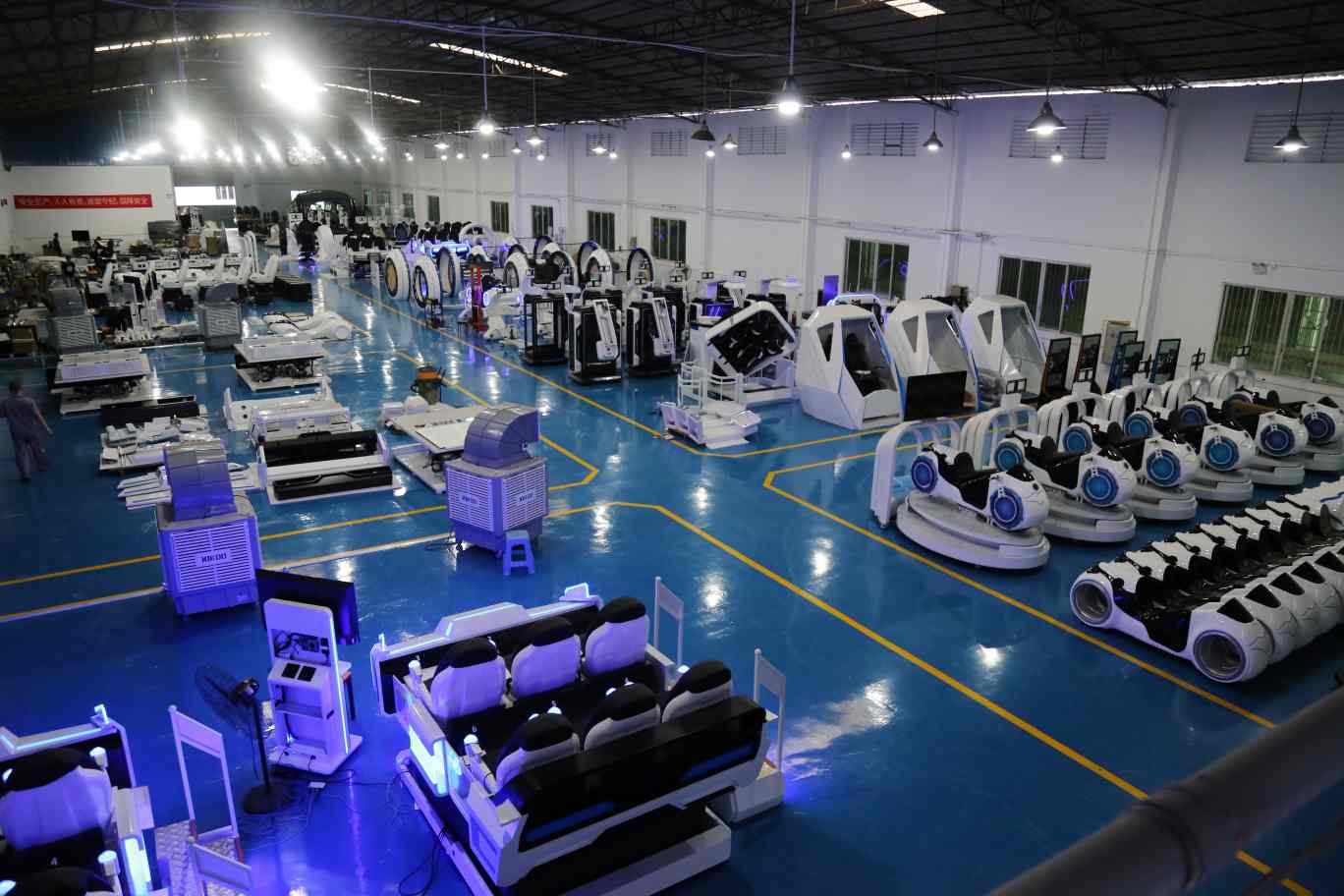
If you are searching for the best vr companies in Guangzhou, you have probably already discovered that this single district — Panyu — manufactures an estimated 60% or more of the world’s commercial VR entertainment hardware. The problem is not a shortage of suppliers. The problem is telling the difference between a factory that will still answer your emails three years after the container arrives, and one that will not.
This article provides a structured, criteria-driven comparison of top vr companies in Guangzhou — built around a 4-pillar evaluation framework, a tiered competitive landscape, a head-to-head comparison table, and a practical factory visit checklist. Whether you are an overseas FEC investor, a shopping-mall developer, or an entertainment equipment distributor evaluating virtual reality companies for your next procurement decision, this is your objective reference.
Why Guangzhou Is the Global Capital of Commercial VR Manufacturing
The Panyu Cluster — Where the World’s VR Entertainment Hardware Is Built
Guangzhou’s Panyu District is not just one of many manufacturing zones in China. For commercial VR entertainment equipment — 9D cinema simulators, VR racing rigs, free-roam arenas, motion platforms, and mixed-reality karting systems — Panyu is the global epicenter. The concentration of sheet-metal fabrication, fiberglass moulding, motion-actuator assembly, PCB integration, and game-content development in a single industrial corridor means that a VR machine can be designed, prototyped, tooled, and mass-produced entirely within a 20-kilometer radius. This supply-chain density is what makes Guangzhou vr companies structurally cost-competitive against manufacturers anywhere else in the world.
For the B2B buyer, this concentration is both a blessing and a curse. It means access to factory-direct pricing that no European, North American, or Middle Eastern distributor can match. It also means navigating a landscape of hundreds of suppliers with dramatically different capabilities — from 12-year, ISO-certified export manufacturers with in-house game studios, to small workshops that assemble machines from third-party components. Learning to distinguish between these tiers is the single most valuable skill a VR equipment buyer can acquire.
The 4-Pillar Framework — What Defines the Best VR Companies
Before naming specific vr companies, a buyer needs a consistent yardstick. The following four pillars are derived from actual procurement criteria used by experienced FEC operators and international entertainment equipment importers. A manufacturer that scores well across all four is not just selling machines — it is delivering a commercially viable, long-term operational partnership.
Pillar 1 — Turnkey Venue Solution Capability
Does the manufacturer merely sell individual machines from a catalog, or does it provide integrated venue planning — custom CAD 2D floor plans, photorealistic C4D 3D visualizations, equipment-mix recommendations based on your specific floor dimensions and target demographics, and a single point of accountability for the entire deployment? The difference between a machine seller and a turnkey vr solutions partner is the difference between hoping four crates work together and knowing they will before a single unit is manufactured.
Pillar 2 — Proprietary Content Ecosystem
Hardware without content is a metal shell. The best vr companies maintain an in-house game development team — not repackaging third-party titles — and deliver a structured content pipeline: a back-end catalog of 700+ commercial VR games spanning cinematic adventures, competitive shooters, family-friendly exploration, and racing. For flagship products like the X-Space VR Arena, LEKE VR ships a curated 18-title premium configuration (12 original in-house developed + 6 continuously updated customized MR titles) — a focused high-replayability bundle purpose-built for the free-roam arena format. Quarterly over-the-air (OTA) updates refresh content across the entire product ecosystem. Crucially, ask whether content updates stop after the warranty period. For most Guangzhou factories, the answer is yes.
Pillar 3 — Global Compliance Certifications & After-Sales Infrastructure
Certifications are not marketing badges — they are the documented prerequisites for customs clearance, commercial landlord approval, and liability insurance. The baseline for a serious export-grade manufacturer includes CE, TUV, RoHS, FCC, ISO 9001, and SGS — producible as PDFs, not just logo stickers. Beyond certifications, evaluate the after-sales architecture: dedicated engineer per venue, 48-hour parts-shipment SLA, remote video-call diagnostics, and a track record of supporting venues across time zones. If the answer to any of these is “we can figure it out later,” you are evaluating a Tier 3 supplier.
Pillar 4 — Verifiable Export Track Record & Innovation Pipeline
Can the manufacturer show you real, operating venues in multiple countries — with photographs, Google Maps locations, and opening dates — not just 3D renderings? Additionally, evaluate the innovation pipeline: does the manufacturer offer next-generation product categories — mixed-reality karting, free-roam multiplayer arenas — or is their catalog the same 9D cinema lineup from 2018? The best vr professionals are defined not just by what they sell today, but by whether their R&D roadmap positions your venue for the competitive landscape three years from now.
Guangzhou VR Companies — The Tiered Competitive Landscape
Applying the 4-pillar framework, Guangzhou’s virtual reality companies naturally separate into three tiers. This is not a marketing classification — it is an operational reality that any buyer who visits five factories in Panyu over two days will observe firsthand.
Tier 1 – Full-Stack Turnkey Solution Provider
LEKE VR (Guangzhou Leke VR Technology Co., Ltd.)
Headquarters: Room 601, Building A Jisheng Vanke, Panyu District, Guangzhou | Established: 2016 — 12 years of R&D and manufacturing
LEKE VR is the only Guangzhou-based manufacturer that operates across the full value chain: in-house game development studio to industrial hardware manufacturing to 3D spatial design team (CAD + C4D) to global logistics coordination to dedicated after-sales engineer per venue. The company has secured Series B venture funding (nearly 100 million RMB), operates a proprietary cloud OS platform with OTA content-update capability, and maintains a verified footprint of 700+ partner venues across 40+ countries.
700+ game library – In-house dev team – Quarterly OTA – X-Space Arena: 18-title premium config (12 original + 6 customized MR)
CE – TUV – RoHS – FCC – ISO 9001 – SGS — Full PDF documentation per shipment
Free custom CAD 2D + C4D 3D per venue — standard deliverable, not upsell
Dedicated engineer – Remote video diagnostics – 48h parts SLA – 3-7 day global delivery
Factory-direct – Zero franchise fee – 100% operator revenue – No ongoing royalty
MR Go-Kart (trackless Li-battery) – X-Space VR Arena (free-roam 1-20+ players)
Beyond the core 9D cinema and motion-simulator lineup, LEKE VR is the only Guangzhou manufacturer fielding two next-generation product categories: MR Go-Kart — a trackless, lithium-battery mixed-reality racing system with 6 immersive virtual themes, intelligent NPC competitors, and cloud-synchronized leaderboards — and X-Space VR Arena — a free-roam, untethered multiplayer platform for 1-20+ players with millimeter-level spatial positioning and PICO 4UE enterprise headsets. These represent the industry’s shift from seated single-player to mobile social-competitive formats — a direction most of the Panyu cluster has yet to reach.
Tier 2 – Established Hardware Manufacturers
Tier 2 companies are legitimate manufacturers with real factories, established domestic distribution, and functional hardware. Their primary limitation is scope: they excel at manufacturing but lack the integrated content ecosystem, turnkey spatial-design capability, and global after-sales infrastructure that define Tier 1.
Movie Power / EPARK
Strengths: One of Panyu’s earliest VR hardware manufacturers. Wide product range — 9D egg chairs, motion platforms, VR racing units. Large factory floor with established sheet-metal and fiberglass lines. Good option if your primary need is competitively priced, functionally reliable hardware and you bring your own content and venue-design resources.
Limitations: Product design language feels dated relative to current FEC expectations. In-house game development is minimal — most content is third-party sourced, limiting exclusivity and update cadence. After-sales for overseas buyers is less structured than Tier 1. Turnkey venue planning (CAD/C4D) is not a standard offering.
Owatch / Zhuoyuan
Strengths: Strong 9D VR cinema single-product market position. Extensive domestic distribution network. Established brand among Chinese-speaking buyers. Reasonable option if your sole requirement is a proven 9D cinema unit without multi-product integration needs.
Limitations: Catalog concentrated on 9D cinema — no MR karting, no free-roam arena, limited racing options. Content library under 100 titles, no in-house development pipeline. Export experience and international certification docs less comprehensive. Primarily a hardware seller — buyers handle venue layout and multi-vendor coordination independently.
Tier 3 – Price-First Competitors
Tier 3 encompasses the many Panyu workshops and price-aggressive brands — including FuninVR and dozens of smaller operations — competing primarily on upfront cost. Their value proposition is the lowest purchase price. For domestic buyers with in-house technical teams, this can be a calculated risk. For international B2B buyers, the risk calculus is fundamentally different.
FuninVR & Similar Price-Competitive Manufacturers
Appeal: Pricing typically 40-60% of Tier 1. Attractive for budget-constrained first-time buyers. Responsive sales process with short lead times.
Risk Factors: (1) QC inconsistency — reported hardware failure rates are higher; (2) After-sales infrastructure minimal for overseas destinations — no dedicated engineer, no SLA, no remote diagnostics; (3) Content is third-party sourced with no structured update pipeline; (4) Certifications are incomplete — CE mark may be present but TUV, FCC, SGS documentation is typically unavailable; (5) No turnkey venue-design capability; (6) Limited verifiable export track record outside China.
Quick Red-Flag Checklist — Signs of a Tier 3 Supplier
- Cannot produce PDF copies of CE, TUV, or ISO certificates when asked
- Has no in-house game development team — “we source games from partners”
- Cannot show real operating venue photographs — only 3D renderings and trade-show booth shots
- No documented after-sales process — “just contact us on WeChat”
- Factory address is a shared office or small workshop, not a dedicated manufacturing campus
Head-to-Head: LEKE VR vs. Guangzhou Competitors at a Glance
5 Procurement Lessons from Real B2B VR Buyers
A VR machine at 40% lower purchase price but with no content updates, no after-sales, and higher failure rates will cost far more over its 3-5 year service life. Calculate total cost of ownership, not the invoice.
Guests pay for the experience — the content. A factory without an in-house dev team and structured update pipeline is selling hardware that will feel stale within 12 months, regardless of motor wattage or frame materials.
Sourcing from multiple Tier 2/3 suppliers to save on unit costs creates a fragmented support landscape. A single vr companies partner providing all equipment lines — and accountable for the whole venue — eliminates this risk.
3D renderings are cheap and unverifiable. If a manufacturer cannot show real venue photographs with Google Maps locations and opening dates, you are evaluating a promise, not a track record. The best vr professionals document their global footprint with specificity.
Vr game companies still relevant in 2029 are investing in next-gen categories today — MR karting, free-roam arenas, cloud-synced platforms. Ask every factory: “What new category did you launch in the last 12 months?” The answer — or the hesitation — tells you everything.
Visiting a Guangzhou VR Factory — 5-Step Due Diligence Checklist
If procurement volume justifies a trip to evaluate virtual reality companies in person, here is a structured checklist to maximize each factory visit. The goal is data points that predict long-term supplier reliability — not being impressed by a polished demo.
Every factory has a polished showroom. Ask to see the actual production floor — fabrication, moulding, assembly lines, QC stations. A manufacturer that declines or redirects you is not showing their real operation. Count units in active production. Observe assembly procedures. These observations predict the consistency of equipment you will receive.
Request actual CE, TUV, RoHS, FCC, ISO, SGS documents with issue dates and certificate numbers. A manufacturer that has them produces them in minutes. A manufacturer that does not makes excuses. Check which specific product models each certificate covers — one CE certificate does not automatically cover the entire catalog.
Ask to meet an in-house developer and see a title in progress. If the factory cannot introduce you to a software engineer within their organization, you have identified a hardware assembler, not a vr game companies partner. No in-house dev team means content updates depend on third-party schedules you cannot control.
Ask: “Connect me with a venue operator you supplied in Germany, Saudi Arabia, or Brazil.” Be region-specific. A manufacturer with genuine global reach can provide multiple verifiable references. Contact them. Ask about after-sales responsiveness, hardware durability, and whether content has been updated since purchase.
After your visit, send a technical question via email — e.g., “What is the voltage tolerance range for the motion actuator on Model X?” Measure response time, answer specificity, and whether the reply came from an engineer or a salesperson. A detailed engineer response within one business day demonstrates the support you will receive. A vague reply or salesperson redirect demonstrates that too.
Apply the 4-Pillar Framework — Start with a LEKE VR Factory Tour
This article gives you the framework. The next step is applying it. LEKE VR welcomes in-person visits at the Guangzhou Nansha campus — walk the production floor, meet the dev team, review certifications. If travel is not feasible, a live video walkthrough can be arranged via WhatsApp. Every inquiry includes a free custom CAD 2D floor plan and equipment recommendation for your venue.
Request Free CAD Design & Price List
Book a Visit / Video Tour: WhatsApp +86-153 6087 7766 | Email: [email protected]
Frequently Asked Questions
Start Your Evaluation — Inquire Today
The framework, landscape, and checklist above equip you to evaluate any vr companies on your shortlist objectively. If LEKE VR is among them, the next step is a direct conversation. Zero franchise fees. 700+ game library with in-house dev team. X-Space Arena: 18-title premium config (12 original + 6 customized MR). 40+ countries. One accountable partner.
Get Free CAD Design & Factory Price List
WhatsApp: +86-153 6087 7766 | Email: [email protected] | Panyu, Guangzhou, China | Response: 1 Business Day (GMT+8)
Request Your Free CAD Floor Plan & Equipment Recommendation
Fill in the form below. Our B2B VR solutions team responds within 1 business day with a customized proposal — equipment recommendations, preliminary CAD floor plan, and factory-direct pricing.