
Mixed reality · Model 2498
Multiplayer VR arena — free-roam, no floor grid
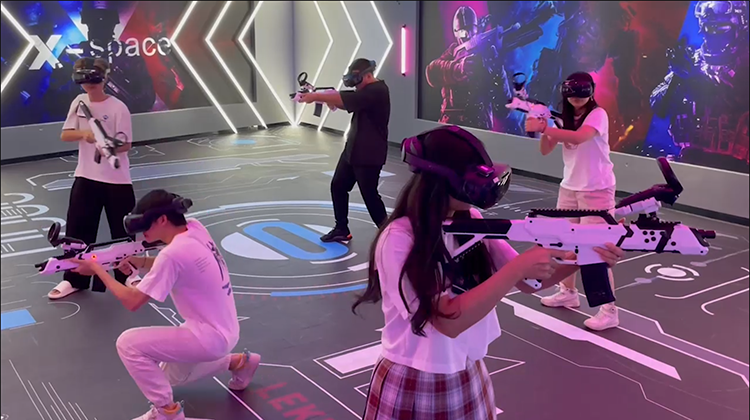
Players walk around a real floor wearing a headset, and see the game drawn over the space they are standing in. The arena is defined by software and a site scan, so there is no grid to lay, no maze to build and no walls to move when the layout changes.
The headset is part of the system. A gun controller and a haptic vest are optional additions: the arena runs without them, and a venue can start with headsets and add the rest once the floor is earning. Capacity is set by the floor rather than by the hardware.
- No floor grid. Position comes from the headset and a site scan, not from markers.
- Free roam. Players walk and crouch in the space instead of standing at a bay.
- Headset standard, gear optional. Add guns and vests when the floor justifies it.
01 / Overview
What a multiplayer VR arena is
This is free-roam VR. Each player wears a headset and walks through a real space while the game is drawn over it; gun controllers and haptic vests are optional additions to that base. Because the players move, the arena floor has to be clear, and the play area is bounded by a barrier rather than by a maze of walls.
The practical difference from a laser-tag build is what you do not install. There is no floor grid to lay, no maze to construct and no themed walls to rebuild when you want a different game. The arena is a scanned floor plus a set of headset positions, and the layout lives in software.
| Players | 1 to 20+, set by the floor area. |
| What players wear | A headset, included. Gun controller and haptic vest are optional. |
| Arena | Barrier around a clear floor; no interior build. |
| Content | 12+ titles: PvP shooters, co-op defence, cinematic team pieces. |
| Scoring | Cloud leaderboard, suitable for leagues and corporate events. |
02 / Watch a session
Gear on, then move
The clip shows a group in the arena: headsets fitted, then players moving around the floor during the round. Watch the fitting sequence rather than the gameplay — every player has a headset to fit and a headset to wipe afterwards, and that is why this format is staffed while a rifle bank is not.
A session runs as follows.
03 / No floor grid
Why the floor stays yours
A conventional laser-tag arena is a construction project: walls, corridors, a themed build and a floor that has to be re-laid when the layout changes. This system replaces that with a scan. Once the space is mapped, players are placed in it by the headset they wear, and the arena layout exists as a file rather than as a structure.
What that buys an operator is change. A junior layout in the afternoon and a longer objective at night, a corporate session that needs a different map, a seasonal theme that would otherwise mean building scenery — none of it requires a contractor. Floor coverings, including a branded carpet or a gridless finish, are a design choice rather than a tracking requirement, so the arena can look finished without being functional hardware.
Scanned, not built
The space is mapped once; players are positioned by the headset they wear.
Layout is a file
Change the map between sessions instead of rebuilding the arena.
Barrier, not maze
A perimeter keeps players in; the interior stays clear for free movement.
Floor finish optional
Branded carpet or a gridless surface is cosmetic, not part of tracking.
04 / Standard and optional
What ships with the arena, and what you add
The headset is part of the system, one per player position. Screens, tracking and the content library run off the same kit, so a base arena is playable as delivered — players are placed in the space, they move, and the round scores.
Two items are optional. A gun controller matches the shooting mechanics in the game rather than acting as a generic pointer, and a haptic vest delivers feedback at the point an impact lands. Both raise what a session feels like, and both add to the fitting routine, so they are usually added after the floor is trading rather than on day one. Ordering them with the arena is cheaper than retrofitting them later, because the player count and the content are configured once.
Headset — standard
Inside-out tracking, so player position comes from the device itself.
Gun controller — optional
Shaped around the shooting mechanics; an upgrade, not a requirement.
Haptic vest — optional
Tactile feedback at the point of impact, which is what players describe afterwards.
Staffed rotation
Fitting sets the throughput; the more gear, the longer the changeover.
05 / Titles
Twelve titles, three kinds of audience
The library is deliberately mixed. Player-versus-player shooters carry the competitive crowd and the evening bookings; cooperative defence games suit families and mixed-ability groups; cinematic team pieces suit corporate sessions and school groups that want something other than a firefight.
That mix matters because an arena is a large footprint for a single audience. A floor that only sells PvP is empty at family hours, and a floor that only sells gentle content loses the teenage trade. The cloud leaderboard is the second half of the offer: it turns a session into a standing, which is what makes a league or a repeat corporate booking possible.
Specification
| Model | 2498 |
| Power | 1,000 W rated; 110 / 220 V adaptable |
| Display | Headset included, one per player position. Gun controller and haptic vest are optional add-ons, not part of the standard kit. |
| Tracking | Inside-out headset tracking after a site scan; no floor markers or grid |
| Content | 12+ titles: PvP shooters, co-op defence, cinematic team pieces; updates over time |
| Output | Cloud leaderboard for standings, leagues and corporate events |
| Certification | ISO 9001:2015 · CE · FCC · RoHS, by model and destination |
| Lead time | Stated on the quotation |
06 / Commercial
What the quotation includes
Comparative quotes in this category are rarely like for like, and the difference is usually in the second column. Both lists are given before any figures are compared.
From LEKE VR
- The headsets for the agreed player count
- The tracking system and the commissioning site scan
- The installed title library and the cloud leaderboard
- Arena layout plan drawn to your floor
- Export packing, documentation and delivery to port
- Installation, calibration and staff training
- Remote diagnostics and spare parts from our own stock
Budgeted on your side
- Freight, insurance and import duty to your market
- The perimeter barrier and any interior build
- Floor covering, branded carpet or graphics
- Local electrical supply and its certification, signed off by your electrician
- Queuing rail, signage and spectator screens
Structural questions remain with your structural engineer and electrical questions with your licensed electrician. We supply the drawings and load data they need.
Quality management is certified to ISO 9001:2015, with CE marking and RoHS and FCC compliance by model and destination. Certificates and test reports are available on request.
Our showroom and factory in Guangzhou can be visited. Projects listed below belong to operators, so access is theirs to grant. If a visit is not practical, we draw an arena plan on your own floor instead. Where a venue wants fixed rifle bays instead of free roam, the AR shooting arcade is the alternative; the rest of the range is listed under commercial VR products.
Reviews
What operators say about the VR arena
Swipe to see more →
The barrier and the scan decide the arena, not the hardware. Plan the perimeter first, then the player count.
We changed the map for a corporate group in the morning and ran a junior layout in the afternoon. No contractor, no rebuild.
Fitting is the throughput limit. Two attendants at a busy door change the queue more than any hardware option.
Free roam is why teenagers come back. We added vests in the second year, which was the right order to do it in.
Projects
Solutions we build
Swipe to see more →
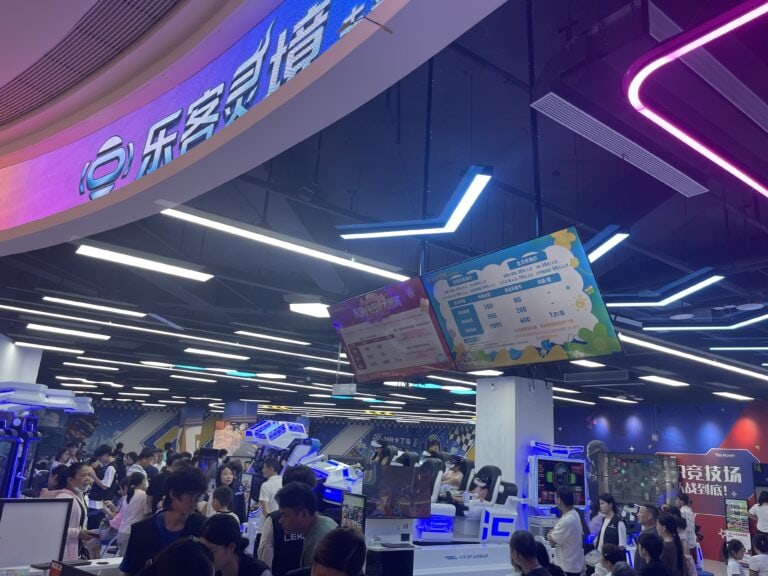 Virtual Reality Examples: A 1,000+m² VR ProjectFloor plan & case →
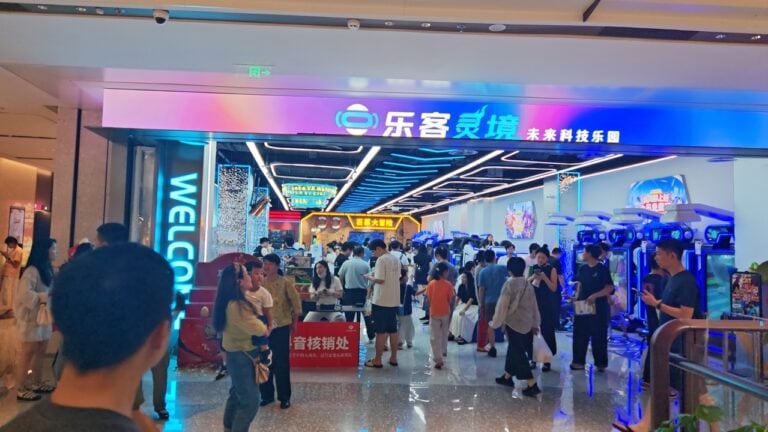 Virtual Reality Examples: Inside LEKE VR’s New 1,000㎡ Flagship at Shanghai PRISMA CenterFloor plan & case →
 VR Entertainment Business Case Study: A LEKE VR Store Generated $13,368 in a Single DayFloor plan & case →
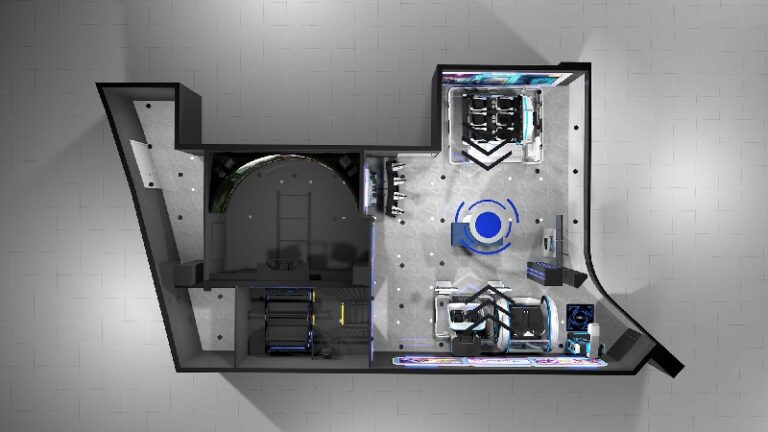 Indoor Theme Park Design: A 240 m² Floor Plan | LEKE VRFloor plan & case →
More machines
Elsewhere in the range
Swipe to see more →

07 / Questions
Questions operators ask
How many people can play?
One to twenty-plus, set by the size of the floor. The kit is the same at any count, so the arena scale is a planning decision rather than a hardware model.
Do we need to build a maze or lay a grid?
No. The space is scanned once and players are positioned by the headset they wear. Layouts are held in software, so changing the map does not mean rebuilding the arena.
What does each player wear?
A headset, one per position, included in the system. A gun controller and a haptic vest are optional add-ons, and the arena runs without them.
Are the guns and vests included?
No, they are quoted separately. Both add to the fitting routine, so many venues start with headsets and add the rest once the floor is trading.
Is the floor covering part of the system?
No. A branded carpet or a gridless finish is a design choice; tracking does not read the floor.
How long does a session take?
The round length plus briefing and fitting. With a vest and headset per player, the fitting routine sets the throughput, so plan the queue with the layout.
Can results feed a league?
Yes. Standings run on a cloud leaderboard, which is what makes repeat corporate events and local leagues practical.
Do we still need a barrier?
Yes. Players move freely, so a perimeter keeps them inside the arena and spectators outside it.
What support is included?
Commissioning and staff training, remote diagnostics, video support while staff are on the floor, spare parts from our own stock, and after-sales maintenance.
Next step
Send the floor, not a wish list
Send the clear floor area, the columns you cannot move and the ceiling height. We return an arena plan, a player count for that space and a line-item quotation.
LEKE VR · Guangzhou Leke VR Technology Co., Ltd. · Guangzhou, China · contact
Figures come from the build sheet and commissioning records for this system and from our own venues. Maintained by the LEKE VR product team in Guangzhou and revised when a number changes.