
Mixed reality · Model 1958
MR Kart — commercial mixed-reality racing kart
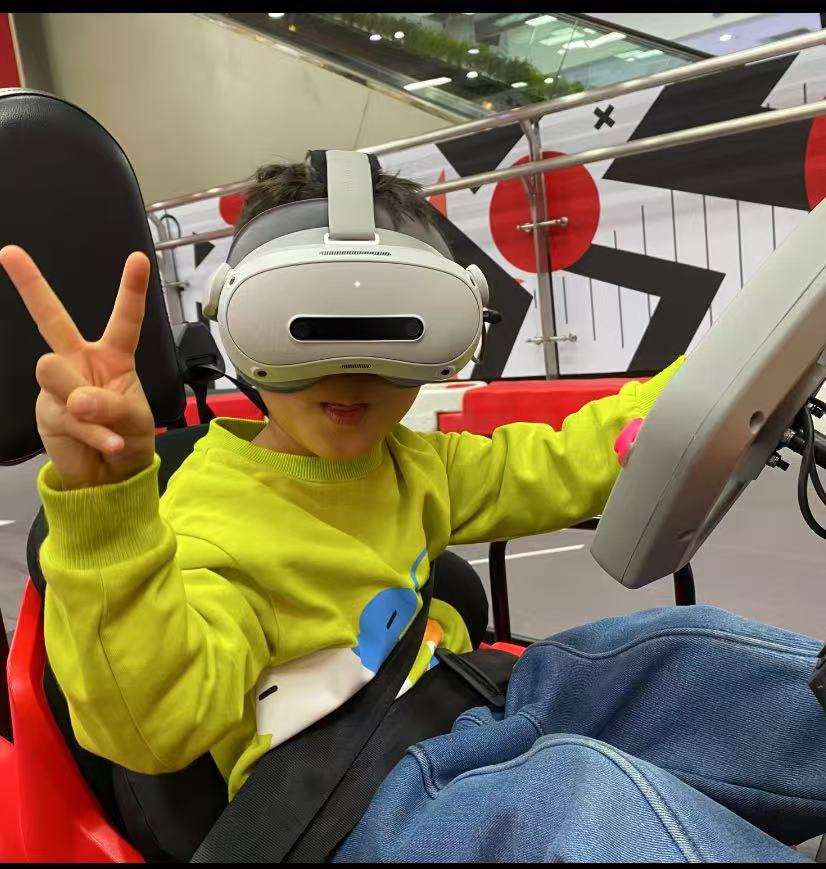
The MR kart is a real vehicle with wheels, steering and a seat. A passthrough headset draws the race over your own floor, so riders see the venue around them while the track, the items and the opponents exist in the headset.
A fleet starts at four karts and runs to twenty on the same tracking and scoring system. There is no permanent track inside the barrier: the layout is drawn in software and changed between sessions.
- Electric drive. No exhaust, no fuel on site, no engine noise.
- Six themed tracks. Item races, lap races and custom formats.
- Battery exchange. A low pack is swapped in under three minutes.
01 / The racing
What a rider actually does in a race
A group enters one race rather than taking turns. Each kart joins the same session from one control point, so riders line up against each other, not against a clock. What separates this from a simulator or a conventional kart track is the content: a simulator runs a fixed course for one rider, a kart track runs real karts but on one permanent layout and without items, and this runs six rotating tracks with pick-ups and power-ups in the same race as the other karts.
| Who you race | The group in the room, joined into one session. |
| Track | Six themed tracks, chosen per session. |
| Items | Pick-ups and power-ups inside the virtual layer. |
| Laps and difficulty | Set by the operator for each group. |
| Result | Lap times to the leaderboard, view on the venue screen. |
Layout is covered separately under one floor, many tracks, which explains how the same floor carries different layouts.
02 / Watch a session
From headset fitting to the first laps
The clip follows a rider from the moment the headset goes on: fitting, taking the seat, and the first laps on the floor. The point it makes is the one that matters commercially — the rider is looking at the room around them, not at a screen, and the kart is moving across the venue rather than sitting on a platform.
The clip covers the start of a session. The rest of the cycle runs as follows.
03 / Electric
Electric drive, and how the battery is exchanged
The kart is battery-electric, with no exhaust, no fuel storage and no engine noise. That is what allows the fleet to operate on a normal commercial floor, including basement and interior units where a combustion kart would need extraction ducts.
Batteries are removable. When a pack runs low, staff exchange it for a charged one in under three minutes and the kart returns to the queue, so a busy session is not interrupted while a vehicle waits. Charging takes place away from the racing area, and the charging point needs a wall supply sized for the fleet. Electrical design is signed off by your licensed electrician; we supply the load figures.
No exhaust
Nothing to vent, so enclosed floors do not need extraction.
No fuel on site
Nothing stored or handled, and no smell in the building.
Low noise
A fleet can run beside other attractions and the venue’s own audio.
Fewer service items
No oil, spark plugs or fuel system. Brakes, tyres and batteries are the routine work.
04 / Fleet and floor
How many commercial VR go karts fit your floor
Fleet size follows the floor. Four karts is the minimum that produces a race, and it needs roughly 200 m². Above that the number depends on your layout, your queue and your peak hour, so we size it from your plan rather than from a table.
What we quote is an operating area, not a single vehicle: karts, headsets, batteries and chargers, tracking, the arena drawing, screen output, the leaderboard and staff training. A single machine arrives ready to use; this arrives as a layout that has to fit a specific floor.
A site plan goes in, an arena drawing comes back: where karts run, where batteries are exchanged, where the queue stands and where spectators watch. You confirm fleet size, layout and theming before production starts. Arena drawings from previous projects are on the solutions page.
You send the plan
Dimensions, columns, clear height and power supply.
We return a drawing
An arena layout sized to that floor, not a template.
You confirm
Fleet size, layout, theming and options.
Build and commission
Production, delivery, installation and calibration.
The drawing is yours to keep whether or not you order.
05 / Tracks
Six themed tracks and three race formats
Six tracks ship with the fleet: Desert, Dinosaur, Polar, Castle, Undersea and Cat City. They are developed in house and new tracks are added over time, so a seasonal change does not depend on a third-party licence. Tracks are selected per session, which means the same karts race a different map in the afternoon and at night.
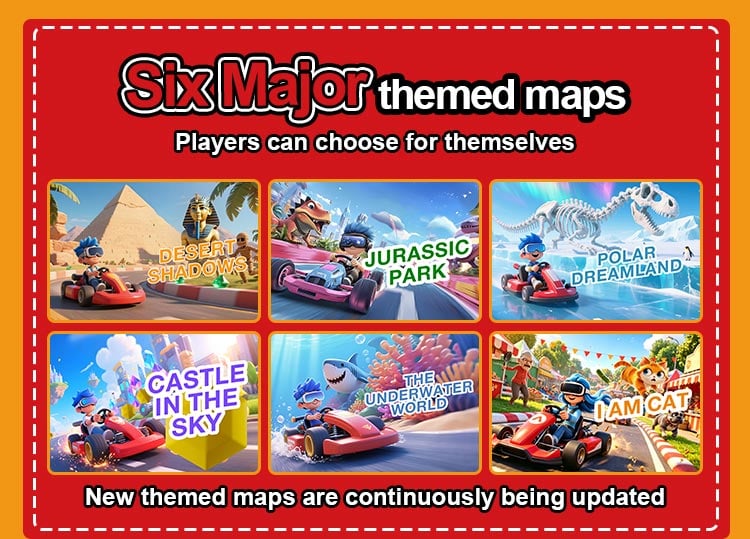
Three formats run on the same karts: item races with pick-ups and power-ups, lap races scored on time, and custom settings where the operator sets laps, track and difficulty. Lap times are stored on a cloud leaderboard, so a group can come back and beat its own record.
Specification
| Model | 1958 |
| Riders | 4 |
| Operating zone | 200 |
| Power | 220 V, 1.5 kW per kart |
| Display | Passthrough mixed-reality headset, one per kart |
| Tracking | Multi-sensor fusion against spatial markers, sub-millimetre accuracy |
| Content | 6 in-house themed worlds; networked multiplayer; adaptive AI rivals |
| Output | Live driver view or full-map race view to a venue display; cloud leaderboard |
| Certification | ISO 9001:2015 · CE · FCC · RoHS, by model and destination |
| Lead time | Stated on your quotation, not on a web page. |
06 / Layout
Barrier, layout and floor preparation
Roughly 300 m2 is the reference floor for a full arena. Flat commercial flooring, no overhead structure required; clear height over the racing line and floor finish are confirmed at survey.
Karts run inside a barrier. That is a physical requirement: it keeps karts in the arena and spectators out, and it is specified together with the arena drawing. Inside the barrier, nothing is built. The racing line exists in software and is redrawn between sessions, so a school group in the afternoon and an adult session at night can use different layouts on the same floor.
A site scan at commissioning sets the coordinate space. After that, each kart’s position comes from the headset the rider wears, so no markers or sensors are fitted to the floor. Matting and decals remain a design choice rather than a system requirement.
Barrier
Specified with the drawing. Safety comes from the perimeter, not from the software.
Racing line
Redrawn per session instead of rebuilt per season.
Floor surface
Scan and calibration are repeated only if the floor itself is resurfaced.
07 / Commercial
What the quotation includes
Comparative quotes in this category are rarely like for like, and the difference is usually in the second column. Both lists are given before any figures are compared.
From LEKE VR
- The karts, the passthrough headsets and the charging hardware
- Tracking, spatial markers, calibration and the commissioning pass
- The six in-house worlds, the race software and the leaderboard
- A 2D floor plan and a 3D render of your unit, as standard deliverables
- Staff training, race-day documentation and remote diagnostics
- Spare parts dispatched from our own stock
Budgeted on your side
- Freight, insurance and import duty to your market
- The perimeter barrier, specified by us and built to your budget
- Any large-format display on the wall
- Floor preparation, resurfacing or screed work
- Local electrical installation and certification, signed off by your licensed electrician
- Signage, decor and anything else a fit-out contractor usually carries
Structural questions remain with your structural engineer and electrical questions with your licensed electrician. We supply the drawings and load data they need.
Quality management is certified to ISO 9001:2015, with CE marking and RoHS and FCC compliance by model and destination. Certificates and test reports are available on request.
Our showroom and factory in Guangzhou can be visited. Projects listed below belong to operators, so access is theirs to grant. If a visit is not practical, we draw a layout on your own plan instead. The rest of the range, including racing simulators and arena attractions, is listed under commercial VR products.
Reviews
What operators say about the MR kart
Swipe to see more →
Six karts in about 950 m². The first Saturday we had people queuing at the entrance, which we did not expect in the first month. My staff can change the layout for school groups in about twenty minutes.
Karts run fine and we have not had a headset problem in eight months. The perimeter barrier took longer than planned because our floor is not completely level. When we had a tracking error they answered on WhatsApp the same day.
We started with four karts and added two more in the second year. Weekend bookings carry the unit.
Projects
Solutions we build
Swipe to see more →

08 / Questions
Questions operators ask
Can an MR kart run indoors or outdoors?
Both. The MR kart is battery-electric, with no exhaust and no fuel on site, so an enclosed floor works as well as an outdoor area. Nothing in the tracking depends on being indoors.
Do we need to build a track?
No. There is no track to pour, paint or mat. The racing line exists in software and is drawn over your floor.
Do we still need a barrier?
Yes. The barrier is a physical requirement and is specified together with the arena drawing.
Do we need floor markings or mats?
No. Position comes from the headset, so matting and decals are a design choice rather than a system requirement.
How much floor does a fleet need?
About 200 m² for four karts. Above that it depends on your layout, and we size it from your plan.
How is a race configured?
The operator sets track, laps and difficulty per group, so a team-building session and a walk-in session can run different formats.
What tracks are available?
Six: Desert, Dinosaur, Polar, Castle, Undersea and Cat City. New tracks are added over time.
What happens when a battery runs low?
It is exchanged for a charged pack in under three minutes, and the kart returns to the queue.
What support is provided after installation?
Remote diagnostics, video support while staff are on the floor, spare parts from our own stock, and after-sales maintenance. Terms are agreed with your sales contact.
Next step
Send your floor plan
Send the dimensions, the clear height and the columns you cannot move. We return an arena layout, a fleet size and a line-item quotation.
LEKE VR · Guangzhou Leke VR Technology Co., Ltd. · Guangzhou, China · contact
Figures come from the build sheet and commissioning records for model 1958 and from our own venues. Maintained by the LEKE VR product team in Guangzhou and revised when a number changes.