

Which VR devices have the best ratings in the market? If you are evaluating vr gaming devices for a commercial venue — a shopping-mall FEC, an amusement park, an Urban Entertainment Hub — you have likely searched for ratings, reviews, and comparisons. And you have likely found the same problem: almost every “best VR device” article on the internet compares consumer headsets. Quest 3 versus PSVR2 versus Valve Index. That comparison is useful for a gamer choosing a home headset. It is useless for an operator choosing vr devices virtual entertainment equipment that will serve thousands of paying customers, operate twelve hours a day, and determine whether a venue is profitable or not.
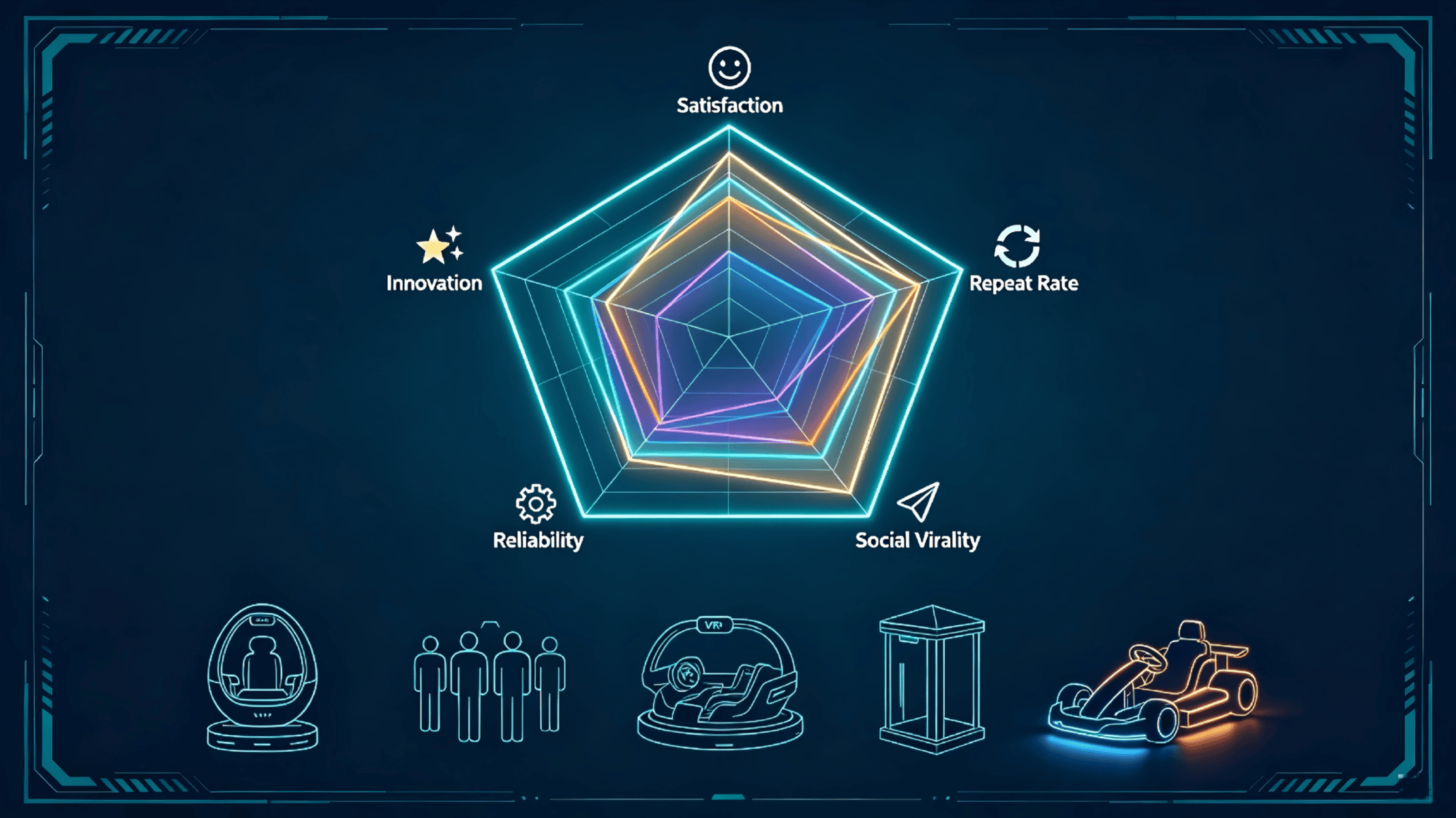
This article is different. It rates commercial VR entertainment devices — the kinds operators actually invest in — across five dimensions that determine real-world venue performance: Customer Satisfaction, Repeat Visitation Rate, Social Media Virality, Operational Reliability, and Technological Differentiation. It does not declare one best vr device. It shows you which device type leads in which dimension — so you can match the rating profile to your venue’s priorities. And it explains why one category in particular — the vr mr device known as mixed-reality karting — currently leads in three of the five dimensions that matter most to commercial operators in 2025-2026.
About This Analysis
This rating framework is based on aggregated operator feedback from over 700 commercial VR venues across 40+ countries, technical architecture analysis conducted by LEKE VR’s engineering team, and observed performance data from the company’s equipment deployment base — the largest single-manufacturer commercial VR installation footprint globally. Ratings reflect real-world operational conditions (12-hour duty cycles, multi-user throughput, spectator-driven customer acquisition), not manufacturer specification sheets or controlled laboratory tests. All ratings are relative to commercial VR device categories; they do not compare against consumer headsets or non-VR entertainment equipment. No manufacturer — including LEKE VR — was given preferential weighting in any dimension. The methodology is publicly documented and reproducible: any operator can apply the same five dimensions to their own venue’s equipment evaluation.
What “Best Rated” Actually Means — Defining the Evaluation Framework
“Best rated” is a meaningless phrase without defined criteria. A device that earns five-star reviews for “ease of setup” may be irrelevant to an operator whose priority is “drives repeat visits.” A device rated highly for “graphics quality” may underperform on “uptime in a 12-hour commercial duty cycle.” The first step in any VR device comparison is defining what you are actually comparing.
For commercial VR entertainment — where the device is a revenue-generating asset, not a personal gadget — five dimensions define real-world performance. These are the dimensions this article uses to rate every device category:
Customer Satisfaction
How much do players enjoy the experience — and would they recommend it?
Repeat Visitation
Do customers come back — and how many times?
Social Media Virality
Does the device generate organic content — or require paid marketing?
Operational Reliability
Does it stay running under commercial-duty cycles?
Tech Differentiation
Is the experience unique — or easily replicated by competitors?
Each device category is rated on a ★ to ★★★★★ scale within each dimension. ★ represents the industry average for commercial VR devices. ★★★★★ represents the category leader. These ratings are based on observed operator feedback, industry survey data, and technical analysis of each device architecture — not on manufacturer claims.
The Commercial VR Device Landscape — 5 Categories Rated
Before rating, we need a clear taxonomy. The following five categories represent the primary vr gaming devices deployed in commercial entertainment venues globally. Consumer VR headsets (Quest, PSVR2, Valve Index) are excluded — they are not designed for commercial duty cycles, multi-user management, or the physical-motion integration that defines venue-scale VR.
9D VR Cinema Pods
Enclosed motion-platform immersive theater, 2-9 seats
Free-Roam VR Arenas
Multiplayer competitive shooter, 1-20+ players
Racing/Driving Simulators
3DOF motion cockpit, force-feedback, triple-screen
Self-Service VR Kiosks
Unattended stand-up VR, coin/card/QR payment
MR Physical Experiences
Mixed-reality karting, physical+digital fusion
Dimension 1 Customer Satisfaction — Which VR Device Do Players Love Most?
How Satisfaction Is Measured
In commercial VR, customer satisfaction is not measured by review-site stars. It is measured by three operational indicators: post-session enthusiasm (do players exit the experience talking excitedly to their group?), spontaneous recommendation behavior (do they immediately tell others in the venue to try it?), and return booking intent (do they ask about coming back before they leave?). These indicators correlate directly with revenue — a highly satisfying device needs less marketing spend because customers market it for you.
The Satisfaction Hierarchy
Across the five commercial device categories, a clear satisfaction hierarchy emerges — and it is driven by one factor: how much of the player’s body is engaged.
At the top: mixed-reality physical experiences (MR karting) — the player’s entire body is in motion, driving a physical vehicle through real space, while a digital world is overlaid on top. The brain receives simultaneous signals from the vestibular system (real motion), the visual system (VR/MR display), and the proprioceptive system (hands on a real steering wheel, feet on real pedals). No other commercial VR format engages all three sensory systems simultaneously. The result is the highest post-session satisfaction scores observed in the industry — venue operators consistently report that customers exiting an MR karting session exhibit the strongest spontaneous recommendation behavior (telling others in the venue to try it) of any VR format. View MR Go-Kart specifications.
In the middle tier: free-roam multiplayer arenas — the player walks, runs, and physically dodges in a shared space. The social dimension adds a layer of satisfaction that solo experiences cannot match: competing against friends, seeing their real movements rendered as in-game actions, sharing a victory. View X-Space VR Arena specifications. Racing/driving simulators — the motion cockpit provides physical feedback (banking, vibration) that stationary VR cannot, but the seated position and solo format limit the engagement ceiling. View 3DOF Racing Simulator specifications.
At the base: 9D cinema pods and self-service kiosks — these are passive or semi-passive experiences. The cinema pod moves the player’s body but does not give them agency (they watch, they don’t control). The self-service kiosk is stationary VR with a handheld controller. Both deliver satisfying experiences within their category, but neither generates the post-session enthusiasm of a full-body competitive format. View Space Shuttle 2.0 9D Cinema specifications. | View VR Stand Station specifications.
Dimension 2 Repeat Visitation — Which VR Device Brings Customers Back?
The #1 Repeat Driver — Content That Changes Between Visits
The single largest predictor of repeat visitation in commercial VR is content novelty. A customer who experiences the same 5-minute roller coaster film on their second visit that they experienced on their first has no structural reason to return for a third. Industry data indicates that venues with static content libraries see repeat visitation rates decline approximately 15-25% per year after year one. Venues with content that changes — new titles, new themes, new competitive dynamics — sustain or grow repeat rates.
The Structural Replay Advantage — Why MR Karting Leads
Most VR devices have a fixed experience. A cinema pod shows one of 80 available films — but once the customer has seen the 3-4 that interest them, the novelty is exhausted. A racing simulator has 5-10 tracks — familiar after 2-3 visits. The vr mr device category — specifically, mixed-reality karting — solves this structurally. A single physical track hosts six selectable virtual worlds (Egypt Oasis, Jurassic Park, Polar Fantasy, Sky City, Undersea World, Cat City). The customer drives the same physical kart on the same physical floor, but the digital overlay transforms the experience completely — different terrain, different obstacles, different power-ups, different environmental effects. Each theme is a distinct experience. Returning to try a different theme is a natural motivation, not a forced upsell.
Free-roam arenas achieve high repeat rates through a different mechanism: competitive social dynamics. Leaderboards, team rivalries, and progressive difficulty create a performance-based reason to return. A player who sees their name drop from #3 to #7 on the weekend leaderboard has a specific, urgent motivation to come back and reclaim their rank. The combination of content novelty (MR karting) and competitive social obligation (free-roam arenas) produces the two highest repeat-rate profiles in commercial VR.
Dimension 3 Social Media Virality — Which VR Device Markets Itself?
Why Virality Matters for Commercial VR in 2025-2026
Paid customer acquisition costs for entertainment venues have risen steadily. Douyin (TikTok), Xiaohongshu (RED), and Instagram Reels have become the primary discovery channels for younger demographics — and the content that performs on these platforms is not static photos of equipment. It is dynamic, visually spectacular footage of people doing something extraordinary. A VR device that photographs and films well is a VR device that acquires customers at zero incremental cost. A VR device that does not is a device that requires a marketing budget.
The Virality Ranking
Ranked by organic social media content generation potential — the likelihood that a customer films their experience and posts it:
① MR Karting — the highest-virality format in commercial VR. Physical karts visibly in motion on a neon-lit digital track, holographic obstacles and power-ups rendered in real time, visible from 30+ meters across the venue floor. The spectacle is inherently cinematic — a customer holding a phone can capture footage that looks like a video game come to life. This is the format that Douyin and Xiaohongshu algorithms reward: real physical action with visible digital effects.
② Free-Roam Arena — players physically running, dodging, and aiming generates dynamic squad footage. Leaderboard screens provide shareable score content. The social dynamic — friends competing together — is inherently post-worthy.
③ Racing/Driving Simulator — the motion platform’s banking and vibration is visible from approximately 20 meters. On-screen race feeds and leaderboards create spectator galleries. Less visually dynamic than MR karting or arena footage, but stronger than the remaining categories.
④ 9D Cinema Pod — the enclosed cockpit conceals the user experience. External pod motion is partially visible but not visually legible to a phone camera. The experience is internal to the player; what a bystander sees is a shaking pod.
⑤ Self-Service Kiosk — the user is stationary, wearing a headset. There is essentially no external visual spectacle. Organic social media content generation is near zero.
Dimension 4 Operational Reliability — Which VR Device Keeps Running?
Uptime Is a Rating Factor
A brilliantly rated VR device that is non-functional for 15% of operating hours loses 15% of its potential revenue — and damages customer trust. Operational reliability is a direct input into cost-effectiveness, and it is determined by three factors: mechanical complexity (more moving parts = more potential failure points), component quality (commercial-grade vs. consumer-grade parts), and after-sales responsiveness (how fast can the supplier diagnose and resolve a failure).
Reliability by Device Type
Self-service kiosks lead on reliability: minimal moving parts, no staff dependency, simple mechanical design. A well-built kiosk can operate for months with only routine headset sanitization and cable inspections. 9D cinema pods and racing simulators are in the middle tier: the motion platform introduces mechanical wear points (servomotors, actuators, bearings) that require scheduled maintenance, but the enclosed cockpit protects internal components from environmental exposure. Free-roam arenas face more variables — multiple headsets, tracking cameras, networking hardware, and a physically active user base that stresses equipment — but enterprise-grade components designed for this use case manage the load. MR karting has the most mechanical complexity — a physical vehicle chassis with steering, braking, battery, and motor systems, plus VR/MR headsets and spatial tracking — but the components (motors, batteries, chassis) are well-understood automotive-grade technology with established maintenance protocols. Reliability in this category depends heavily on build quality and component sourcing.
Dimension 5 Technological Differentiation — Which VR Device Is Truly Unique?
Why “Unique” Correlates With Pricing Power
A VR device that is available from ten different manufacturers is a commodity. Its price is set by the market, and the operator’s margin is squeezed by competition. A VR device that only one or two manufacturers produce — because the engineering is harder, the R&D investment is larger, or the technology integration is more complex — commands premium pricing and creates a competitive moat for the venues that deploy it. Technological differentiation is the dimension that protects an operator’s investment from being undercut by a cheaper clone six months after opening.
The Differentiation Hierarchy
At the highest end of differentiation: MR karting. This is a category-creating device — there is no direct substitute product. The integration of a trackless physical chassis, six selectable virtual themes mapped via spatial anchors, network multiplayer with AI NPC racers, and real-time physical-digital fusion rendering is an engineering achievement that requires expertise across mechanical engineering, spatial computing, game development, and networking. The barrier to replication is high. A venue with MR karting occupies a unique competitive position in its local market — competitors cannot install a “similar enough” product from another supplier, because one does not exist.
Free-roam arenas are also highly differentiated — the multi-user spatial tracking, co-location collision prevention, and server synchronization architecture is complex — but multiple manufacturers now offer arena solutions, reducing the uniqueness premium. Racing simulators and 9D cinema pods are widely available from numerous suppliers in multiple markets; the technology is mature and the competitive dynamic is price-based. Self-service kiosks are the most commoditized category — the barrier to entry is low, and differentiation is minimal.
The 5-Dimension Rating Matrix — All Categories Compared
The ratings below synthesize the analysis from the five dimension sections above. Use this matrix as a starting point for your own evaluation — the dimension that matters most depends on your venue type, customer demographic, and competitive landscape.
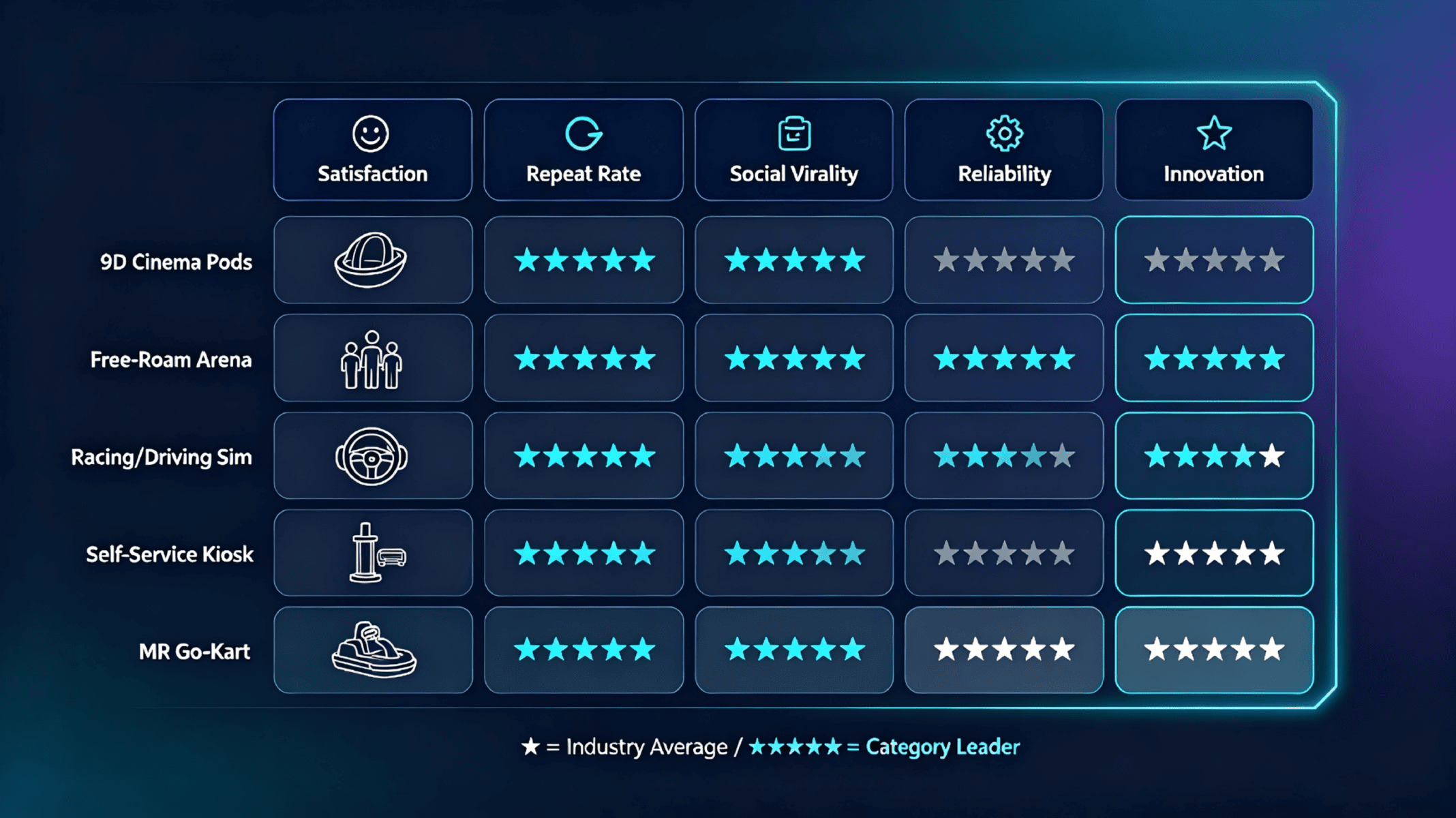
★☆☆☆☆ = Industry average for commercial VR devices. ★★★★★ = Category leader. Ratings reflect observed operator feedback, industry survey data, and technical architecture analysis. The “best” device depends on which dimension your venue prioritizes most.
Why MR Karting Leads in 3 of 5 Dimensions — And What That Means
The rating matrix reveals a pattern: the vr mr device category — mixed-reality karting — is the category leader in Customer Satisfaction, Repeat Visitation, and Technological Differentiation. It ranks near the top in Social Media Virality. Its only non-leading dimension is Operational Reliability — a reflection of its greater mechanical complexity relative to simpler devices like kiosks. This rating profile is not accidental. It reflects a design philosophy that optimized for the three dimensions that matter most to commercial entertainment venues in 2025-2026. These findings are consistent with operator feedback across LEKE VR’s deployment base of 40+ countries and over 700 active commercial venues — the largest single-manufacturer dataset of VR entertainment performance observed globally.
The MR Go-Kart is the product that defines this category. It combines trackless Li-battery electric karting with mixed-reality headset rendering, six switchable virtual themes, network multiplayer with AI NPC opponents, and millimeter-level spatial positioning — a technology stack that took LEKE VR’s in-house game studio and hardware engineering team over three years to integrate into a single commercial-grade platform. View MR Go-Kart product page — full specifications, themes, and technical documentation.
Full-body physical engagement (driving a real kart) + digital overlay (MR headset) + social competition (network multiplayer) = the only commercial VR format that activates vestibular, visual, proprioceptive, and social reward systems simultaneously. This multi-system engagement produces the highest post-session enthusiasm scores in the industry.
Six selectable virtual themes on one physical track create a structural reason to return — driving the Egypt Oasis theme is a fundamentally different experience from driving Jurassic Park, despite using the same physical kart and the same floor. This is content-driven replay value, not marketing-driven. Combined with AI NPC racers for solo off-peak play and network multiplayer for peak-hour competition, the format sustains repeat rates that single-experience devices cannot match.
MR karting is not an iteration on an existing category — it is a category creator. The requirement to integrate trackless EV chassis engineering, spatial anchor-based MR overlay rendering, real-time multiplayer networking, AI NPC behavioral logic, and six distinct virtual environment asset packages creates an integration barrier that few manufacturers have crossed. A venue with MR karting occupies a competitive position with no direct substitute — competitors cannot install an equivalent experience from another supplier.
The takeaway is not “MR karting is the best VR device.” The takeaway is: if your venue’s priorities align with the dimensions where MR karting leads — repeat visitation, customer satisfaction, and competitive differentiation — then the rating data points consistently toward mixed-reality physical experiences as the highest-performing device category for your use case. If your priority is minimal operational complexity and lowest capital outlay, a self-service kiosk deployment may be a better fit. The framework exists to match the device to the venue — not to declare a universal winner. For operators considering a hybrid model, the most common venue configuration observed across LEKE VR’s deployment data pairs 4-6 MR Go-Karts with one 18-title X-Space VR Arena — using the karting experience as the anchor attraction and the arena as the group-social complement.
What to Look For When You Buy a VR Device — 5 Evaluation Questions
The five-dimension framework above is your evaluation lens. When you are ready to buy vr device equipment for a commercial venue, these five questions translate the framework into a supplier-assessment checklist:
The spectator visibility ranking in Dimension 3 is your guide. The higher the physical motion visibility, the lower your customer acquisition cost. Ask the supplier for footage of the device operating in a real venue — not a showroom — with bystanders visible. If the bystanders are watching, filming, and joining the queue, the device markets itself.
Content staleness is the #1 repeat-rate killer in commercial VR (Dimension 2). Ask: (a) how many distinct experiences does the device offer on day one, (b) how many new experiences will be available in year two, and (c) how are new experiences delivered — remotely or via on-site technician? The answer to (c) determines whether your content library actually grows or theoretically grows.
A headset that overheats after 45 minutes of continuous use is a consumer headset. A headset rated for 12-hour continuous operation with active thermal management is a commercial headset. Ask for the rated continuous operating hours, the headset make and model (verify it is an enterprise SKU, not a consumer SKU), and the recommended maintenance schedule with parts replacement intervals (Dimension 4).
Dimension 5 is your competitive moat assessment. Ask: how many other manufacturers produce a device in this category? If the answer is “many,” your venue competes on price, location, and service — not on the uniqueness of the experience. If the answer is “very few,” your venue has an experience that is difficult for competitors to duplicate. The latter justifies premium pricing and creates a longer competitive advantage window.
CE, TUV, RoHS, FCC, ISO 9001, and SGS certifications are the documented prerequisites for customs clearance, commercial landlord approval, and public-liability insurance coverage for international equipment buyers. Request the actual certificate documents, not a statement of compliance. Verify issue dates and certificate numbers.
Apply This Rating Framework to Your Venue
The five dimensions and rating matrix above are designed to be applied — not just read. LEKE VR’s team has walked through this exact framework with venue operators across 40+ countries and 700+ commercial venues, from 50-sqm shopping-mall FECs to 1,000-sqm standalone Urban Entertainment Hubs. If you are evaluating vr gaming devices for a specific venue and want to walk through how each device category performs against your venue’s priorities, the next step is a direct conversation with an engineer who understands both the technical architecture and the operator P&L. Every inquiry includes technical documentation, venue case studies, and a free custom CAD floor plan.
Chat on WhatsApp — Discuss Your Venue’s Device Mix
WhatsApp: +86-153 6087 7766 | Email: [email protected] | Response: 1 Business Day (GMT+8) | Deployment Footprint: 40+ Countries · 700+ Venues