

Ask five suppliers for a 9D VR cinema price and you will get five numbers that look nothing alike. That is not because someone is lying. It is because the quotes cover different machines, different scopes, and different levels of after-sales commitment.
The useful question is not “how much does a 9D VR cinema cost” but “what am I actually buying at this price.” This guide breaks down what sits inside a real quote, which six variables move the number, and where cheap units quietly push cost onto you.
- A 9D VR cinema price is driven mainly by seat count, motion axes, and screen format — not by the “9D” label itself.
- Two quotes with the same seat count can differ sharply because one excludes shipping, installation, or content licensing.
- The cheapest unit in a category is usually cheapest because something was removed from the duty cycle, the frame, or the support scope.
1. What a 9D VR Cinema Quote Should Actually Include
Most disputes about a 9D VR cinema price come from comparing two numbers that never described the same thing. Before you compare, make sure you are comparing scope. A complete quote for a commercial 9D VR cinema normally covers eight line items — if a supplier’s number looks unusually low, check which of these are missing.
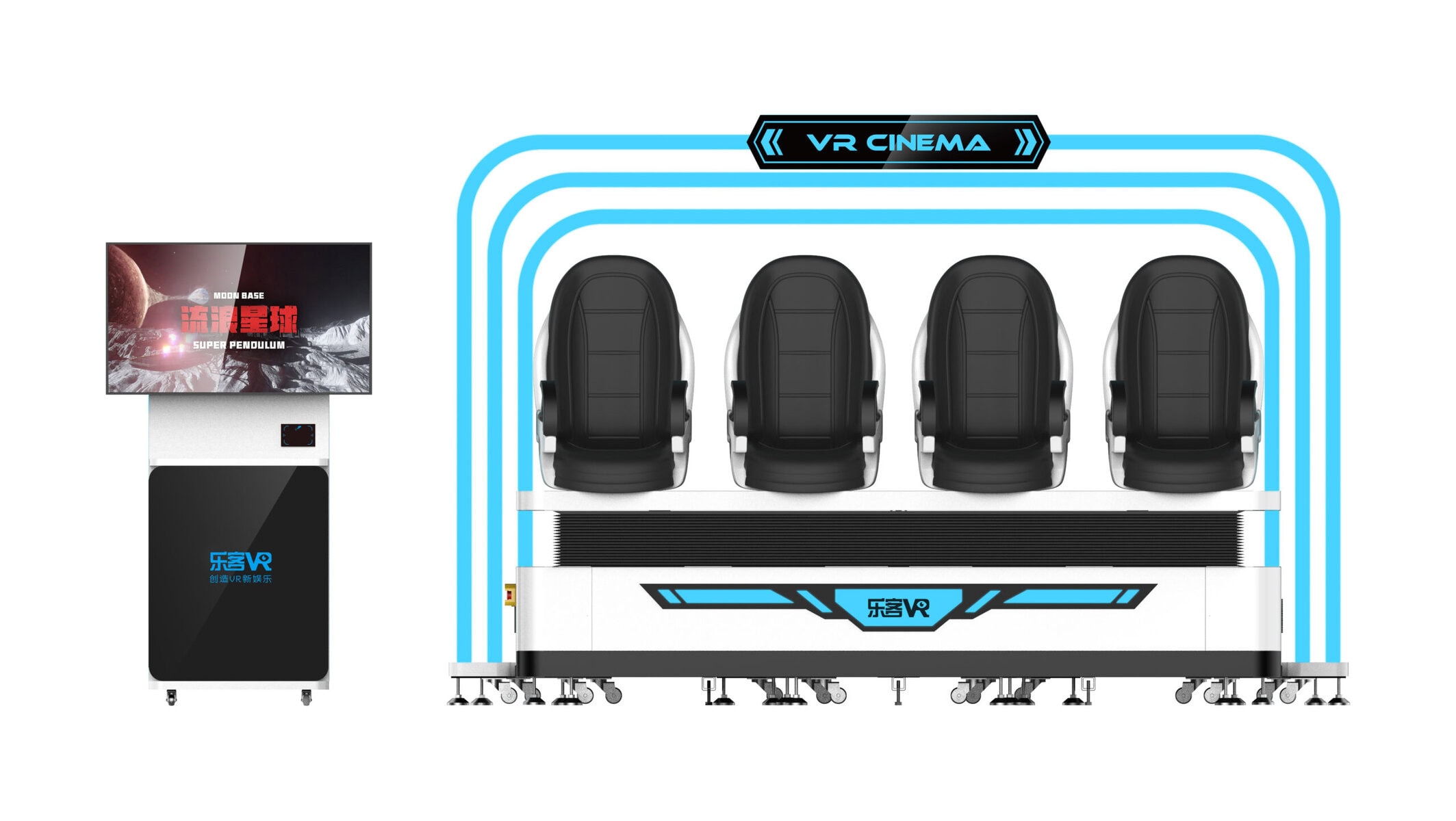
Seat count is the first line item in any quote — it changes the frame, the actuators, and the restraint hardware.
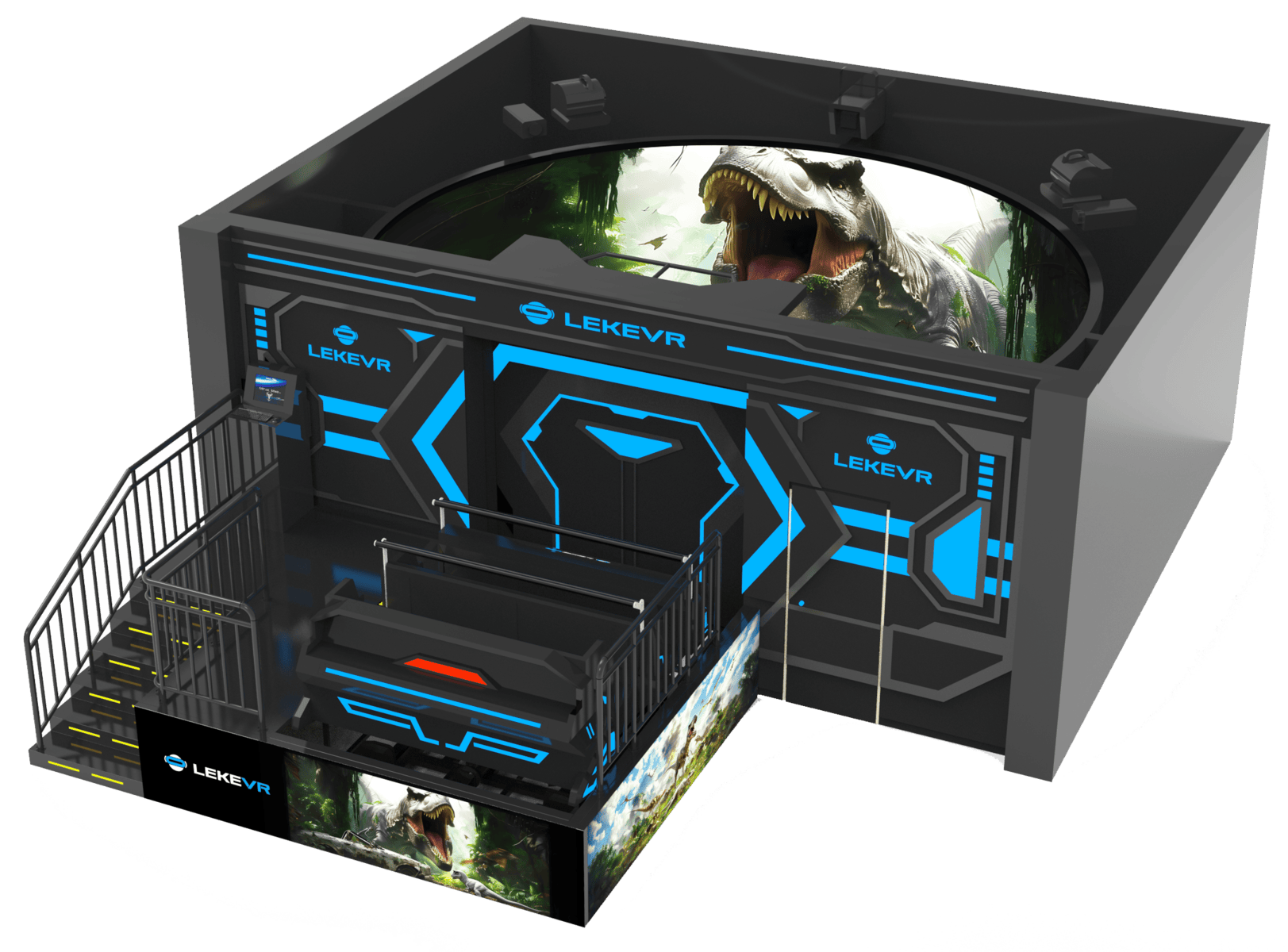
The motion base is where the invisible part of the price sits — axis count, actuator spec, and frame rigidity.
| Line item | What it covers | Commonly omitted |
|---|---|---|
| 1. Core unit | Motion platform, seats, restraint system, frame, canopy | — |
| 2. Display | Headset set or arc screen and projection assembly | Screen format upgrades |
| 3. Motion system | Electric or hydraulic actuators and control board | Axis count, actuator spec |
| 4. Control & audio | Host PC, amplifier, speakers, cabling | Spare cabling |
| 5. Content | Pre-installed film library and its licence terms | Licence duration, per-title limits |
| 6. Export & logistics | Packing, freight, insurance, customs documents | Very often quoted separately |
| 7. Installation | On-site assembly, calibration, test run | Engineer travel and visa cost |
| 8. Warranty & spares | Cover period, spare parts, remote support | Parts availability after year one |
Watch this first. A number that excludes items 6, 7, and 8 is not a lower price — it is a partial price. Add those back before you compare, or the cheapest quote will win a tender it should not win.
2. The Six Variables That Move the Price
Seat count
Seats are the most visible cost driver in any 9D VR cinema price and the easiest to understand. More seats mean a longer, heavier platform, stronger actuators, a bigger frame, and more restraint hardware. Going from a 2-seat to a 4-seat unit is not a simple doubling — the motion system has to be re-engineered to move the added load smoothly, which is why per-seat cost often falls as seat count rises while total cost climbs.
Motion axes and actuator type
This is the single most misunderstood line in a quote. A 3-axis platform tilts and pitches. A 6-axis platform adds translation and rotation on more planes. The difference is not marketing — it changes the actuator count, the control board, the frame rigidity, and the maintenance profile.
Screen format: headset vs arc screen
Headset-based cinemas carry lower display cost but shift cost into hygiene management, headset replacement, and throughput limits. Arc-screen formats such as Bermuda Cinema — Naked-Eye 3D Arc Theatre remove the headset entirely, which raises the display investment but simplifies cleaning between shows and lets more people watch at once. For venues running continuous sessions, that trade-off usually decides the format more than the ticket price does.
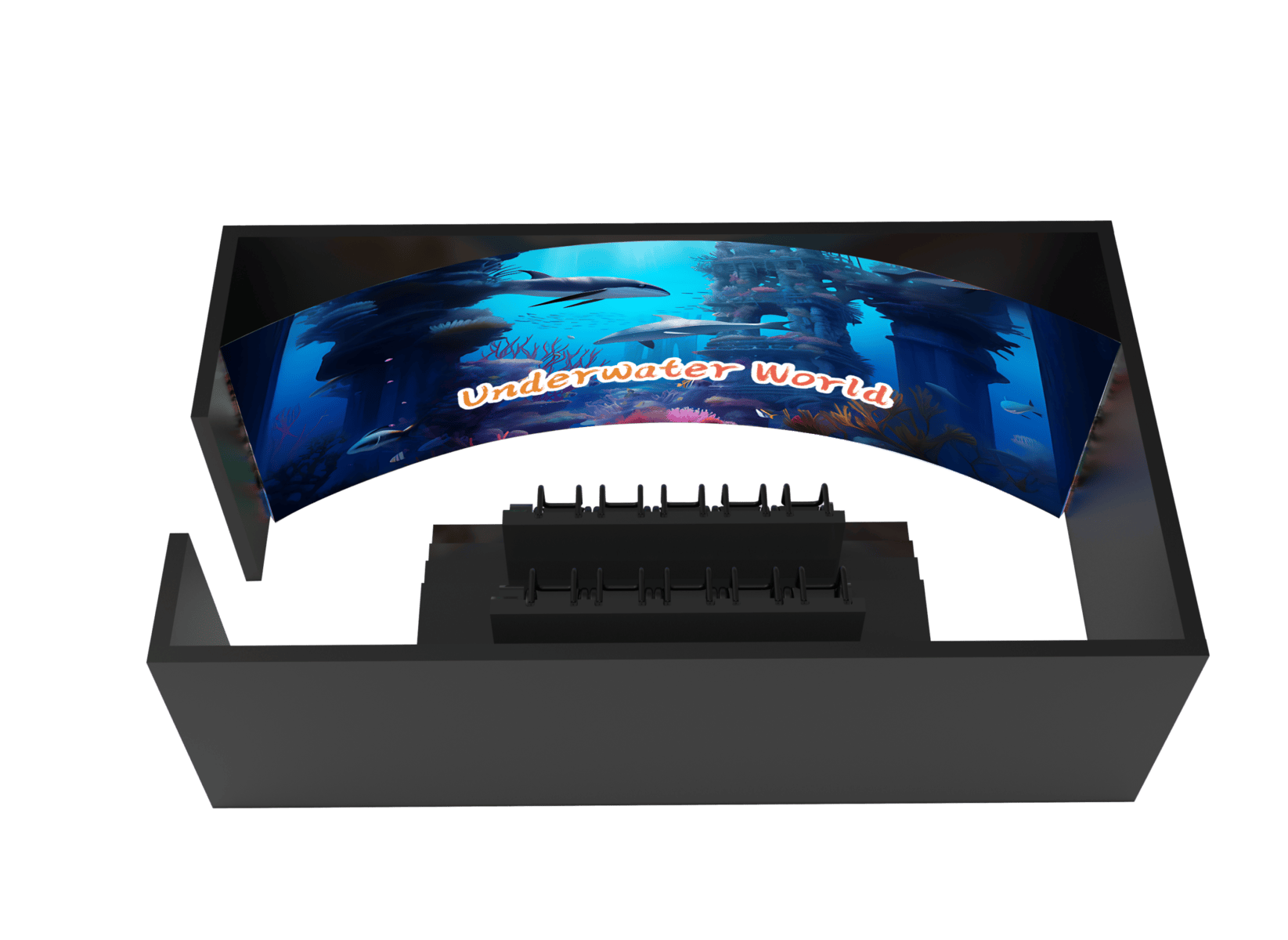
Replacing the headset with a curved screen raises the display cost but removes the per-guest fitting and sanitizing step.
Content library and licensing
Content is where “included” needs a definition. Ask how many titles ship with the machine, whether the licence is perpetual or time-limited, whether new titles are billed per unit, and whether you can load your own content. A generous initial library with a restrictive licence is worth less than a smaller library you own outright.
Duty cycle and build grade
A machine rated for occasional use and one rated for continuous operation are different products. Commercial duty cycle shows up in frame thickness, actuator quality, bearing grade, seat materials, and ventilation. This is the part of the price you cannot see in a photo, and it is the first place a low-cost supplier saves money.
Logistics, installation, and support
Freight, insurance, customs handling, engineer travel, installation, training, and remote support are all real costs. They scale with distance and with how complicated the machine is to assemble. A quote that bundles them is not more expensive — it is more complete.
3. Cheap vs Commercial Grade: Where the Difference Lands
A low 9d vr cinema price is not automatically a bad deal. It is a bad deal when the savings come out of components that fail under daily operation. The market splits cleanly in two on this point, and the price gap between them is rarely as large as the reliability gap.
| Area | Entry-level unit | Commercial-grade unit |
|---|---|---|
| Frame | Thinner steel, welded in fewer points | Reinforced frame rated for repeated load cycles |
| Actuators | Generic, limited service life | Specified actuators with published duty rating |
| Control board | Closed, hard to source replacements | Replaceable modules, documented wiring |
| Seats & restraints | Light upholstery, simple buckles | Commercial upholstery, redundant restraint |
| Ventilation | Minimal, heat builds in long sessions | Designed for back-to-back shows |
| Spare parts | Often discontinued with the model | Parts stocked and orderable after purchase |
| Support | Email only, slow response | Remote diagnostics plus a spare parts channel |
Run the arithmetic on downtime instead of on purchase price. One actuator failure during a peak weekend costs you the tickets you did not sell while the unit sat idle — plus the emergency freight for a part nobody stocks. A unit that is cheaper by a small margin but loses two weekends a year is the more expensive machine.
The question is never whether a 9D VR cinema is cheap to buy. It is whether the machine is still running in year three without a parts hunt.
4. Before You Request a Quote: An Eight-Point Checklist
Send these eight answers with your enquiry and you will get comparable quotes instead of five unrelated numbers.
Why this matters: a supplier who receives these eight points can quote accurately and flag problems early. A supplier who receives only “price for 9D cinema” will quote the safest generic machine, which is rarely the right one for your site.
5. Matching a Cinema Format to a Venue
The machines in the cinema line are not interchangeable, the right one depends on where the unit is going, and that choice moves the 9D VR cinema price as much as any specification does.
6. How LEKE VR Quotes a Cinema Project
LEKE VR builds commercial VR cinema systems as a certified factory, and quotes are structured so that every line above is visible and separable — you can see what the machine costs, what content costs, and what logistics and support cost. Because the 9D VR cinema price is assembled from named line items rather than a single rounded figure, you can compare our quote against any other on equal terms.
The cinema line covers 2-seat, 4-seat, 6-seat, and 9-seat 9D configurations, VR Chair 360°, Space Shuttle 2.0, and Bermuda Cinema — Naked-Eye 3D Arc Theatre for venues that want to run without headsets. Models you can price today include the 2-seat 9D VR egg chair, the 4-seat 9D cinema, the 6-seat cinema, and the arc display flying cinema.
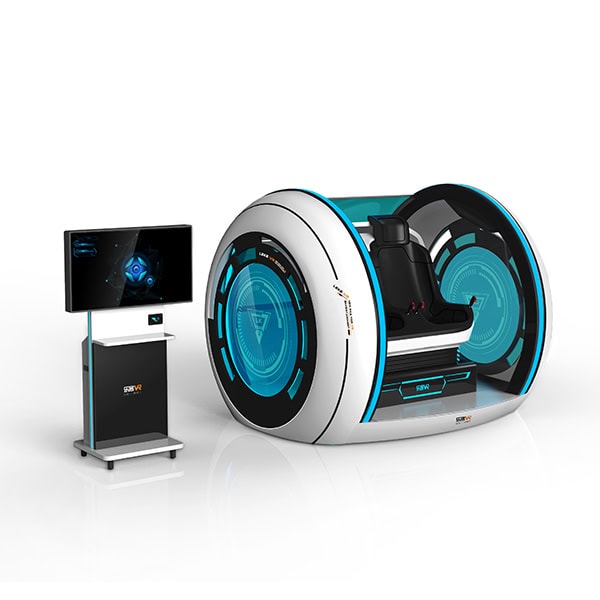
One of the anchor-style units in the cinema line — the format that suits parks and high-traffic venues.
On the support side, LEKE VR handles export documentation, installation coordination, operator training, and after-sales support from the build team, with content updates deployed to your machines remotely. Content updates are delivered through a dedicated operator back office — we describe the mechanism rather than promising a fixed update schedule, because the schedule depends on your configuration.
The full range with specifications is on our VR cinema line page, and a configured quotation for your site is the only way to get a number that means anything.
FAQ: 9D VR Cinema Price and Cost Questions
Send us your floor area, ceiling height, power supply, and target seat count. We will come back with a line-by-line quotation and flag anything in your site that needs checking first.