9D VR Cinema Simulator — 4-Seat Compact Immersive Attraction for Commercial Arcades Not every venue can accommodate a 6-seat cinema. For operators working wit...
B2B Factory-Direct · Request a Custom Quote
ISO 9001 FactoryCE / FCC / RoHSLekeVRTurnkey Delivery
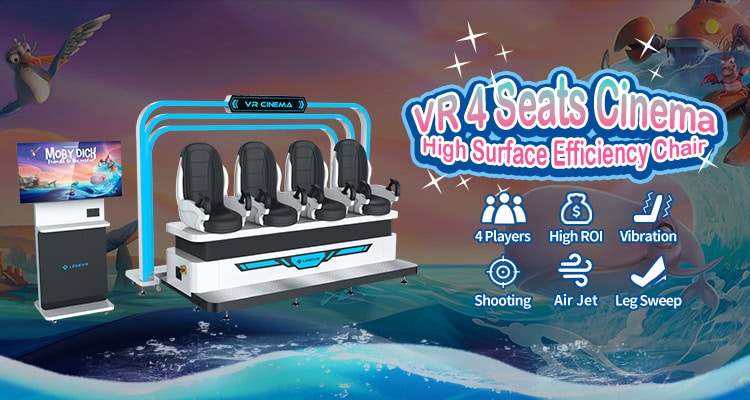
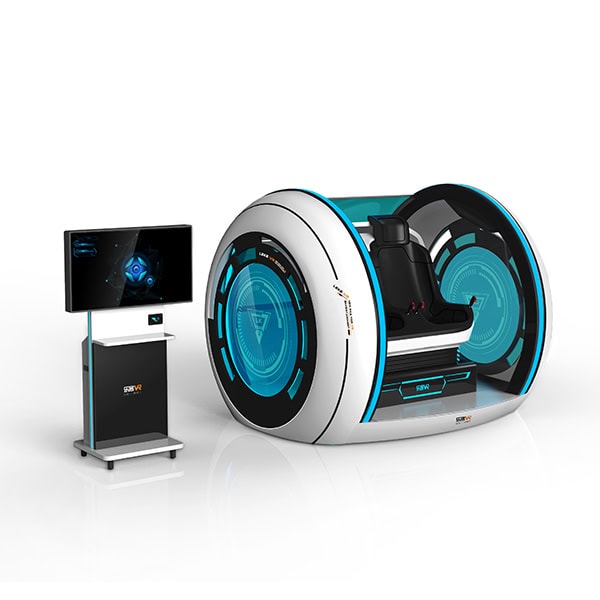
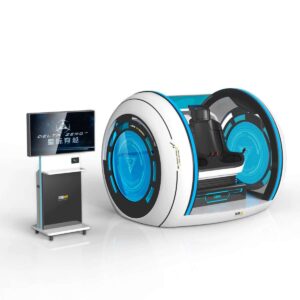
Not every venue can accommodate a 6-seat cinema. For operators working with tighter floor plans — boutique arcades, hotel game rooms, cruise-ship entertainment decks, or FEC corners where an extra meter of depth is simply not available — the 4-seat 9d vr cinema simulator delivers the same immersive group-attraction economics in a dramatically slimmer footprint. At just 1,600 mm deep and 6.76 m² total, this is the shallowest multi-seat VR cinema in its class: four ergonomic seats in a single row, each equipped with a DEEPOON E3S headset, powered by a 5,000 W / 220 V single-circuit system. With 35+ pre-installed titles, multi-motion effects spanning vibration, wind, lifting, diving, and shaking, plus 3D surround audio — all housed in a customizable sheet-metal spaceship-inspired cabin — the 9d vr cinema simulator offers a lower total cost of ownership entry point into the commercial VR cinema category without sacrificing the sensory depth that drives repeat-play revenue.
6.76 m², 1.6 m Deep: The Slimmest Multi-Seat VR Cinema in Its Class
Depth is the scarcest dimension on most arcade floors. Width can be negotiated; depth is usually fixed by aisles, walkways, and fire-egress corridors. The 9d vr cinema simulator in its 4-seat configuration is engineered specifically for depth-constrained deployments: at W 4,200 × L 1,600 × H 2,100 mm, it extends just 1.6 meters from the wall — roughly the depth of a standard claw-machine island or a pair of racing cabinets placed back-to-back. This shallow profile unlocks venue placements that deeper multi-seat attractions simply cannot occupy: narrow mall kiosk zones, cinema-lobby alcoves, cruise-ship corridors, hotel game-room walls, and the perimeter edges of FEC floors where circulation aisles consume the remaining depth budget.
The four seats are arranged in a single row, ensuring every player has an unobstructed forward-facing view with no second-row sightline compromise. The 2,100 mm height sits comfortably under standard commercial ceiling heights (typically 2,400 mm minimum). At 651 kg with a distributed base-frame load, the unit requires no structural floor reinforcement — it can be positioned on standard commercial-grade flooring and, if needed, repositioned within a venue as floor layouts evolve across lease cycles. A single 5,000 W / 220 V power circuit within 3 meters of the cabinet’s rear access panel is the only infrastructure requirement — half the power draw of a 6-seat cinema, a meaningful consideration for venues with legacy electrical distribution or multiple high-draw attractions sharing a circuit phase.
Ergonomic Seats: Comfort That Extends Session Duration and Repeat Intent
An uncomfortable seat shortens session tolerance, triggers complaints, and discourages re-queuing — three micro-frictions that quietly erode daily throughput. Each of the four seats in this 9d vr cinema simulator is an ergonomically contoured bucket design with high-density foam cushioning that distributes body weight evenly across the seat pan and backrest, reducing pressure-point fatigue during sessions. The seat geometry supports a broad anthropometric range — from children approximately 120 cm tall to adults above 190 cm — without requiring per-player adjustments. In a commercial context, this universal-fit design means the operator spends zero time adjusting seats between player rotations, and the player spends the full session duration engaged with the content rather than distracted by physical discomfort.
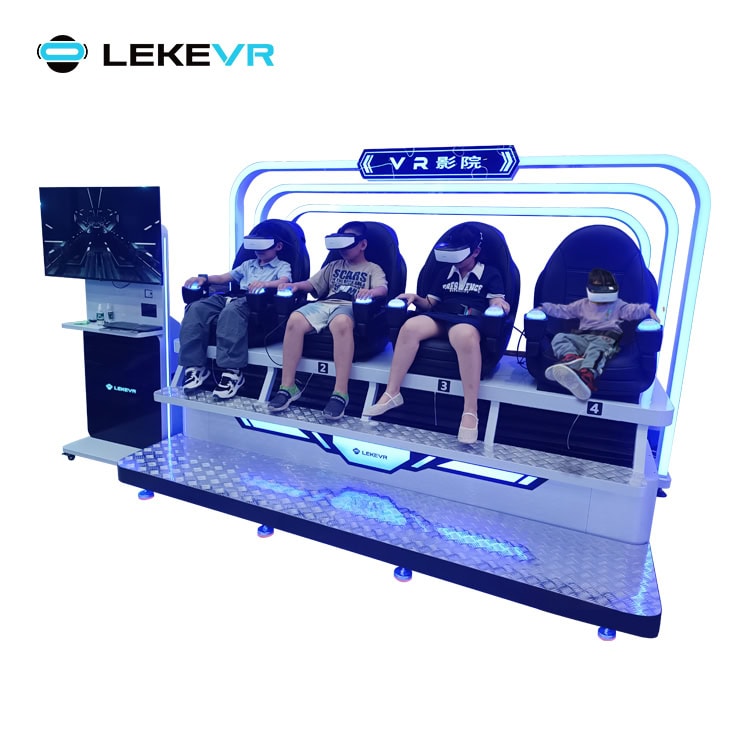
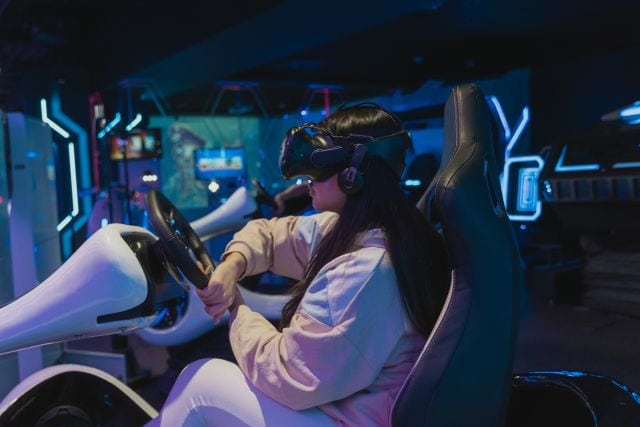
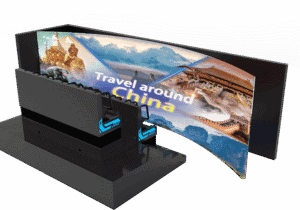
Figure 1 — The 4-seat 9D VR cinema simulator in a commercial arcade environment, featuring its spaceship-inspired cabin, four ergonomic seats in a single-row layout, DEEPOON E3S VR headsets, and 35+ pre-installed games across domestic and international titles.
Vibration, Wind, Lifting, Diving, Shaking: Multi-Motion Effects That Redefine Immersion
A static VR booth delivers visual input and nothing else — the player’s body remains stationary while the eyes report motion, creating the visual-vestibular disconnect that limits immersion and, for some users, causes discomfort. This 9d vr cinema experience eliminates that gap by synchronizing five distinct motion effects to the on-screen action via a unified motion-control engine:
Vibration — haptic actuators embedded in each seat deliver directional impact feedback during explosions, collisions, and terrain transitions. The vibration intensity is authored per scene, not a binary on/off toggle, ensuring the physical sensation matches the on-screen event scale. Wind — directional fans integrated into the cabin trigger wind bursts during high-speed sequences such as dives, acceleration, and open-air flight, with intensity graded to the on-screen velocity. Lifting & Diving — the seat platform executes vertical-axis elevation changes synchronized to in-game ascents and descents, creating the stomach-drop sensation of a virtual free-fall or the upward surge of a launch sequence. Shaking — lateral oscillation effects simulate terrain roughness, earthquake sequences, and impact recoil, adding a layer of physical unpredictability that static chairs cannot replicate.
These motion effects are reinforced by a multi-channel 3D surround audio system with dedicated subwoofer output. Directional speakers position sound cues in three-dimensional space — a creature approaches from the left, the audio shifts to the left channels; an explosion occurs overhead, the upper drivers engage; a low-frequency rumble builds, the subwoofer drives the vibration actuators in sympathetic resonance. The combined sensory envelope — visual, auditory, and kinetic — is what separates a 9d vr cinema simulator from a passive viewing booth. For the operator, this depth of engagement is what converts first-time curiosity players into repeat customers who bring friends.
35+ Pre-Installed Titles: A Game Library Curated for Repeat-Play Longevity
Content breadth is the single strongest predictor of an arcade attraction’s second-year revenue trajectory. A machine with 10 games feels repetitive within two months; a machine with 35+ titles keeps even daily regulars engaged for months before exhausting the library. The 9d vr cinema simulator ships with 35+ commercially licensed titles drawing from both domestic and international VR content catalogues — a curated mix of scenic fly-throughs, adventure quests, action scenarios, thriller experiences, and family-friendly explorations that collectively span the full arcade demographic from young children to adult players.
A touchscreen content-selection interface at the operator station enables session-by-session title changes with zero reboot time: the operator reads the queuing audience — a family with young children, a group of teenagers, a couple on a date — and selects the appropriate title in seconds. That real-time demographic matching maximizes the addressable audience across the full operating day, from daytime family traffic to evening youth footfall. With 35+ titles in rotation, even a daily regular has access to approximately 3 hours of unique content before repeating a single scenario — a content depth that protects the operator’s investment against the novelty-decay curve that erodes per-session pricing power on shallower content libraries.
Spaceship-Inspired Cabin: The Design That Markets Itself
The blue, white, and black spaceship-inspired exterior — fully customizable at order to match chain branding or venue theme — is not merely aesthetic. It is a passive customer-acquisition asset. On a competitive arcade floor, a machine that visually signals “premium group experience” from 20 meters away will outperform a generic-looking cabinet of equivalent technical specification, every time. The open-front architecture is a deliberate commercial choice: passers-by can see the four ergonomic seats, watch players react to the motion effects, and hear the 3D surround audio bleeding into the surrounding zone — a spectacle that converts walk-by curiosity into queue-forming demand without a floor attendant pitching the experience. The sheet-metal construction ensures this visual presence endures across years of commercial duty, resisting the scuffs, dents, and wear that degrade the curb appeal of plastic-shell cabinets over successive lease terms.
Source Direct from a 9D VR Cinema Factory: Inquire for Wholesale Pricing
Whether you are launching a boutique arcade, expanding a hotel entertainment zone, outfitting a cruise-ship deck, or adding a depth-efficient group attraction to a space-constrained FEC floor, the 4-seat 9d vr cinema simulator delivers the immersive depth, content breadth, compact footprint, and lower total cost of ownership that commercial operators benchmark. As a 9d vr cinema factory supplier, we offer direct wholesale pricing with transparent lead-time communication, global freight coordination, and customizable exterior color schemes. Contact our B2B sales team to request a 9d vr cinema price quotation, confirm current production availability, and discuss multi-unit chain deployment options.
9D VR Cinema Simulator — Technical Specifications
Players
4
Occupier Area
6.76 m²
Dimensions (W × L × H)
4,200 × 1,600 × 2,100 mm
Net Weight
651 kg
Pre-installed Games
35+
VR Headset
DEEPOON E3S
Main Material
Sheet Metal
Color
Blue & White & Black / Customizable
Power / Voltage
5,000 W / 220 V
The cabinet occupies 6.76 m² (W 4,200 × L 1,600 × H 2,100 mm). The defining dimensional advantage is the 1,600 mm depth — this is the shallowest multi-seat VR cinema in its class, extending less than 1.7 meters from the wall. For operators working with narrow retail units, cinema-lobby alcoves, cruise-ship corridors, or FEC perimeter zones where aisle clearance consumes most of the available depth budget, this shallow profile is the difference between deploying a group VR attraction and being forced to settle for single-seat booths. For operational installation, we recommend allocating a total zone of approximately 5.0 m × 3.0 m (≈ 15 m²) to accommodate player entry/exit, staff access to the operator control station, and a small queuing area in front of the cabin.
The 2,100 mm height sits comfortably under standard commercial ceiling heights (typically 2,400 mm minimum). The unit requires a single dedicated 220 V / 5,000 W power circuit within 3 meters of the cabinet's rear electrical access panel. At 5 KW — half the draw of a 6-seat cinema — it is compatible with venues that have legacy electrical infrastructure or multiple attractions sharing a distribution board without requiring a panel upgrade. No structural floor reinforcement is required; the 651 kg distributed base-frame load is compatible with standard commercial-grade flooring. The cabin is constructed from sheet metal and ships as a pre-engineered, bolt-together assembly with remote installation guidance provided via video call.
The platform integrates five distinct motion effects driven by a unified motion-control engine that synchronizes each effect to the on-screen content timeline: (1) Vibration — haptic actuators embedded in each seat deliver directional impact feedback during explosions, collisions, and terrain transitions, with intensity authored per scene rather than binary on/off. (2) Wind — directional fans integrated into the cabin trigger wind bursts during high-speed sequences — dives, acceleration, and open-air flight — with velocity graded to on-screen speed. (3) Lifting — the seat platform executes vertical-axis elevation synchronized to in-game ascents, creating the physical sensation of upward motion during launch sequences and climb segments. (4) Diving — the inverse of lifting; the platform drops in frame-locked synchrony with virtual descents, generating the stomach-drop sensation of a free-fall or steep plunge. (5) Shaking — lateral oscillation effects simulate terrain roughness, earthquake sequences, and impact recoil, adding a layer of physical unpredictability to the experience.
These motion effects are reinforced by a multi-channel 3D surround audio system with dedicated subwoofer — directional speakers position sound cues in three-dimensional space, and the subwoofer's low-frequency output drives the vibration actuators in sympathetic resonance during explosion and rumble sequences. The combined effect is a full-body sensory envelope where what the player sees, hears, and physically feels are frame-locked into a single coherent experience.
The four seats are ergonomically contoured bucket designs with high-density foam cushioning that distributes body weight evenly across the seat pan and backrest. This reduces pressure-point fatigue during sessions and supports a broad anthropometric range — from children approximately 120 cm tall to adults above 190 cm — without requiring per-player seat adjustments. In commercial operation, this universal-fit design means zero staff time spent adjusting seats between player rotations, and the player remains physically comfortable for the full session duration, maximizing the likelihood of re-queue behavior. A comfortable player is a player who stays for a second round; an uncomfortable player walks away and doesn't come back.
As a factory-direct supplier, we offer wholesale pricing without intermediary distributor markups. The exact 9d vr cinema price for a 4-seat unit is provided upon inquiry, as it varies with order volume, shipping destination, customs duty considerations, and any custom exterior color or branding requirements. What we can provide is the total-cost-of-ownership framework that allows an operator to model their own numbers.
A 4-seat configuration running 5-minute sessions at a conservative 40% occupancy during a 10-hour operating day processes approximately 48 group sessions — up to 192 individual player tickets per day. Three key TCO advantages differentiate the 4-seat unit from larger 6-seat configurations: (1) Lower Capital Outlay — the 4-seat unit represents a more accessible entry price point into the commercial VR cinema category, making it viable for smaller independent operators, boutique venues, and first-time VR attraction buyers who may not have the budget headroom for a 6-seat cinema. (2) Reduced Power Infrastructure Cost — at 5,000 W (vs. 10,000 W for a 6-seat unit), the electrical infrastructure burden is halved. This is particularly meaningful for venues in older buildings, leased retail units where electrical upgrades require landlord negotiation, or multi-attraction floors where total circuit capacity is a binding constraint. (3) Floor-Rent Efficiency — at 6.76 m² with a 1.6 m depth, the unit fits into alcove and perimeter zones that a deeper 6-seat cinema cannot occupy, effectively monetizing floor space that would otherwise sit idle or host a lower-revenue redemption machine.
For a detailed 9d vr cinema price quotation — including production lead time, shipping terms (FOB/CIF), and available custom exterior color options — contact our B2B sales team directly with your venue specifications and target delivery timeline.
The 35+ title library draws from both domestic and international VR content catalogues, spanning scenic fly-throughs, adventure quests, action scenarios, thriller experiences, and family-friendly explorations — collectively covering the full arcade demographic from young children to adult players. A touchscreen content-selection interface at the operator station enables session-by-session title changes with zero reboot time, allowing the operator to match the game to the queuing audience in real time. With 35+ titles in rotation, even a daily regular has access to approximately 3 hours of unique content before repeating a single scenario — a content depth that protects against the novelty fatigue that erodes per-session pricing power on shallower libraries. The content breadth also supports demographic scheduling: family-friendly scenic titles during daytime family hours, adventure and thriller titles during evening youth and young-adult peak traffic — maximizing utilization across the full operating day without alienating any audience segment.
For installation, we provide comprehensive remote guidance via video call with a dedicated technical engineer who walks your on-site team through unboxing, base-frame assembly, electrical connection, DEEPOON E3S headset pairing, audio-system calibration, motion-effects testing, and full system commissioning in real time. Supporting documentation includes a multilingual illustrated installation manual and a daily startup/shutdown operator checklist.
After-sales technical support is available via email and instant messaging during business hours (GMT+8), with a standard response window of under 24 hours. Critical downtime incidents receive prioritized remote diagnostics and guided component-level troubleshooting. Spare parts — including DEEPOON E3S headsets, motion actuators, audio drivers, control electronics, power-supply units, and cabin structural components — are stocked and dispatched directly from our factory warehouse via international express. Hardware warranty terms covering manufacturing defects on major components are detailed in the wholesale purchase agreement and proforma invoice.
Finland
VR Cafe Design: A 150 m² Mall Unit Floor Plan | LEKE VR
A vr cafe is usually described as a scaled-down arcade. That framing misses what decides whether a vr cafe earns: at 150 m² you cannot fit everything, so every machine you add is a machine you chose over another one. The design is a series of exclusions, not a list. This article works through one […]
Venue Capacity: 20+
Machine Fleet: 8
Target Market: Finland
Philippines
Turnkey VR Park Solution: A Mall Floor Plan | LEKE VR
Most turnkey vr park solution pages show you equipment photographs and a list of what the supplier can build. What they rarely show is an actual floor plan with dimensions on it — because that is the part that reveals whether the layout will work in your building. This article publishes one. It is a […]
Venue Capacity: 30+
Machine Fleet: 11
Target Market: Philippines
Indonesia
50㎡ VR Zone Revenue Model: Scaling Profit Without Overexpansion
Search for “vr arcade” and you will find two kinds of content: glossy renderings of 500㎡ mega-venues, and forum threads asking whether a small VR zone can actually make money. This article is neither. It is a data-backed, square-meter-by-square-meter revenue model for a 50㎡ virtual reality experiences zone—the kind you can install inside an existing […]
Venue Capacity: 9+
Machine Fleet: 5
Target Market: Indonesia
Guangzhou Leke VR Technology Co., Ltd. — backed by 12 years of R&D and production, we manufacture commercial VR simulators in-house and deliver turnkey VR park solutions. Every machine is assembled, tested and quality-audited in our ISO-certified factory before shipment.
Factory-Direct Manufacturing: no middlemen — competitive B2B pricing with direct engineering support.
Certified Quality: CE / RoHS / FCC / SGS Audited / ISO 9001 compliant production line.
Turnkey Delivery: 3D venue layout, equipment mix, installation guidance and operator training.
R&D Capability: in-house engineers, 12 years of iteration, OEM / ODM customization available.
Global Support: 700+ commercial titles, deployments in 40+ countries, 24/7 spare parts and remote diagnostics.
12+Years R&D
700+VR Games
40+Countries
24/7Support
Certifications & Compliance
ISO 9001:2015Export RegistrationCE · Time Space ShuttleCE · ExplorerCE · Time FlywheelCE · Egg Chair
4-Attraction Bundle (EUR) — A Proven Revenue Package
A complete, revenue-balanced four-attraction package engineered for shopping-mall FECs and standalone VR arcades. Mixes a group shooter, a premium cinema pod, a motion chair, and an AR gallery to capture both group bookings and walk-in family traffic.
USD figures are a reference conversion at an assumed EUR/USD rate of 1.1 for illustration only.
This is a modeling example based on a typical European urban venue, in EUR with a USD reference. Actual results vary by location, foot traffic, staffing costs, rent, and local pricing. Use it as a starting point for your own ROI projection — never as a guarantee. Request a custom projection for your venue's numbers.
VR Cafe Design: A 150 m² Mall Unit Floor Plan | LEKE VR
A vr cafe is usually described as a scaled-down arcade. That framing misses what decides whether a vr cafe earns: at 150 m² you cannot fit everything, so every machine you add is a machine you chose over another one. The design is a series of exclusions, not a list.
This article works through one such design. It is a 150 m² mall unit with eight attractions across four zones, drawn against the client’s own floor rather than adapted from a template. It is a design proposal — nothing has been built — and every image here is a drawing or a rendering, not a photograph.
Market
Finland
Floor area
150 m²
Attractions
8
Stage
Design
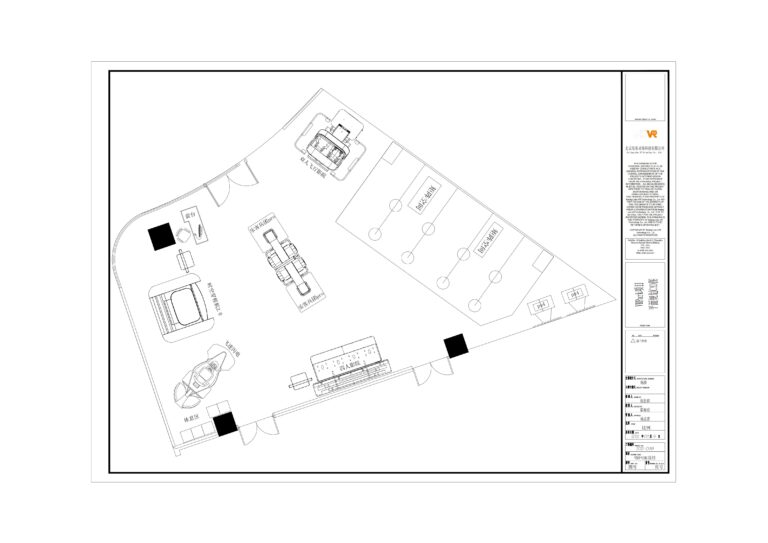
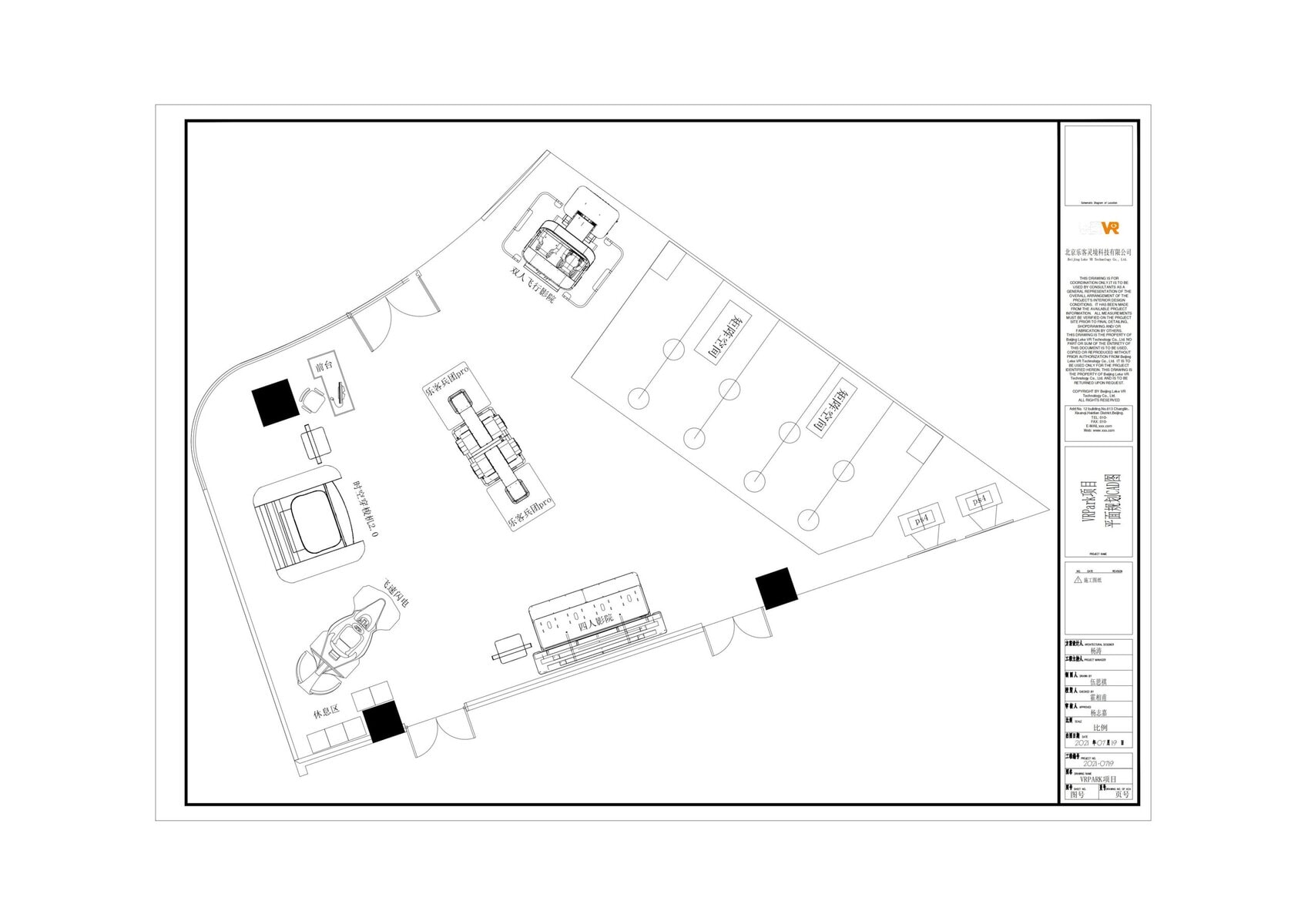
The dimensioned floor plan the layout is built on. The curved wall at the lower left faces the mall corridor; the columns inside the unit are the fixed points nothing can move. Design drawing, not a photograph of a built venue.
What this design resolves
150 m² carries eight attractions, grouped into four zones so no two formats compete for the same guest at the same moment.
The two highest-capacity formats sit deepest in the room, which pulls guests past everything else on the way in.
Nothing blocks the mall frontage, so the unit keeps selling itself to the corridor even at full occupancy.
1. The Constraint: 150 m² Is a Budget, Not a Space
At 150 m² an indoor entertainment venue has roughly the same usable floor as a mid-sized retail unit. That sounds generous until the fixed elements are subtracted. Circulation has to stay clear, escape routes have to be respected, and a queue forming at one machine must not block another. What remains is the area you can actually put attractions on, and it is considerably less than 150 m².
Two features of this particular unit matter more than the total area, and both shape the commercial vr equipment list that follows. The first is the curved wall at the lower left, which bows out toward the mall corridor. The second is the column positions inside the floor; they are structural, they cannot move, and every equipment decision has to route around them.
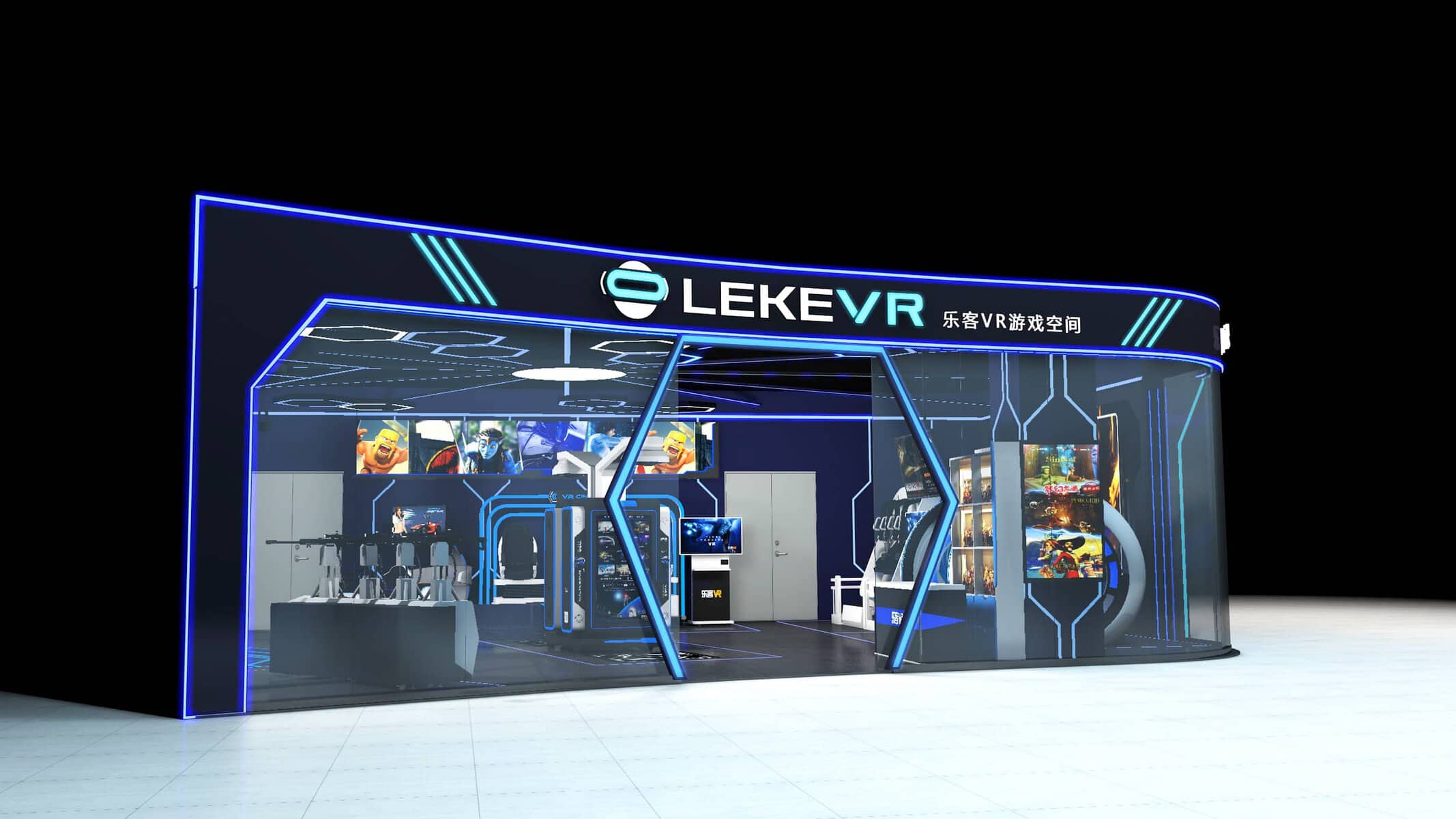
A curve is usually treated as a problem in layout work because it wastes the corners. Here it does the opposite: a curved frontage gives a passing shopper a longer sightline into the room than a straight one would, which is why the design keeps the entire arc clear of machines and puts nothing tall against it.
The rule that follows for a vr cafe. Whatever faces the mall must stay low and open. Whatever is tall, enclosed or slow to load goes to the back. A venue that gets this backwards spends its whole lease apologising to passing traffic it cannot see.
The storefront as proposed, seen from the mall corridor. The curved frontage lets a passing shopper read the whole floor before deciding to come in. Design rendering, not a photograph of a built venue.
2. Four Zones on One Floor
Eight attractions sorted into four zones is what keeps a vr cafe legible. This is the part of family entertainment center equipment planning that a product list cannot do for you. The grouping decides which guests meet which machines, and in what order.
Zone 1 — seating and reception
The counter and the waiting area sit inside the entrance, where they also work as a windbreak. Guests wait here rather than in the aisle, which keeps the mall corridor clear.
Zone 2 — seated motion
The two-seat flying unit, the time-shuttle pod and the speed-racing motorcycle. All three are seated, all three reward a single guest or a pair, and all three sit where they can be seen from the counter without staff moving.
Zone 3 — the self-service row
Two unattended stations running back to back. They absorb solo visitors and overflow without adding a staff position, and their throughput is limited only by how many are installed.
Zone 4 — the group zone
The two four-player standing platforms plus the four-seat cinema at the back. These take groups, they are the loudest formats, and they are deliberately the furthest from the frontage.
The zoning order follows one principle: the closer a format is to the door, the shorter its session. A guest who walks in and commits to a fifteen-minute group experience should walk past the two-minute options first, because some of them will take one instead. A guest who came specifically for the standing platform should be able to reach it without threading through a queue.
It also decides the staff model. With the seated formats and the self-service row placed so that both are visible from the counter, one person can supervise the room at normal load. That is not a small thing in a European market, where labour is one of the largest recurring costs a small venue carries.
On a small floor, the sequence of machines is the business model. The equipment list is just the invoice.
The standing shooting platform in the proposed design, with the self-service row alongside it. This is the highest-turnover zone on the floor. Design rendering, not a photograph of a built venue.
3. The Equipment Mix
Eight units across six product types. A vr entertainment center setup of this shape is specified position by position: the room decides the order, and the order decides what is viable. Each unit below is placed for a reason that can be checked against the plan.
Zone 2 · 2 guests · 8.64 m²
VR Chair 360 — 2-Player
On the drawings this unit is annotated as the two-seat flying cinema; in the product line it is the VR Chair 360 in its 2-player configuration. It sits in the seated zone, and it earns its position twice over. In use it is a two-guest cockpit turning through a full 360° in synchronisation with the content, which makes it a genuine ride rather than a chair with a screen. Between sessions it is the strongest passive advertisement in the room: the rotation is visible through the canopy, so the machine keeps working on passing traffic even when nobody is on it. Its footprint is 8.64 m², the largest single cabinet in the plan, which is why it is placed against the wall rather than in the open floor.
Two guests sit side by side in an enclosed cockpit while a multi-dimensional kinetic base delivers synchronised pitch, bank and vertical drop against a library of 80+ titles spanning coasters, space and undersea content. It is the format that covers the guest the others do not: a couple, or a parent with a younger child, neither of whom wants to compete. In a family-leaning mall that is often the difference between a group staying together and splitting up. At 5.59 m² it packs a full motion experience into very little floor, which matters when the total is 150 m².
The proposed interior, looking across the floor. The cinema pod, the printed floor graphic and the self-service kiosk are all visible from a single position, which is what makes the room runnable by a small team. Design rendering, not a photograph of a built venue.
Zone 3 · 1 guest each · 2.46 m² each
Self-Service VR Stand Station × 2
Two of them, running back to back, and the duplication is the point. The station trades without a staff member: a guest selects a title from the built-in library, pays by card, coin or QR, and plays, with an automated headset lift handling the equipment between sessions. Two units rather than one means the row absorbs both the solo visitor and the overflow when the seated formats are full — and because each occupies only 2.46 m², the second one costs the floor almost nothing.
Two of these, and they are the reason a 150 m² venue can sell to groups. Four players stand on the platform together — cooperating or competing — rather than sitting in separate machines, which is what makes it a group booking instead of four singles. The mechanism that separates it from a static VR booth is underfoot: a motorised dynamic floor tilts, vibrates and shifts in sync with what the players see, so the ground lurches when a scene charges and trembles during an explosion. Headset tethers run through an overhead retraction system instead of snaking across the play floor, which removes both the trip hazard and the wear that ground-level cables suffer. Each arena occupies 16 m² and carries its own library of exclusive zombie-themed titles rather than repurposed consumer games.
The four-seat cinema completes the group-side of the floor. It is the slimmest multi-seat format in its class at just 1,600 mm deep, which is exactly why it fits here: on a 150 m² unit, depth is the scarcest dimension, and a machine that needs less of it frees the floor for the standing platforms. Four seats in a single row, each with its own headset, means every guest has an unobstructed forward view. It requires no structural floor reinforcement, so it can sit on standard commercial flooring.
The eighth and final unit, and the one that gives the room a competitive edge without needing a group. A single rider sits on a low-slung motorcycle posture at 470 kg on a 5.10 m² footprint, drawing 1,750 W from a 220 V supply, and the software matches the screen content to the machine’s physical lean angle in real time — so the bike banks into a corner as the rider leans, rather than replaying a canned sequence. That lean synchronisation is what prevents the motion sickness cheaper motorcycle rigs cause. Its cyberpunk silhouette also makes it the strongest single visual anchor available for the frontage, which is why a machine that seats only one guest is worth the floor it takes.
Design proposals usually list what a floor includes. The more useful list is what it excludes, because those are the decisions that cost the operator something.
No large-format ride
A 54 m² tunnel or arc-screen theatre would take more than a third of the floor and leave no room for the group formats. At this size the client chose breadth over one headline attraction in the vr cafe in the vr cafe, and that is a defensible trade — but it is a trade.
No dedicated party room
There is nowhere to put a birthday group except the floor itself, which means bookings compete with walk-in trade at peak. Larger units solve this with a separate room; here the standing platforms have to double as the group space.
No stockroom or back office
Spare parts, cleaning equipment and a staff area all have to live inside the 150 m². It is worth confirming with the landlord whether any back-of-house space is available before the plan is finalised.
Being explicit about what a vr cafe excludes is not a weakness in a proposal. An operator who finds out at fit-out stage that there is nowhere to store a spare headset has a problem; an operator who was told on page four does not.
5. What to Check Before This Becomes a Contract
A vr cafe layout is a set of assumptions about the building. These are the ones that decide whether a vr cafe of this shape survives contact with the site.
1
Measure the columns, not the area
In a unit this size a single badly placed column can remove one machine position. Record every column against the plan before the equipment list is fixed.
2
Confirm the connected load per machine
Ask for the electrical schedule rather than one total, then check what the unit’s existing supply can carry and where the distribution board sits relative to the planned positions.
3
Walk the escape route with the plan in hand
The standing platforms are occupied floor area with guests on them. Their placement has to leave the required routes clear, which is usually what keeps them at the back of the unit.
4
Check the mall’s signage and frontage rules
Curved frontages often come with restrictions on what may be fixed to them. Confirm this before designing a facade treatment that the landlord will later refuse.
5
Decide the staffing model first
Eight attractions with two unattended stations can be run by a small team, but only if the plan keeps them in one sightline. If the layout cannot achieve that, the equipment list has to change.
The order matters more than the answers. Columns, then routes, then power, then frontage, then staffing. Settling them in this sequence means the plan is redrawn once, not four times.
6. How the Drawing Becomes a Venue
A plan commits nobody on its own, which is why the vr cafe it describes has to be checkable before any money moves. What makes it useful is that it is drawn against the operator’s own dimensions, and that the same team carries it from the drawing to the machines running on the floor.
The sequence on this project was straightforward: unit dimensions and columns first, then the CAD plan and the 3D visualization, then equipment selection against the four zones the plan created. If it proceeds, the same drawings become the basis for manufacture, shipping documentation and the remote installation guidance that commissions the equipment on site.
Two things are worth knowing if you are evaluating suppliers on the same basis. LEKE VR manufactures the equipment and operates its own venues, so after-sales comes from the builder rather than a third party. And the design work is not a paid study: a CAD plan and 3D visualization are produced as standard, and the drawing stays with the operator whether or not the order follows.
For an operator planning a vr cafe, the useful comparison is not which supplier has the largest catalogue. It is whether the supplier will draw against your actual floor — columns, curve and all — and tell you what the space cannot hold, before asking you to commit to anything.
FAQ
Is this venue built?
No. This is a design proposal for a 150 m² mall unit, drawn from the client’s site dimensions. Nothing has been manufactured or installed, and every image in this article is a design drawing or a 3D rendering rather than a photograph of a finished venue.
How many attractions fit in a 150 m² vr cafe?
This plan carries eight, across six product types. Mall entertainment equipment at this density is limited not by the count but by the circulation: as long as every machine opens onto a single route and no queue blocks another station, density is workable. Below roughly 100 m² the group formats usually have to go, because the open floor area they need is no longer available.
What is the difference between a vr cafe and an indoor theme park?
Scale and ambition, mostly. A vr cafe is generally a single mall unit built around breadth — several formats, short sessions, one staff position. An indoor theme park is larger, and can carry a headline attraction such as a 54 m² ride alongside the smaller machines. Both can be profitable; the difference is what the floor lets you offer.
Can an irregular or curved unit be used?
Yes, and a curved frontage can work in your favour. It gives passing mall traffic a longer view into the room than a straight shopfront, which is why this plan keeps the arc clear of tall equipment. What matters is that the layout is drawn against the real geometry rather than adapted from a template.
What does a project like this cost?
The cost of a vr cafe at this size depends on the equipment mix, the floor area and the condition of the unit, so LEKE VR quotes per project rather than publishing a figure for an indoor entertainment venue of a given size. Send the floor dimensions, the column positions and the attractions you are considering, and the team will return a layout with a line-item quotation.
Will the same layout work in another country?
The zoning logic travels; the specification does not. Building regulations, escape route requirements, ceiling heights, labour costs and lease structures differ by market, and any of them can move a machine or remove a format. That is why every layout is drawn against the actual unit rather than reused.
Can the equipment be seen before ordering?
The showroom and factory in Guangzhou are LEKE VR’s own facilities and visits there can be arranged directly. Delivered venues belong to the operators who commissioned them, so access to those is theirs to grant rather than something LEKE VR can arrange on their behalf. Where a visit is not practical, project documentation — layouts, installation photographs and video walkthroughs — is shared instead.
What support comes with the equipment?
LEKE VR provides engineering support online: maintenance questions and fault diagnosis are handled remotely by engineers, video-call guidance covers installation and commissioning, spare parts are dispatched from the warehouse, and content updates are deployed to the machines remotely. Support comes from the team that builds the equipment rather than from a third party.
Send Us the Unit and We Will Draw It
Give us the floor dimensions, the column positions, the clear ceiling height and where the supply enters. We return a CAD plan and a 3D visualization for your vr cafe, with a machine list and connected load per unit — and the drawing stays yours whether or not you proceed.
Turnkey VR Park Solution: A Mall Floor Plan | LEKE VR
Most turnkey vr park solution pages show you equipment photographs and a list of what the supplier can build. What they rarely show is an actual floor plan with dimensions on it — because that is the part that reveals whether the layout will work in your building.
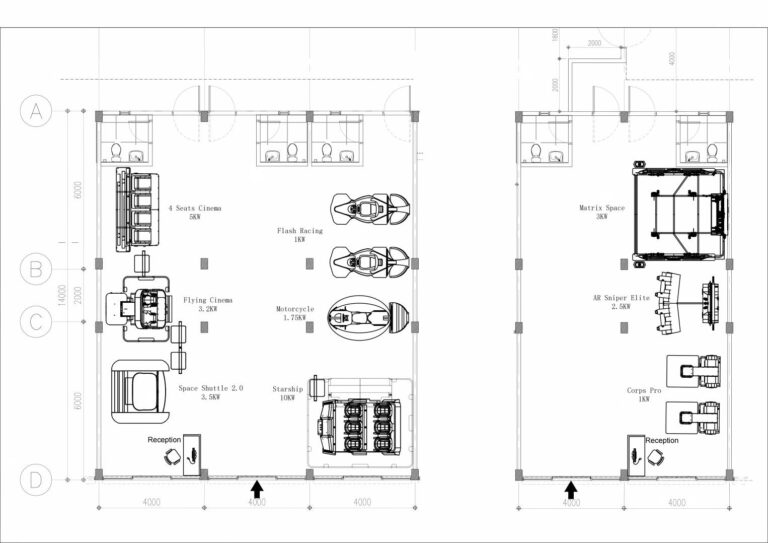
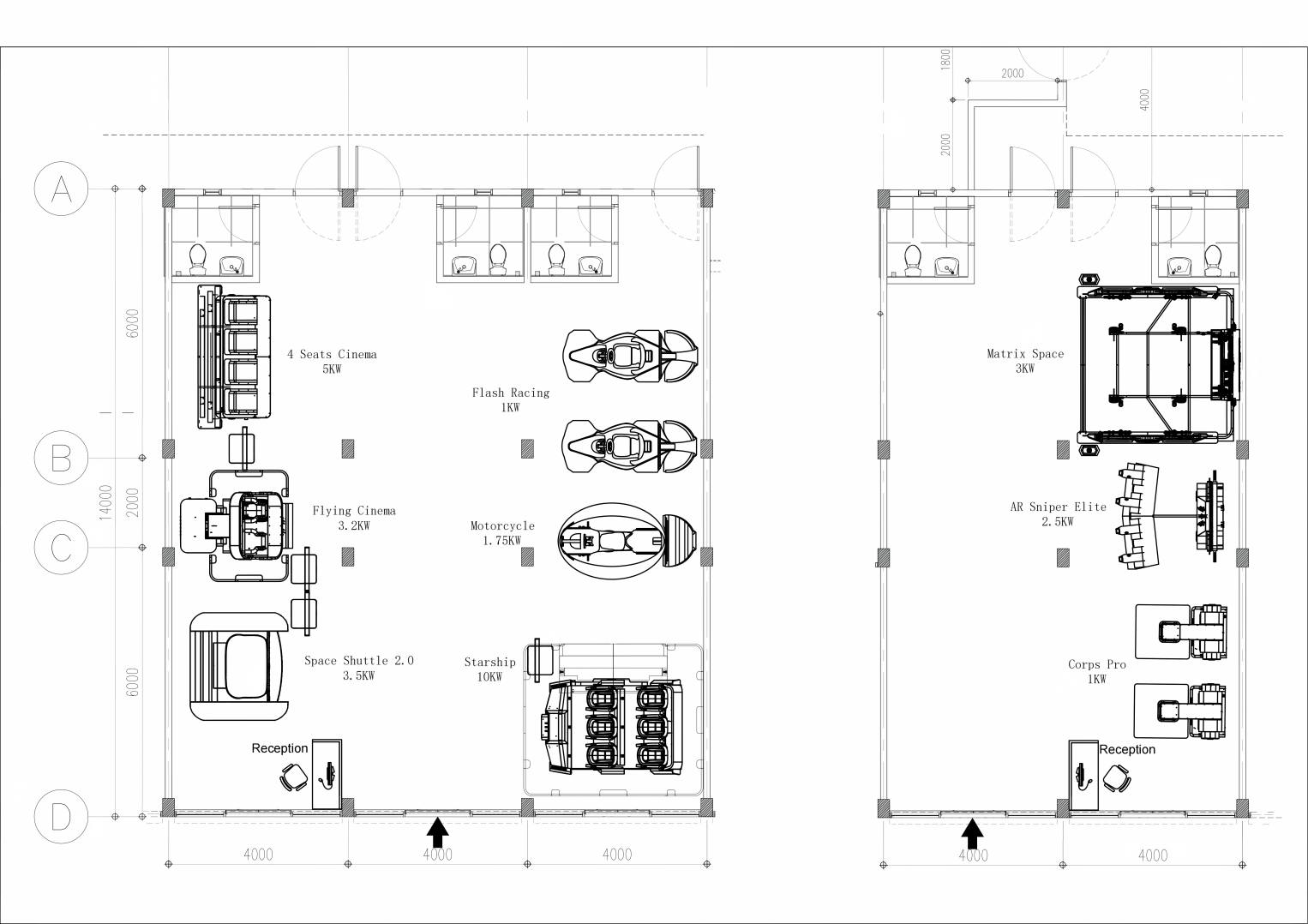
This article publishes one. It is a two-unit mall arrangement designed for a client in the Philippines, redrawn here as a reference plan: two units side by side, eleven machines across them, every dimension and power figure taken from the drawing itself. If you are planning a VR floor, you can read this as a worked example and adapt the logic to your own space.
The reference plan. Two units of 8000 × 14000 mm, each with its own entrance and service counter, separated by a 4000 mm public passage. Equipment names and power ratings are printed on the drawing exactly as they appear here.
2
units, side by side
11
VR machines installed
32.95
KW total connected load
4000
mm planning grid, both axes
Key takeaways
The plan splits eleven machines into two asymmetrical units — seven on one side, four on the other, on identical floor areas. It is the split, not the machine list, that makes this turnkey vr park solution work in a mall.
Every placement resolves to a 4000 mm grid on both axes, which is what makes the layout re-drawable rather than bespoke.
Total connected load is 32.95 KW, and it is not distributed evenly — one unit carries 77% of it. That single fact shapes the electrical plan.
1. Why a Real Floor Plan Beats a Product Catalogue
When an operator evaluates a turnkey vr park solution, the equipment list is the easy part. Anyone can assemble a convincing set of machines on paper. The difficult questions are geometric and electrical: does the mix fit the building, how does traffic move, and how much power has to be brought to the floor?
A dimensioned plan answers all three at once, which is why this article publishes one rather than describing a concept. The client project behind it is a shopping mall in the Philippines, and the arrangement is a common one in that market: two adjacent retail units of the same size, taken together as a single VR entertainment floor.
The value of reading someone else’s plan is not to copy it. It is to see the decisions underneath it — why the heavy machines went to one side, why the two units are not mirrored, and how the 4000 mm grid absorbed all of it without a single custom dimension. Read this way, a turnkey vr park solution stops being a quotation and becomes a design method you can apply to whatever shell you have.
What the plan decides
Without a plan
With the reference plan
Machine count
Estimated from floor area
Counted, with each machine drawn to position
Traffic flow
Assumed
Entry, counter and aisle widths resolved
Electrical load
Summed from datasheets at the end
Known per machine and per unit from the start
Change cost
Rework after delivery
Redrawn on the same grid before anything ships
2. The Two-Unit Format Behind This Turnkey VR Park Solution
Each unit measures 8000 mm across by 14000 mm deep, giving roughly 112 m² of usable floor per side, or about 224 m² for the pair. They sit side by side with a 4000 mm passage between them.
The critical detail is that both units keep their own entrance and their own service counter, facing the mall corridor independently. This single decision does more for the operation than any equipment choice, and it is worth understanding why.
A single large hall with one entrance concentrates all arriving and departing traffic through one point. At peak, that point becomes the bottleneck, and the queue outside the door is a worse advertisement than no queue at all. Two counters running independently double the processing capacity without adding a square metre of floor, and they let the two sides operate on different rhythms — one taking walk-in families while the other runs a booked group.
It also de-risks the lease. If the mall later needs part of the frontage back, or if the operator wants to phase the investment, the two units can be opened in sequence rather than as one indivisible commitment. That flexibility is a product of the layout, not of the equipment, and it costs nothing to build in at the drawing stage — which is the main reason a turnkey vr park solution should always start with the shell rather than with a machine list.
A note on the 4000 mm passage. It is the mall’s public circulation, not part of the leased floor. That matters for two reasons: it gives each unit its own frontage and shop window, and it means the queue for one side does not physically block the other. A turnkey vr park solution that merges two units into one internal hall throws this advantage away, and it is rarely possible to get it back once the fit-out is signed off.
3. The Equipment Split: Seven and Four
The two units are the same size but they are not the same venue. The distribution is deliberately asymmetrical, and the reasoning is the most transferable idea in this plan.
One side carries the seated, high-power, cinematic machines. The other carries the active and competitive ones. Rather than sorting by category for its own sake, the split follows the two fundamentally different ways a guest spends time on the floor — and keeping them apart is what stops the two audiences from interfering with each other.
Unit A — cinematic and seated
Qty
Unit load
4 Seats Cinema
1
5.0 KW
Flying Cinema
1
3.2 KW
Space Shuttle 2.0
1
3.5 KW
Starship
1
10.0 KW
Flash Racing
2
2.0 KW
Motorcycle
1
1.75 KW
Unit A subtotal
7
25.45 KW
Unit B — active and competitive
Qty
Unit load
X-Space Free-Roam Arena
1
3.0 KW
AR Sniper Elite
1
2.5 KW
Corps Pro
2
2.0 KW
Unit B subtotal
4
7.5 KW
Both units also have a service counter near the entrance, so a complete vr park equipment package for this floor is eleven machines plus two counters. Counting the counters matters: they are a purchase line, not an afterthought, and they need power and data brought to the right position on the plan. Group them with the rest of your family entertainment center equipment list rather than treating them as venue fit-out, or they will be the last thing anyone remembers to power.
4. The Logic Behind the Split
The obvious reading is that one side is bigger and busier than the other. The useful reading is about the two kinds of guest the floor serves, and it is the idea most worth carrying into your own turnkey vr park solution.
X-Space — the free-roam multiplayer arena listed as a single 3 KW unit in Unit B. Players wear headsets and move freely across a large open floor area, so several guests take part at once rather than watching in turns. Tracking is trackless — it runs on flat commercial flooring, and the floor graphic is branding rather than a tracking requirement.
Seated cinematic machines hold guests still for the length of a show. Racers, shooters and free-roam arenas keep guests moving, shouting and standing in groups. Put both in one open hall and the quiet experience is ruined by the loud one — a seated guest wearing a headset does not want a competitive arena two metres away. Separating them into two units solves this with architecture rather than with signage or rules.
The split also produces two different dwell patterns that complement each other. The seated side generates steady rotation at a predictable pace. The active side generates fluctuating, group-driven demand and holds people longer because competition extends a visit. One smooths out the other, which makes the whole floor easier to staff than either half would be on its own.
Unit A leads with capacity
The 10 KW Starship and the 4 Seats Cinema are there to move groups through in numbers. Seven machines on this side means the seated rotation never stalls behind a single machine.
Unit B leads with replay
A free-roam multiplayer arena plus two identical shooter platforms. The duplicate pair is not redundancy — it lets two people play the same title head to head, which is what turns a play into a repeat visit.
Both keep their own queue
Two counters on two frontages mean a school group booking out one side does not close the walk-in trade on the other. The floor keeps earning while an event runs.
A mall VR floor is not one attraction. It is two audiences sharing a lease, and the layout should admit that from the first sketch.
5. Reading the Dimensions: A 4000 mm Grid on Both Axes
The plan is drawn on a 4000 mm grid, and the same 4000 recurs on the horizontal axis, on the vertical axis and in the passage between the two units. Nothing on the floor requires a dimension that is not a multiple of it.
That consistency is the reason this drawing is reusable for other sites. A layout built from one module can be scaled down by removing a bay, or extended by adding one, without redrawing the machines. It also means the plan survives a change of mind: swapping a machine later does not break the geometry, because every position is already on the grid. Very few turnkey vr park solution proposals are drawn this way, and the ones that are tend to survive their first year without a layout revision.
The vertical dimension chain runs 6000 / 2000 / 6000 to a total depth of 14000 mm. Read as zones rather than as structure, that is a deep band, a narrow service strip, and a second deep band — which is exactly how the machines are arranged, with the tight middle strip reserved for movement and back-of-house rather than for equipment.
Horizontal: 4000 × 4000 × 4000
Each unit is two bays wide. The centre bay carries the entrance and the service counter, so guests arrive at the middle of the frontage rather than at a corner.
Vertical: 6000 / 2000 / 6000 = 14000
Two deep equipment bands with a 2000 mm service and circulation strip between them. The narrow strip is what allows staff to move behind the machines and guests to cross the floor without walking through a play zone.
Passage: 4000 between units
Public mall circulation. It preserves two independent frontages and two independent queues, and it costs the operator nothing because it is not leased floor.
6. The Power Budget, and Why It Is Lopsided
Total connected load across the floor is 32.95 KW. The distribution is the part that shapes the electrical design: Unit A carries 25.45 KW and Unit B carries 7.5 KW, so roughly 77% of the load sits in one of two identically sized units.
That asymmetry is normal for a mixed floor, and it is precisely the kind of thing an operator discovers too late if the equipment is specified before the plan is drawn. Two units of the same area do not need the same supply, and assuming they do either overspends on one side or leaves the other unable to run its full fleet. Any turnkey vr park solution that quotes a single total load without breaking it down by zone is asking you to carry that risk into construction.
The single largest item is the Starship at 10 KW, which is more than the entire load of Unit B. Its position on the plan therefore matters twice over: it needs the supply brought to it, and it should not sit where a future second unit of the same class would have to share that circuit.
Practical takeaway. Ask for connected load per unit, not for the total. A single floor total tells you whether the site has enough supply. A per-unit figure tells you how to distribute it, which is the number the electrical contractor actually needs.
7. How to Adapt This Plan to Your Own Building
If your site is one unit rather than two, or larger than 112 m² per side, the logic still applies. What changes is which decisions you make first. A workable order for a vr entertainment center setup looks like this.
One additional note on specification order. Mall entertainment equipment is usually procured on a timeline set by the lease, and the electrical upgrade is the item with the longest lead time. Decide the machine mix early enough that the supply work can start before the shopfront is stripped, and the whole project compresses. A turnkey vr park solution is only genuinely turnkey if that sequence is planned in advance rather than discovered on site.
1
Measure the shell, not the area
Record column positions, ceiling height, door and service positions and any structure you cannot move. Area alone will not tell you whether the plan fits.
2
Set a planning module before choosing machines
Pick a grid — 4000 mm works widely — and keep every position on it. This is what makes the layout extensible later.
3
Separate seated from active
Even inside one hall, use a wall, a change of level or a distance to keep headset experiences away from competitive ones. Do not rely on signage.
4
Duplicate where competition is the product
Two of the same machine lets two guests play against each other. If replay matters to your model, budget for pairs rather than for variety.
5
Check the supply before the order
Connected load per unit, brought to the correct position on the plan. A building that cannot deliver it changes the equipment mix, not the other way round.
6
Keep the frontage count
One counter per frontage. If you have two ways in, run two points of sale — it is the cheapest throughput upgrade available at the design stage.
8. Where the Plan Comes From
LEKE VR draws the arena on the operator’s own floor plan before anything is ordered, and the drawing is handed over whether or not the project proceeds. That is how this plan was produced: from the client’s real unit dimensions in the Philippines, with the equipment mix and the power budget resolved together rather than sequentially. It is also what separates a genuine turnkey vr park solution from a quotation with a layout attached to it afterwards.
The same team covers the venue layout, the manufacturing, the export documentation, the installation and the operator training, so the plan that gets drawn is the plan that gets built. Where a floor spans several equipment families — cinema, racing, shooting, free-roam — they are planned as one layout instead of being assembled from separate suppliers and reconciled on site.
Because LEKE VR also operates its own venues, the layouts are developed against floors that are actually trading rather than against a showroom. Certification covers ISO 9001 quality management and CE marking, with RoHS and FCC compliance and a TÜV Rheinland test report on file, and spare parts ship from the Guangzhou Nansha hub, typically within three to seven business days. For an operator comparing turnkey vr park solution proposals, the useful question is not what a supplier can build, but whether they have run a floor like the one they are drawing for you.
FAQ
What should a turnkey vr park solution include?
A layout drawn on your real floor plan, a machine list with quantities and per-unit connected load, the service counters, and the compliance documents your market requires. In this reference plan that means eleven machines, two counters and 32.95 KW of connected load across two units.
How much floor space does this turnkey vr park solution need?
The reference plan uses two units of 8000 × 14000 mm, about 112 m² each and 224 m² for the pair, plus the public passage between them. Single-unit layouts work at smaller areas with a reduced machine count.
How much power does an eleven-machine VR floor require?
This plan totals 32.95 KW connected, split 25.45 KW in the cinematic unit and 7.5 KW in the active unit. Ask any supplier for the per-unit figure, not only the total, because the distribution decides the electrical design.
Can the two units share one entrance?
Physically yes, but it costs throughput. Two frontages with two counters double the processing capacity and let one side run a booked event while the other keeps taking walk-ins.
Does a commercial VR floor need construction work?
The machines themselves sit on the existing floor. What the building needs is the connected load brought to the correct positions, the ceiling height the taller units require, and the floor loading checked for upper-level sites.
Why does this plan duplicate two machines instead of adding variety?
Because head-to-head play is what generates repeat visits. Two identical shooter platforms let two guests compete on the same title, which a single unit of each type cannot do.
Can you draw a plan for my own floor?
Yes. Send the unit dimensions, the ceiling height, the structures you cannot move and the position of the existing supply, and the layout is drawn on your plan before any commitment. You keep the drawing either way.
Have the Floor Plan Drawn on Your Own Unit
Send us the unit dimensions, the ceiling height, the columns you cannot move and where the supply enters. We return a layout, a machine count with per-unit connected load, and a line-item quotation — and the drawing stays yours whether or not you proceed.
Search for “vr arcade” and you will find two kinds of content: glossy renderings of 500㎡ mega-venues, and forum threads asking whether a small VR zone can actually make money. This article is neither. It is a data-backed, square-meter-by-square-meter revenue model for a 50㎡ virtual reality experiences zone—the kind you can install inside an existing shopping mall, a supermarket retail strip, or an airport concourse. No overexpansion. No $500k gamble. Just a disciplined spatial architecture, a three-zone revenue layering strategy, and the throughput numbers to underwrite the investment. If you have ever searched for vr examples of compact, profitable setups—or wondered whether a rec room can evolve into a micro-entertainment hub—this is the blueprint.
Focus Keyword
vr arcade
Reading Time
12 minutes
Model Coverage
50㎡ · EU & SEA · CAPEX-to-Payback
Why 50㎡ Is the Strategic Sweet Spot for a VR Arcade
If 30㎡ is the entry-level precision format—compact, low-overhead, but fragile—then 50㎡ is the controlled scale model. It is the smallest footprint that unlocks what makes a vr arcade structurally profitable: revenue layering. At 30㎡, every machine must multitask; revenue is dependent on peak utilization; one machine going down can collapse the day’s income. At 50㎡, you can introduce dedicated zones, separate traffic types, engineer price differentiation, and smooth volatility.
A 50㎡ virtual reality experiences zone is:
✓Large enough to support multiple revenue streams simultaneously, introduce structured queue management, create visible attraction in malls, and offer pricing tiers.
✓Small enough to operate with 1–2 staff, maintain cost discipline, and avoid high-risk rent commitments.
Key Insight: 50㎡ is not about cramming more machines into a bigger room. It is about revenue layering—the difference between a machine cluster and a micro-entertainment hub. Among available vr examples, the 50㎡ model stands out as the format that balances investment discipline with revenue diversification. Explore LEKE VR’s compact zone solutions →
The Three-Zone Revenue Architecture
A stable 50㎡ VR zone does not succeed by accident. It succeeds because the equipment is organized into three distinct revenue zones. This separation prevents queue bottlenecks, revenue cannibalization, and underutilization during slow hours.
Revenue models live or die on throughput assumptions. Below is a blended utilization model assuming 5-minute sessions, 1-minute reset windows, and 55% blended utilization across a standard operating day:
Payback analysis (conservative): At a net margin of 30–40%, the European/North American scenario yields approximately $20,000–27,000 monthly net—4–6 month payback under stable traffic. The Southeast Asian/Middle Eastern scenario typically sees 6–10 month payback. These are conservative estimates based on reference data; actual performance depends on location quality, staffing efficiency, and content refresh cadence.
Strategic Insight — Why 50㎡ Outperforms a Traditional Rec Room: Three structural reasons. (1) Short 5-minute sessions with 1-minute resets create throughput density that passive entertainment cannot match. (2) Multi-layered pricing allows the same 50㎡ to extract different revenue rates from different customer segments simultaneously. (3) Group psychology—when a 4-seat cinema fills, bystanders are more likely to join the VR chairs or shooting unit rather than walk away, creating a self-reinforcing occupancy loop. A rec room filled with static gaming stations cannot replicate this dynamic because each station is a silo. A well-designed VR zone behaves as an ecosystem. Explore LEKE VR’s compact zone solutions →
Scaling Logic Beyond 50㎡
If a 50㎡ zone stabilizes for six or more months with consistent weekend throughput, the expansion path is not “double the floor space.” It is targeted scaling of what already works:
✓Duplicate the cinema — a second 4-seat unit doubles the highest-throughput zone without changing the operational workflow.
✓Add a second premium simulator — a 6DOF racing platform alongside the existing 3DOF unit creates a premium head-to-head tier.
✓Create a group party package — bundle Zone A + Zone C into a fixed-price group experience for predictable weekend revenue blocks.
Avoid: jumping directly to a 150㎡ arena without traffic proof. The discipline of 50㎡ is not a limitation—it is a verification stage.
How much does it cost to set up a 50㎡ VR arcade, and how long is the typical payback period?+
Total CAPEX for a commercial-grade 50㎡ vr arcade ranges from approximately $75,000 to $115,000, covering a 4-seat VR cinema, three VR chairs or standing platforms, one racing simulator (such as the LEKE VR 3DOF Racing Simulator), one compact shooting unit, and installation. Monthly OPEX (rent, 1–2 staff, utilities, maintenance) runs approximately $4,500–9,000 depending on location. Under conservative assumptions with stable traffic, European/North American markets typically see a 4–6 month payback; Southeast Asian/Middle Eastern markets 6–10 months. Every location is different, and LEKE VR builds a customized projection during site assessment. Request a CAPEX estimate for your location →
What equipment should I put in a 50㎡ VR zone to maximize revenue per square meter?+
The optimal 50㎡ configuration follows a three-zone revenue architecture: Zone A (18㎡) — a 4-seat VR cinema as the group anchor and visual billboard; Zone B (10㎡) — three VR chairs or standing platforms for high-turnover solo plays; Zone C (6㎡) — one racing simulator as the premium upsell tier; plus a compact shooting unit (6㎡) as flex/overflow. At 55% blended utilization, this processes 48–50 plays per hour across four pricing tiers, yielding approximately $6.60/hr per square meter in revenue density. Explore the recommended racing simulator →
What kind of VR experiences generate the highest throughput in a compact commercial zone?+
Among available virtual reality experiences for compact commercial venues, three categories consistently deliver the strongest throughput-to-footprint ratio: (1) multi-seat immersive cinemas — zero skill barrier, 5-minute sessions, processes 4 guests simultaneously; (2) solo VR chairs or standing platforms — fast rotation, impulse-friendly, fills gaps between group sessions; (3) motion racing simulators — lower hourly play count but highest per-session ticket price, functioning as the premium tier that lifts the blended revenue rate. The key is combining all three in a zone architecture that prevents bottlenecks and revenue cannibalization. Tour the X-Space group anchor platform →
A 50㎡ vr arcade is not about being bigger than 30㎡. It is about layered revenue, operational resilience, price segmentation, and space engineering. When designed properly—with a three-zone architecture that separates group anchor traffic from solo impulse plays and premium upsells—it behaves like a micro-entertainment hub, not a machine cluster. Among the available vr examples for operators evaluating their first or next move, the 50㎡ model stands out as the format that best balances investment discipline with revenue diversification. One manufacturer. One accountable partner. A zone model that works from day one.
Core VR Solutions
Explore More Commercial VR Attractions
A complete ecosystem for your VR business, manufactured in our certified factory.
Get a Tailored Quote for the 4-Seat 9D VR Cinema Simulator – Compact Immersive Experience for Arcades
Share your floor plan dimensions, target country and budget. Our solutions team returns a tailored equipment mix, 3D venue layout and revenue projection. No cost. No commitment.