

Mixed reality · Model 2367
Commercial VR racing simulator — car-shaped motion rig
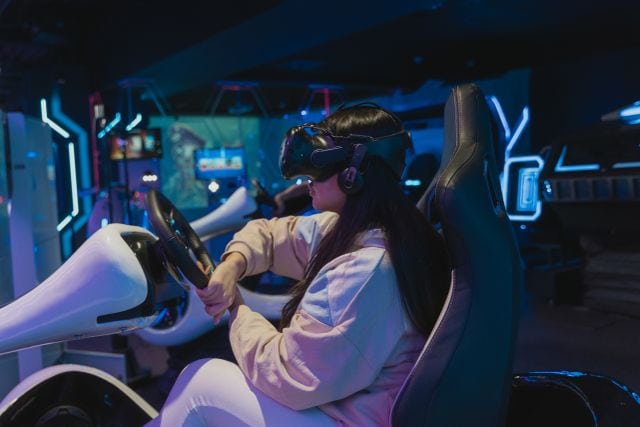
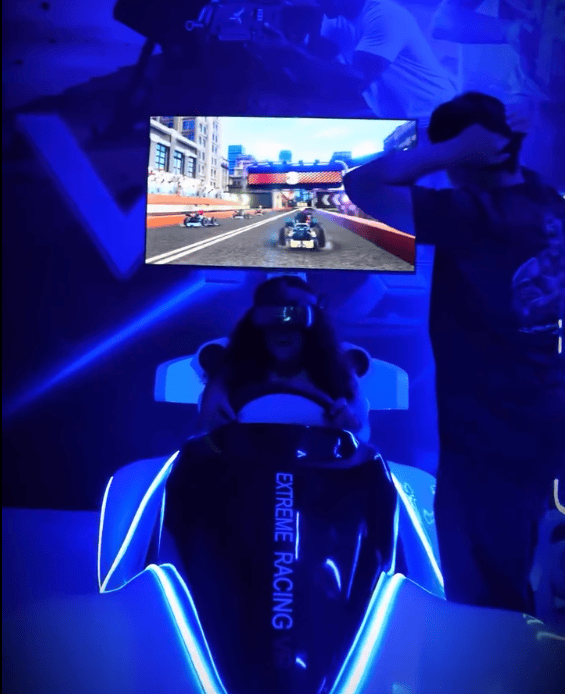
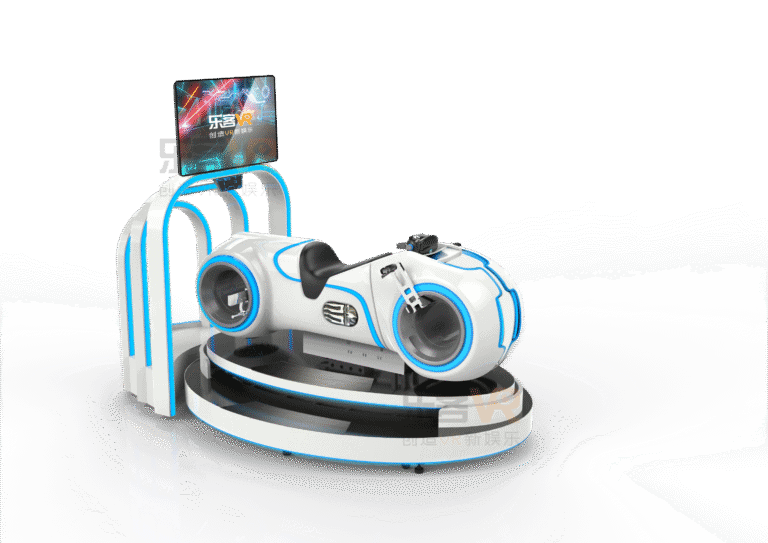
A single seat inside a body shaped like a small car, with a display panel built into the unit. A guest sits down, puts on the headset and races; people standing nearby watch the same race on the screen mounted on the car.
The chassis tilts and pitches with the car on screen rather than replaying a fixed motion file. Two or more units can be networked into one race, so a pair of friends compete against each other and a lone guest is matched with another seat.
- Car-shaped body. Reads as a vehicle from across the floor, not as a cabinet.
- Onboard display. The race runs on a screen on the unit, so bystanders can follow it.
- Self-service. Voice onboarding takes the guest from login to launch.
01 / Overview
What a commercial VR racing simulator is
A racing simulator is a fixed unit, not a vehicle. Nothing drives across the floor: the guest sits in a seat, the motion chassis moves under them, and the race runs in the headset. That is why it needs 3.45 m² rather than the floor area a kart fleet needs, and why it is usually the first racing product a venue buys.
The body is the part that does the selling. It is moulded to look like a small car rather than an arcade cabinet, with lighting across the shell and a display panel mounted on the unit that shows the race to anyone standing nearby. The commercial version differs from a home rig in three places: the body is built to survive public use, onboarding runs without an operator, and several units can be networked so guests race each other.
| What it is | A single-seat racing unit with a car-shaped body, an onboard display and a motion chassis. |
| Who rides | One guest per unit; two or more units race together over the network. |
| Motion | Chassis tilt and pitch driven by the physics engine. |
| Onboard display | Shows the race to bystanders, so the unit draws a crowd while it works. |
| Footprint | 3.45 m² at 303 kg. |
02 / Watch a session
A guest, from login to the chequered flag
The clip shows a unit in use on a public floor: guest seated, headset on, voice prompts stepping through the start, then the race with the chassis moving under the car on screen. Watch what happens around the unit as well — the onboard display gives the people waiting something to follow, which is why these units hold a queue better than a screenless cabinet.
The cycle runs as follows.
03 / Body and display
The car-shaped body, the screen on it, and the chassis underneath
The body is a moulded fibreglass shell shaped like a compact racing car, with configurable colour and LED lighting across it. In a mall it does the job a sign cannot: from the corridor it reads as a moving car rather than a game machine, which is the main reason it is placed facing the walkway.
The display panel mounted on the unit shows the race as it happens. That panel is doing commercial work, not just decoration: a guest waiting for a turn can see the track, the position and the crash, so the queue stays engaged and a passer-by stops to watch. It is also what makes the unit work as a pair, because the second guest can see what the first is doing.
Under the body, the chassis tilts and pitches in step with the physics engine rather than replaying a canned file. A fixed sequence repeats the same movement regardless of how the guest drives, and regulars notice within a couple of sessions; motion that follows the car stays consistent with what the guest did on the wheel.
Car-shaped shell
Moulded fibreglass body with configurable colour and lighting.
Onboard display
Shows the race to the queue and to passers-by on the floor.
Physics-driven motion
Tilt and pitch follow the car, not a looping animation.
303 kg chassis
Weight is what keeps the unit planted through the motion range.
04 / Space and power
Footprint, weight and supply
The unit measures 1,240 mm wide, 1,980 mm deep and 2,470 mm high, giving 3.45 m² of floor and 303 kg of load. The height is the number that catches people out: the body stands 2.47 m tall, so the position needs clear headroom and the delivery route has to take the unit as shipped.
Power is one 220 V supply at 1,000 W per unit. Where two or more are networked, plan the power drops and the network run together rather than adding the second unit later; the electrical design is signed off by your licensed electrician, and we supply the load figures.
Send the position
Floor area, headroom, delivery route and power position.
We confirm the fit
Clearance for boarding, the display sightline and the seat travel.
Order and production
Body colour, lighting and title selection fixed at order.
Delivery and commissioning
Positioned, powered, networked if required, then handed over.
Placement examples are on the solutions page, including racing zones built from several units.
05 / Titles and multiplayer
Titles, tracks and networked racing
Two racing titles ship installed, each with several track models, vehicle types and in-race power-ups. Several units can be networked into the same race, so friends can be matched against each other and a single guest can be paired with the next unit instead of racing alone.
Results are shown at the end of the run and can also be pushed to a venue display, which turns a row of units into something an audience can follow. Content updates are deployed remotely, so a title refresh does not require a service visit. Title and track selection is confirmed at the quotation stage.
Specification
| Model | 2367 |
| Dimensions | 1240 × 1980 × 2470 mm (W × L × H) |
| Weight | 302 |
| Riders | 1 |
| Footprint | 3.45 |
| Power | 220 V, 1,000 W |
| Display | DEEPOON E4C |
| Content | 2 racing titles, multiple track models, vehicle types and in-race power-ups |
| Output | Race results on the onboard display; can also push to a venue screen |
| Certification | ISO 9001:2015 · CE · FCC · RoHS, by model and destination |
| Lead time | Stated on the quotation |
| Shell colour | Blue, white or black; custom available |
06 / Commercial
What the quotation includes
Comparative quotes in this category are rarely like for like, and the difference is usually in the second column. Both lists are given before any figures are compared.
From LEKE VR
- The unit, the motion chassis and the car-shaped fibreglass body
- The onboard display panel and the headset
- The two racing titles with their track models
- Export packing, documentation and delivery to port
- Installation, calibration and staff handover
- Remote content updates, diagnostics and spare parts from our own stock
Budgeted on your side
- Freight, insurance and import duty to your market
- Floor preparation or any local building work
- Local electrical supply and its certification, signed off by your electrician
- Any large venue screen
- Queuing rail, signage and decor
Structural questions remain with your structural engineer and electrical questions with your licensed electrician. We supply the drawings and load data they need.
Quality management is certified to ISO 9001:2015, with CE marking and RoHS and FCC compliance by model and destination. Certificates and test reports are available on request.
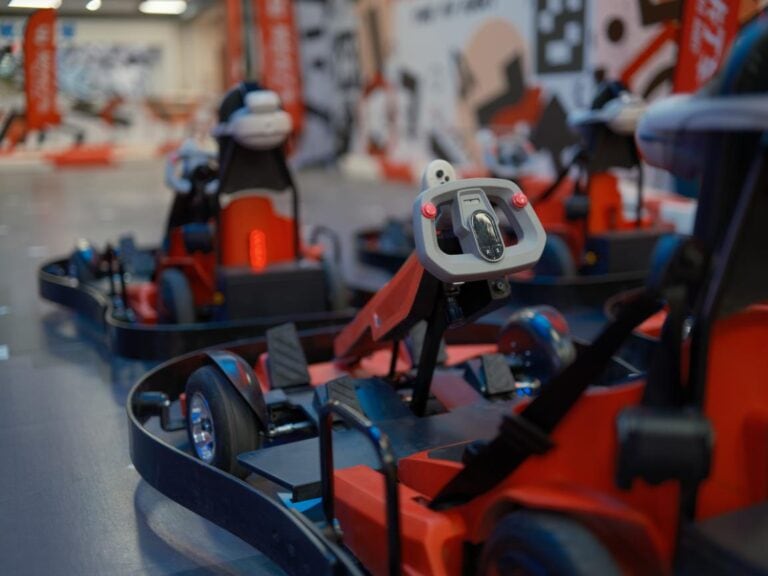
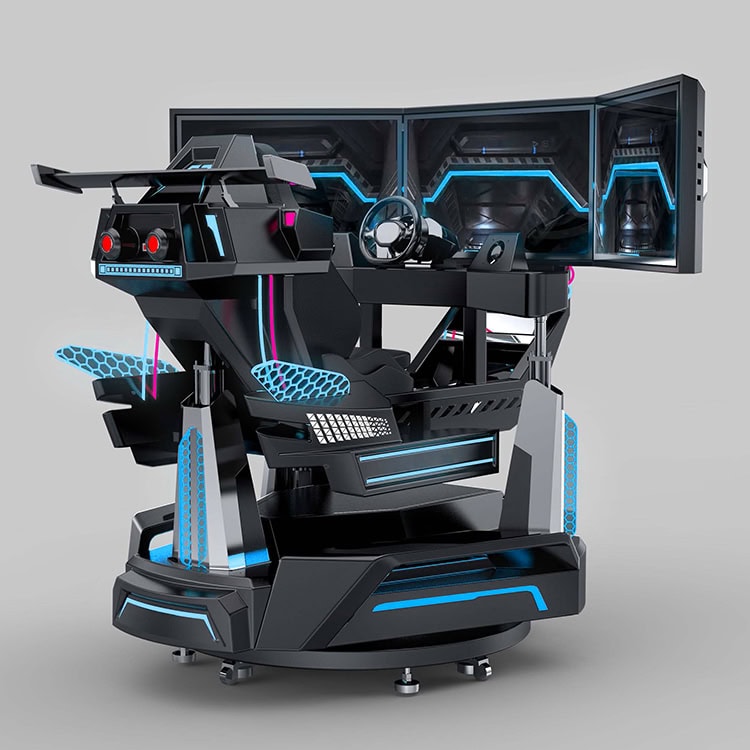
Our showroom and factory in Guangzhou can be visited. Projects listed below belong to operators, so access is theirs to grant. If a visit is not practical, we work from your floor plan instead. The rest of the range, including the mixed-reality kart fleet and the 3DOF triple-screen simulator, is listed under commercial VR products.
Reviews
What operators say about the racing simulator
Swipe to see more →
The body stands 2.47 m tall, so the headroom and the lift decide a site, not the 3.45 m² floor area.
We networked two units and the queue doubled. Guests book in pairs now instead of taking turns alone.
The screen on the body is what makes the queue wait. People watch the crash while they queue for their own turn.
Onboarding really does run without staff. We still keep someone nearby to hand out headsets on busy weekends.
Projects
Solutions we build
Swipe to see more →
 50㎡ VR Zone Revenue Model: Scaling Profit Without OverexpansionFloor plan & case →
 VR Arcade Equipment for an 80–100 m² Venue: A 5-Unit Bundle with VR Racing Kart | LEKE VRFloor plan & case →
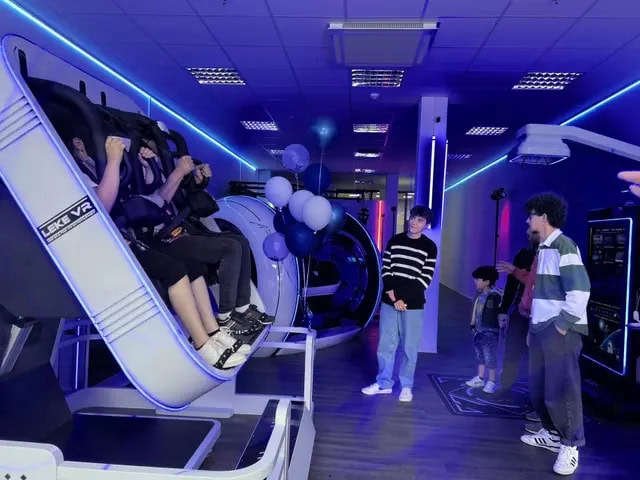 Virtual Reality Services: Germany VR Game Center Case | LEKE VRFloor plan & case →
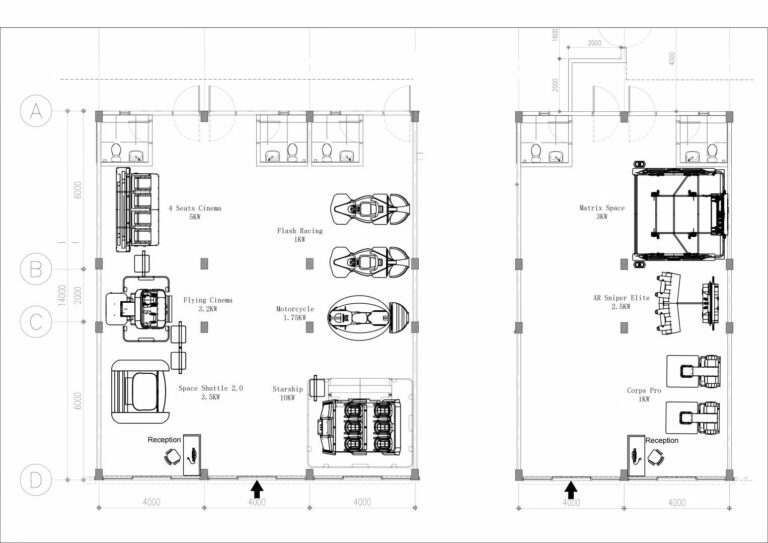 Turnkey VR Park Solution: A Mall Floor Plan | LEKE VRFloor plan & case →
More machines
Elsewhere in the range
Swipe to see more →

Where it goes
Where this machine is usually installed
Suited to family entertainment centres, shopping-mall units, e-sports halls, theme parks and standalone venues.
Layout, access and power are confirmed against your floor plan before the order is placed, so a site is not ruled out until the plan has been checked.
07 / Questions
Questions operators ask
How many people can race at once?
One guest per unit. Two or more units can be networked into the same race, so friends compete against each other rather than a clock.
What is the screen on the body for?
It shows the race as it happens, so the queue and passers-by can follow it. It also lets a second guest see what the first is doing.
What does the motion actually do?
The chassis tilts and pitches in step with the physics engine, so the movement matches what the guest does with the wheel rather than replaying a fixed sequence.
Does it need an operator to run?
No. Voice onboarding and the self-service dashboard take the guest from login to launch, so staff stay on the counter and the queue.
What headroom does it need?
About 2,470 mm, plus clearance for boarding. The body arrives assembled, so the delivery route has the same constraint.
What power supply does it need?
One 220 V connection at 1,000 W per unit. Where two are networked, plan both drops and the network run together.
What titles are included?
Two racing titles, each with several track models, vehicle types and in-race power-ups.
What support is included?
Remote content updates, remote diagnostics, video support while staff are on the floor, spare parts from our own stock, and after-sales maintenance.
Next step
Send the position, not a wish list
Send the floor area, the headroom and the delivery route. We confirm the fit, the power supply and whether a second unit should be networked in.
LEKE VR · Guangzhou Leke VR Technology Co., Ltd. · Guangzhou, China · contact
Figures come from the build sheet and commissioning records for this model and from our own venues. Maintained by the LEKE VR product team in Guangzhou and revised when a number changes.