

VR Entertainment Centers: Turnkey Setup Guide — Real Plan, Real Store, Real Reference
You want to open a vr entertainment center. You have searched for vr examples. You have browsed equipment catalogs. But three questions keep you from signing anything: how do these machines fit together on a real floor plan, how long until the investment pays back, and who handles support when something stops working three months after opening? This article answers all three. It takes you through the CAD design, the equipment matrix, a simulated ROI model, and the real on-site photographs of a LEKE VR store already operating inside a shopping mall in Tianjin, China — built on a right-triangle floor plan that most landlords would call “difficult to lease.” Spoiler: it works.
Store
Tianjin Jinyu Jiapin Mall
Floor Plan
Right-Triangle · ~150㎡
Equipment
6 LEKE VR Products
Focus Keyword
vr entertainment centers
Why Traditional FECs Are Losing Ground — and Where the Opportunity Is
Walk into a typical family entertainment center in 2026 and you will see the same three revenue engines that have been running for twenty years: ball pits and climbing structures (large footprint, fixed per-hour revenue), token-redemption arcades (shrinking audience as mobile gaming captures casual play), and bumper cars or mini-karting tracks (permanent floor modifications, rigid layout, impossible to relocate). These formats share one structural weakness: the experience is static. A ball pit is the same ball pit on the hundredth visit as it was on the first. There is no content update pipeline. There is no seasonal refresh. There is no new reason to come back. This is where a well-designed vr theme park or vr amusement park concept fundamentally changes the unit economics.
A vr entertainment center powered by LEKE VR replaces static physical infrastructure with software-defined experiences. The same VR Arena floor area that houses a free-roam shooter today can deliver an entirely new game title next quarter without moving a single cable. The AR Shooting bay can switch its twelve built-in games seasonally. The 2-Seat 9D Cinema and 360° VR Chair load new immersive film content on a quarterly update cycle. This is not a collection of arcade machines bolted to a floor. It is a content platform disguised as a retail space.
The Floor Plan Decoded — How a Right-Triangle Store Becomes a Fully Zoned VR Center
Most equipment catalogs assume you have a perfect rectangle. Real commercial leases rarely deliver one. The Tianjin store occupies a right-triangle unit with the hypotenuse facing the mall’s main pedestrian corridor. Instead of fighting the shape, the LEKE VR spatial design team used the triangle’s geometry to create four naturally separated functional zones, each with a distinct revenue role. Below are the actual CAD 2D floor plan and C4D 3D rendering produced during the design phase — the same documents every LEKE VR partner receives before a single piece of equipment is manufactured.
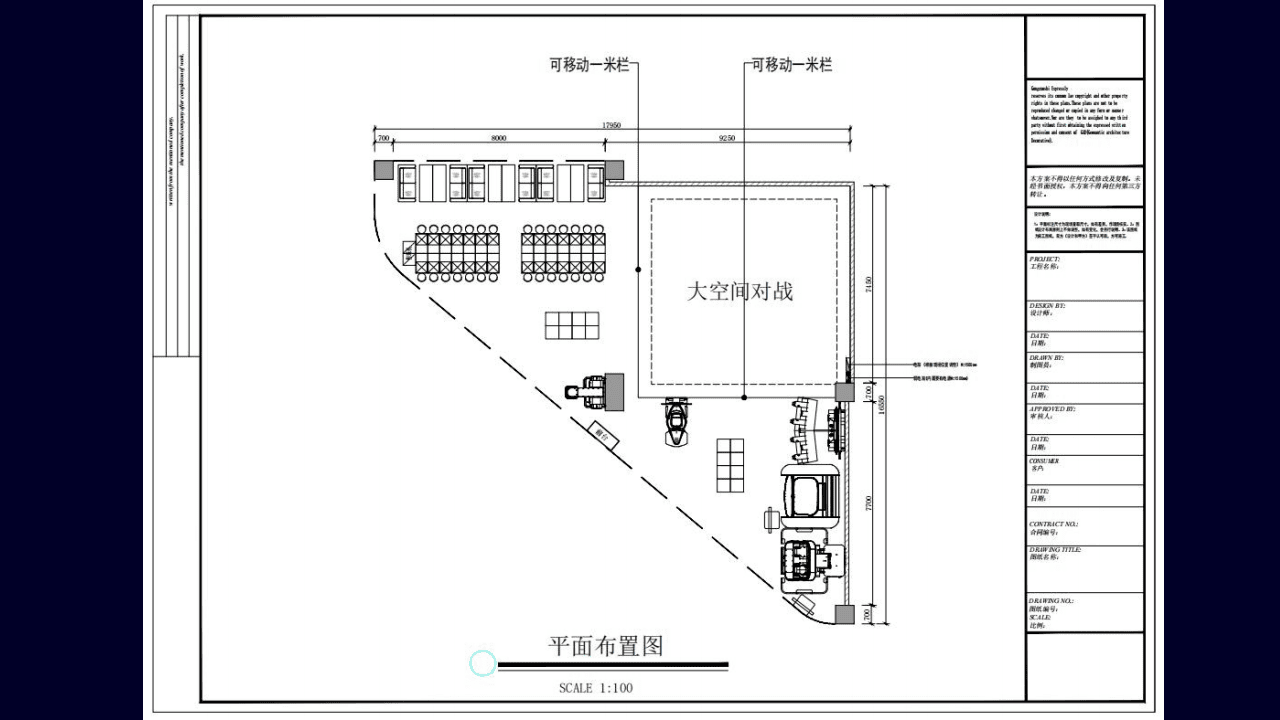
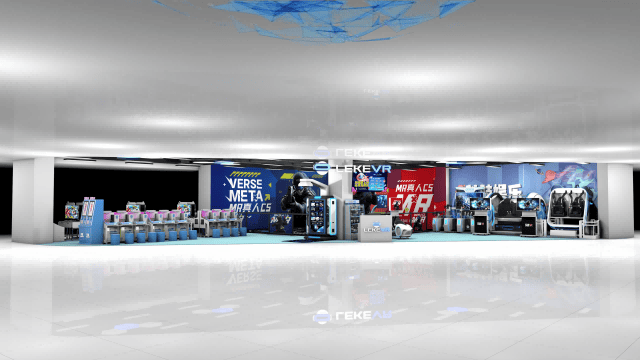
Design Principle: The right triangle is not a problem to solve. It is a zoning advantage. The hypotenuse is the longest single edge, maximizing storefront exposure. The right-angle corner — where two solid walls meet — provides a natural enclosure for the largest attraction (VR Arena at 9,250 × 7,460mm) without needing additional barriers. The two legs create a natural progression path that carries guests deeper into the experience. LEKE VR’s spatial design team produces a custom CAD floor plan and C4D 3D rendering for every partner venue — these are standard deliverables, not upsells. Inquire about a custom floor plan for your venue →
Equipment Matrix — The Six Products That Power This Store
Six LEKE VR products deployed across four functional zones. Below is the complete equipment matrix with product page links:
Case Study — A Fully Operational LEKE VR Store at Tianjin Jinyu Jiapin Mall
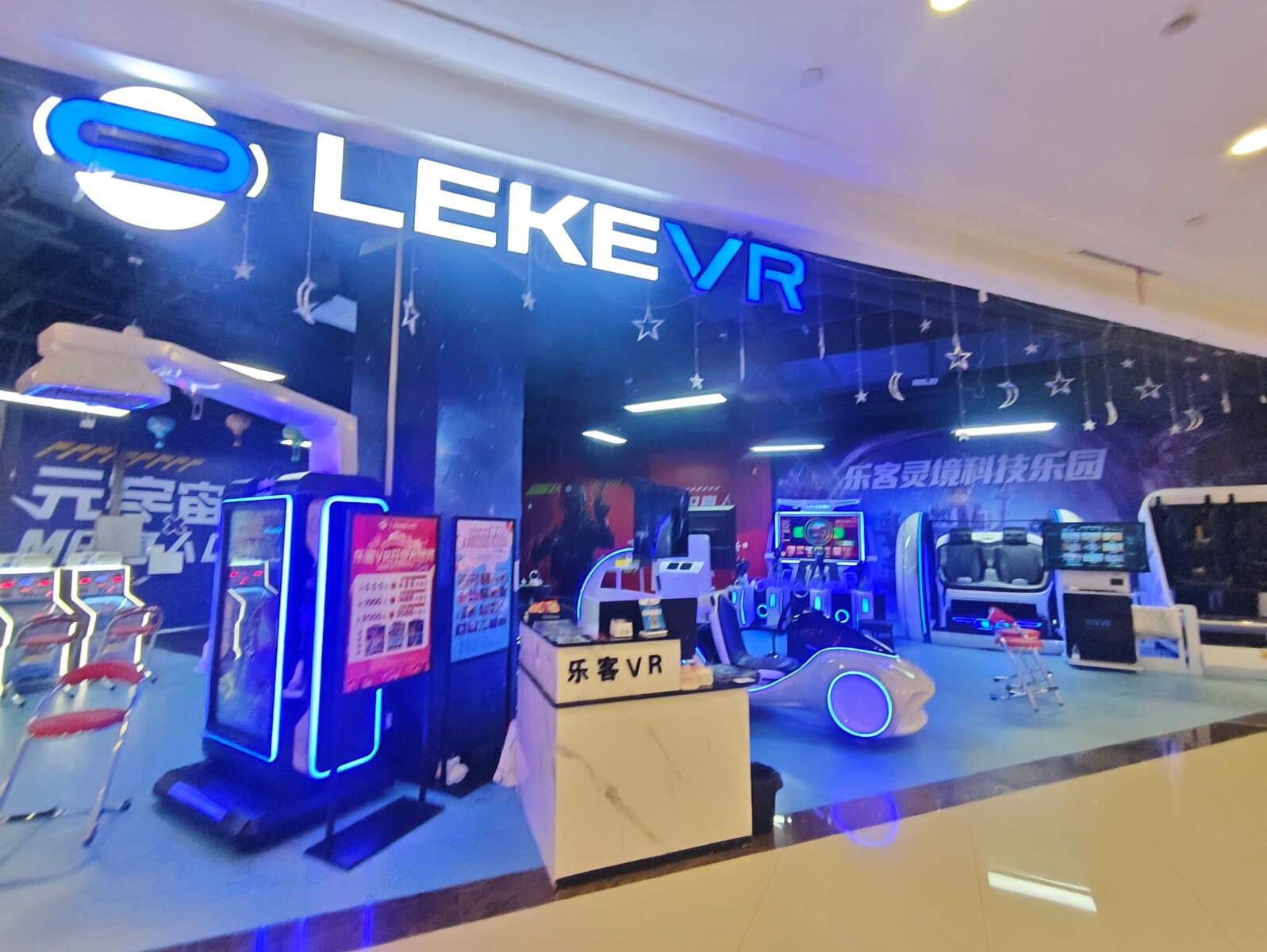
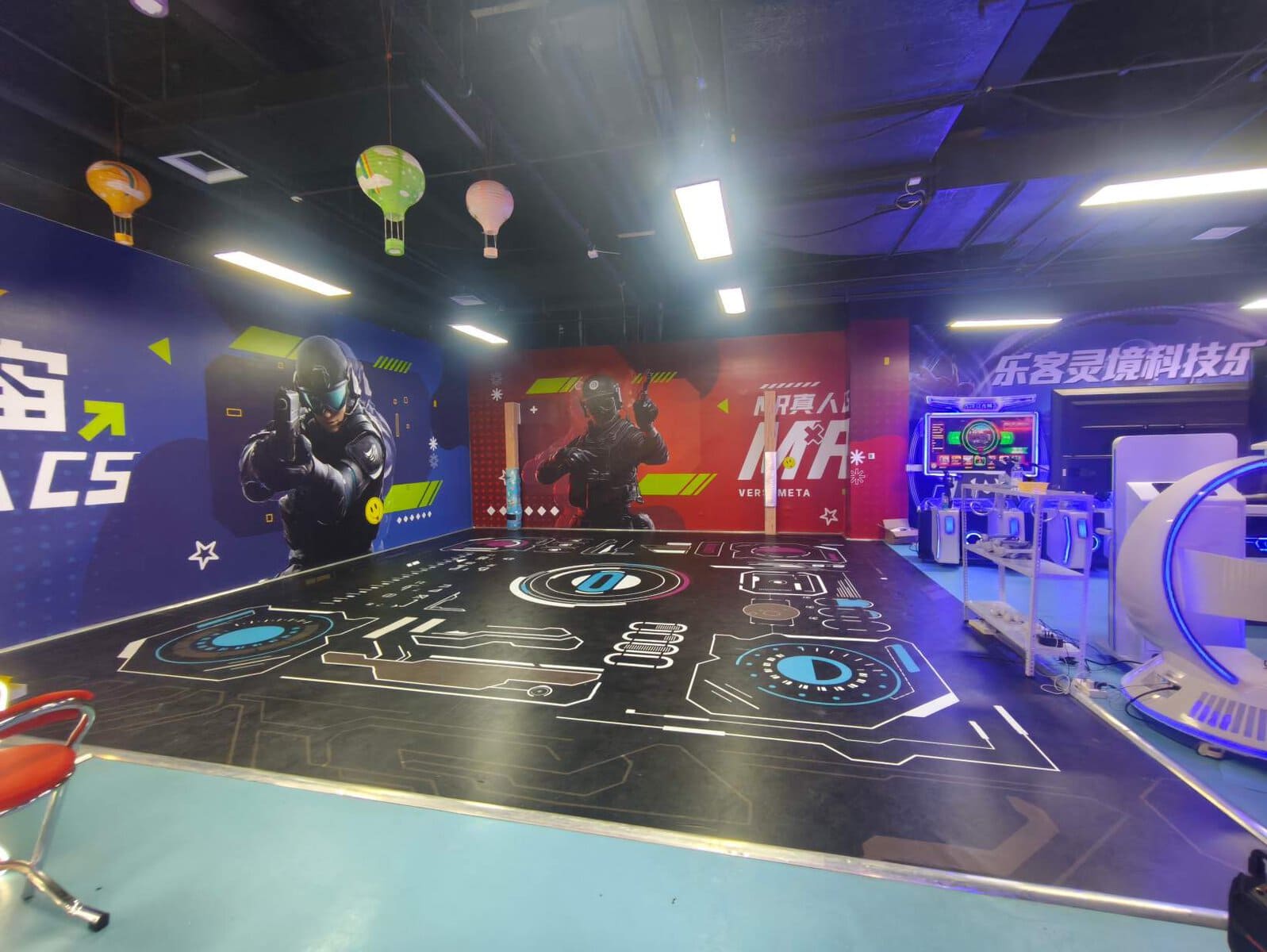
The following photographs are not renderings. They were taken inside the Tianjin Binhai Jinyu Jiapin Mall LEKE VR store — a right-triangle commercial unit currently in operation. Compare each photograph against the CAD and C4D documents above: the finished store matches the plan.
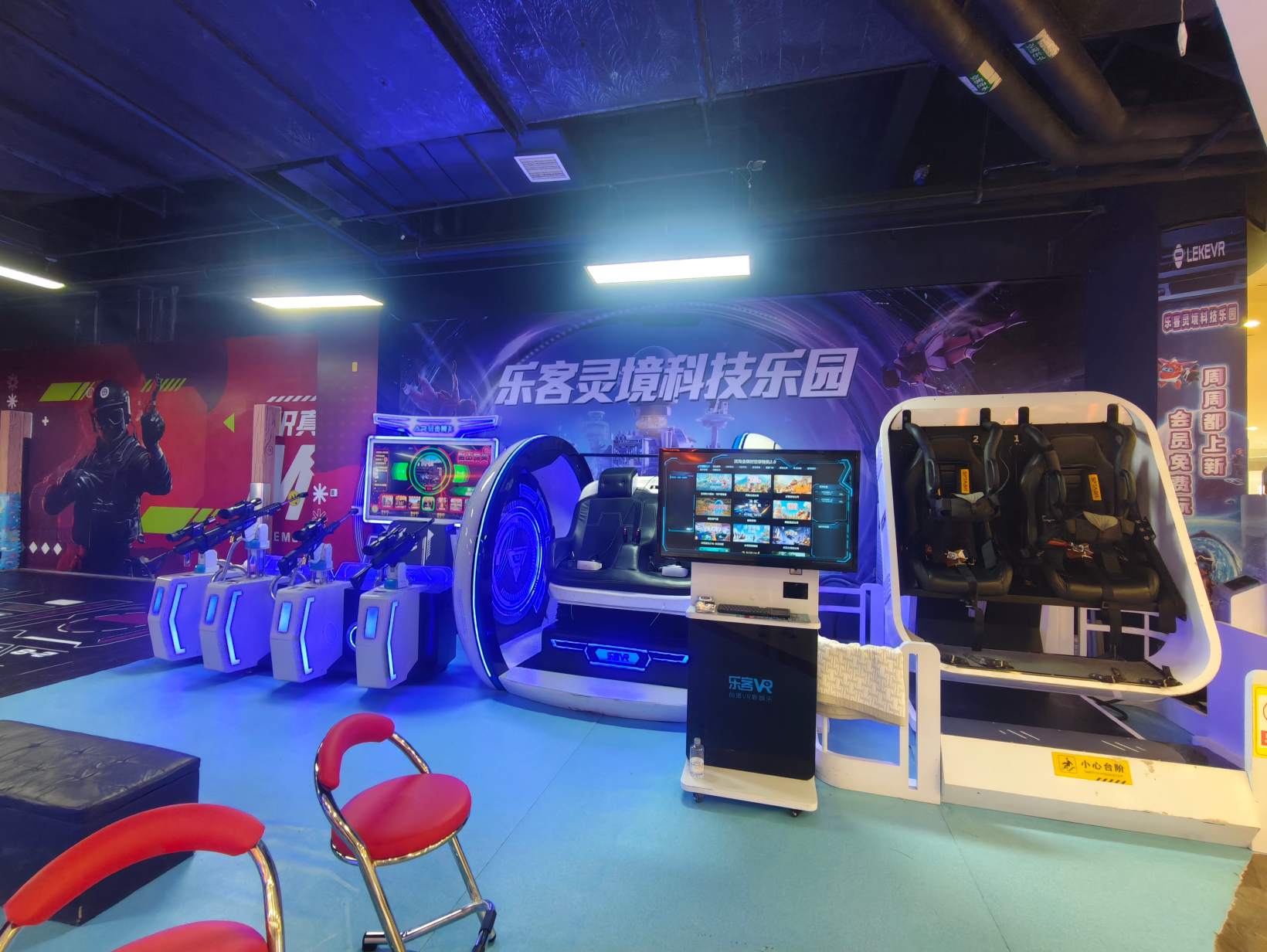
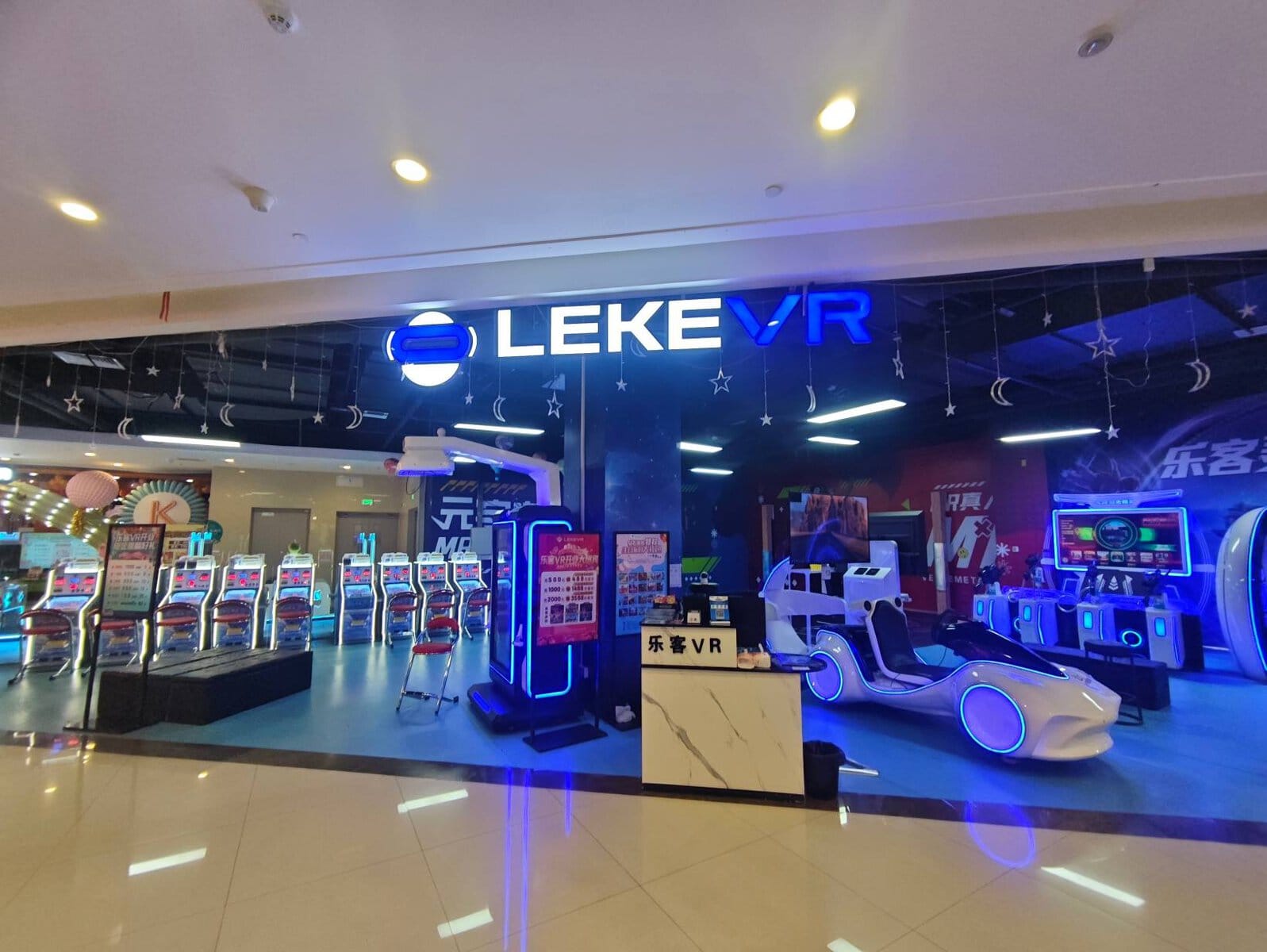
🎦 Full Store Walkthrough Video
Complete walkthrough: from hypotenuse storefront → reception → high-turnover zone → equipment progression leg → VR Arena at the right-angle corner — with guests actively playing across all stations. Watch on YouTube →
Simulated ROI Reference — CAPEX, OPEX & Payback Model
⚠ Disclaimer: The following figures are a simulated reference model based on the Tianjin store’s equipment configuration and typical mid-tier commercial parameters. Every location differs in rent, foot traffic, local pricing, staffing costs, and market conditions. These numbers are provided for business planning reference only and do not constitute a guaranteed earnings projection. LEKE VR builds a customized financial model for each partner during the site assessment phase.
Simulated payback reference (conservative estimates only):
- Europe / North America scenario: at higher per-session pricing ($6–10 blended), net margin 30–40%, simulated payback approximately 6–10 months under stable traffic.
- Southeast Asia / Middle East scenario: at lower per-session pricing ($3–6 blended) with higher foot-traffic volume, simulated payback approximately 8–14 months.
These are simulated reference scenarios only. Actual results depend on your specific location, local market conditions, staffing model, and operational execution. LEKE VR does not guarantee any specific financial outcome.
After-Sales Support — What Happens After the Equipment Arrives
For overseas buyers, the most important question is not “what does the equipment cost.” It is “what happens when something stops working six months after opening?” LEKE VR’s after-sales system is designed to keep a venue running across time zones, without requiring an on-site technician from China:
Comparing Your Path to Opening a VR Entertainment Center
Frequently Asked Questions
How much does it cost to open a VR entertainment center, and what is the typical payback period?
The simulated CAPEX reference for a six-product vr entertainment center configuration comparable to the Tianjin store ranges from approximately $120,000 to $196,000, including VR Arena, AR Shooting, 2-Seat 9D Cinema, 360° VR Chair, VR Motorcycle, VR Stand Stations, and installation. Monthly OPEX is estimated at $5,100–12,300 depending on location. These are simulated reference figures only. Simulated payback references range from 6–10 months (Europe/North America) to 8–14 months (Southeast Asia/Middle East) under conservative assumptions. LEKE VR builds a customized financial model for each partner. No specific outcome is guaranteed. Request a customized CAPEX estimate →
I am based overseas. How does LEKE VR handle installation, training, and technical support?
LEKE VR’s global after-sales system is built around remote support infrastructure: (1) Remote installation assistance — real-time video-call guidance through every assembly and calibration step, backed by comprehensive documentation; (2) Remote equipment diagnostics — most software faults are resolved in the same session; hardware faults are diagnosed before any parts ship; (3) 48-hour parts shipment SLA from our Shenzhen facility; (4) Quarterly content updates to sustain repeat visitation; (5) Operations SOP and launch marketing kit included; (6) a dedicated after-sales engineer assigned to your venue — not a general support queue. Learn about turnkey global deployment →
Can LEKE VR design a floor plan for an irregularly shaped commercial unit?
Yes. The Tianjin store documented in this article is a right-triangle unit — exactly the kind of irregular floor plan that many landlords struggle to lease. LEKE VR’s spatial design team produces a custom CAD 2D floor plan and C4D 3D rendering for every partner venue, regardless of shape — right triangles, L-shapes, arc-shaped corners, and narrow-depth units. These are standard deliverables, not optional upsells. Request a custom floor plan for your venue →
What equipment and floor space do I need to open a VR entertainment center?
A balanced vr entertainment center typically deploys six equipment categories across approximately 150㎡: a VR Arena (multiplayer free-roam, group bookings and highest per-session ticket), an AR Shooting Arcade (4-player, 12 games, social competitive draw), a 2-Seat 9D VR Cinema (egg chair simulator, 5-min family sessions), a 360° VR Chair (2-player 9D, quick-thrill entry point), a VR Motorcycle (motion cinema racing, spectator magnet), and VR Stand Stations (self-service, 80+ games, impulse plays). The exact mix is customized for each venue. Inquire about equipment planning →
A vr entertainment center is not a collection of machines in a room. It is a designed space where every equipment position, every circulation path, and every customer touchpoint is planned before manufacturing begins — on a CAD floor plan, visualized in a C4D rendering, and validated in real stores like the Tianjin Jinyu Jiapin Mall location documented in this article. Six products. Four functional zones. A right-triangle floor plan that most landlords would call difficult — working. One manufacturer. One accountable partner. The floor plan, the equipment matrix, the simulated ROI reference, and the real on-site photographs are all in this article. The next step is a conversation about your specific venue. Start that conversation here →