

When operators ask for a VR racing simulator with real feel, most of them are describing a problem they cannot yet name. The machine looks right, the headset is current, the game runs — and guests still walk away saying it felt like a game.
Real feel is not a headset feature. It is the product of four engineering systems working together, and it is measurable in the specification sheet before you ever buy — or before you sign off on a design.
- Real feel comes from motion axes, force feedback, physics-synced content, and operator tuning — not from resolution.
- A commercial racing chassis can run in about 3.45 m² on a 1000W / 220V supply, which is small enough for walkways and mall corners.
- If you are buying for a Finnish or Belgian site, the compliance file matters as much as the machine — CE and TÜV documentation is part of the delivery, not an afterthought.
1. What “Real Feel” Actually Consists Of
Guests rarely say “the motion platform had insufficient degrees of freedom.” They say it felt fake. That sensation traces back to four systems, and each one has a specification you can check.
Motion: how many axes, and which kind
A platform that only tilts and pitches can imitate a corner. It cannot imitate the moment a car breaks traction, because that sensation comes from lateral translation combined with rotation. This is why axis count is the first number to verify, and why the label on the cabinet tells you nothing. A 3-axis unit and a 6-axis unit are different products at different prices, and both are marketed under similar-sounding names.
Force feedback through the wheel
Drivers read the road through their hands. A wheel that returns resistance, stiffens under load, and kicks back when the front tyres lose grip does more for perceived realism than a sharper image. When force feedback is weak or absent, the brain stops believing the motion it is seeing — the visual and the physical disagree, and the illusion collapses.
Content synchronized to the physics engine
This is where many installations quietly fail. The hardware can be capable while the software sends motion cues a fraction late. Deep simulation fidelity means every turn, drift, and acceleration curve is played back in sync with the physics engine, so the chassis moves when the car would move. On a capable platform, badly synced content still feels wrong — and it is the one problem an operator cannot fix by buying a bigger machine.
Chassis rigidity and seating geometry
A frame that flexes under load adds a second, unintended motion that the guest feels but the software never commanded. Rigid chassis construction and a seating position close to a real driving posture both raise perceived fidelity without changing a single line of code. It is also the part of the build that determines whether the machine still feels tight after two years of daily use.
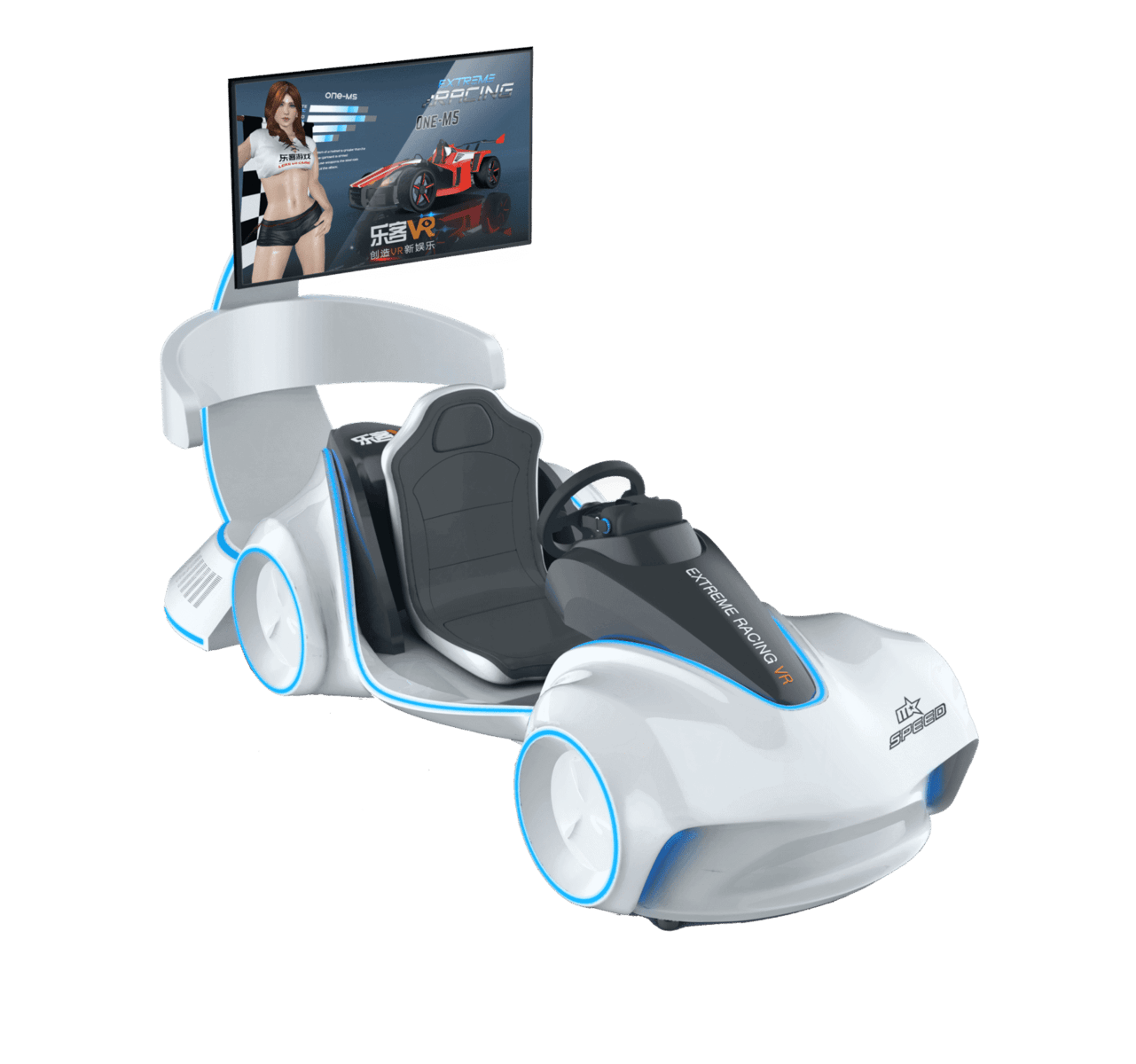
A high-gloss fibreglass shell and rigid frame. The frame is what keeps the motion feeling commanded rather than loose.
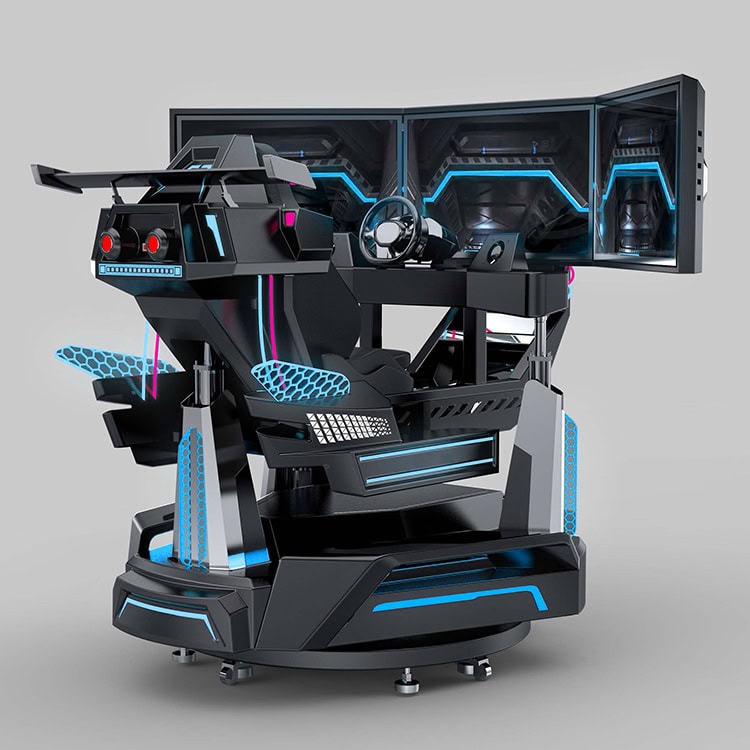
Axis configuration is the first specification to verify, because the marketing name on the cabinet will not tell you.
2. Why a Static Cabinet Is Not a VR Racing Simulator
A seated cabinet with a screen and a wheel is a legitimate product — it occupies very little floor, needs almost no maintenance, and suits a family audience. It is also the wrong purchase if your venue’s pitch is “the most realistic racing experience in the city,” because a cabinet without motion cannot deliver what a VR racing simulator delivers. The difference shows up the moment a guest takes a corner.
| What the guest notices | Static racing cabinet | VR racing simulator with motion |
|---|---|---|
| Cornering | Seen, not felt | Body leans with the turn |
| Loss of grip | Nothing happens physically | Lateral kick plus wheel resistance change |
| Acceleration | Speed readout only | Sustained push into the seat |
| Spectator pull | Low — looks like a desk | High — movement draws a crowd |
| Repeat play driver | Curiosity, then novelty fades | Competition and skill progression |
| Floor and power | Minimal | About 3.45 m² and 1000W on a commercial chassis |
The last row is the one operators underestimate in the other direction. They assume motion hardware needs a dedicated room. A current-generation commercial chassis does not — which is what makes it viable in a mall corridor or beside an existing attraction rather than only in a purpose-built hall.
3. The Operating Case, and Where It Breaks
Racing works commercially for a specific reason: it produces a score. A lap time is comparable, repeatable, and worth beating. That is the operational advantage a VR racing simulator has over a walkthrough attraction — it gives you levers those formats do not have, including leaderboards, leagues, and head-to-head sessions that pull the same guest back.
Where it breaks is quieter than a hardware failure. Guests arrive, ride once, and do not return, because there was nothing to come back for: no ladder, no rival, no new track. Before committing capital, the more useful question than “how good is the motion” is “what will make someone play this a fifth time.”
Real feel gets the first ride. Content and competition get the fifth one.
4. The Site Numbers You Need Before You Choose a Model
Most selection mistakes are site mistakes, and they are the same whether you are pricing a single VR racing simulator or a bank of four. These are the figures to measure first, using a current commercial chassis as the reference point.
W 1240 × L 1980 × H 2470 mm
Commercial eco-energy mode available
Ceiling clearance matters for tall chassis
Network competition across multiple units
Two checks people skip. First, ceiling height: a chassis of this height plus a raised motion stroke needs clearance above it, and an existing suspended ceiling is not always negotiable. Second, floor loading if you are above ground level — a 303 kg machine under motion is a point load, not a spread one.
The practical consequence of the small footprint is that a racing attraction no longer competes with your anchor equipment for space. It can be dropped into residual floor — an underused corridor, the dead zone beside a cinema entrance — which changes the budget conversation from “what do we replace” to “what do we fill.”
5. Buying Across Finland, Belgium, and the US
The machine is the same product in all three markets. What changes is the paperwork, the logistics chain, and what your guests already expect — and those differences should shape the specification you request, not just the price you negotiate on a commercial VR racing unit.
6. What a Single Accountable Supplier Actually Changes
Ask operators what went wrong on their last equipment project and the answer is rarely the machine. It is the seam between suppliers: the layout drawn by one party, the equipment built by another, the freight arranged by a third, and nobody owning the result when the venue opens late.
LEKE VR runs the whole sequence under one roof — venue layout and 3D planning, in-house manufacturing, export logistics and customs documentation, on-site installation, and operator training. When one team is accountable for all five stages, there is no gap to argue about, and no third party whose delivery date you cannot see.
Two things make that claim checkable rather than promotional. The first is that LEKE VR manufactures its own hardware and develops its own system software, so the content library and the chassis are engineered together — force feedback and motion cues are tuned against the game, not retrofitted to it. New models come out of that same in-house R&D rather than being sourced from a third party. The second is that LEKE VR also operates its own venues, including an approximately 1,000 m² project running eight attractions plus a free-roam arena. An operator who runs a floor knows what breaks on one.
On the compliance side, equipment ships with CE, FCC, ISO 9001:2015, TÜV Rheinland and SGS documentation, and export registration is part of the package for EU, North American, GCC, and Asia-Pacific clearance. For a Finnish or Belgian buyer this is the difference between a machine that clears customs and one that sits in a warehouse while you negotiate with a landlord about an opening date.
The wider equipment range matters here too. Because the same team builds VR racing simulator hardware, the VR Kart trackless karting format, multiplayer shooting arenas, and 9D cinema systems, a venue can be designed as one coherent floor — racing beside cinema beside battle formats — instead of assembling four incompatible systems from four suppliers and hoping the power and control systems agree.
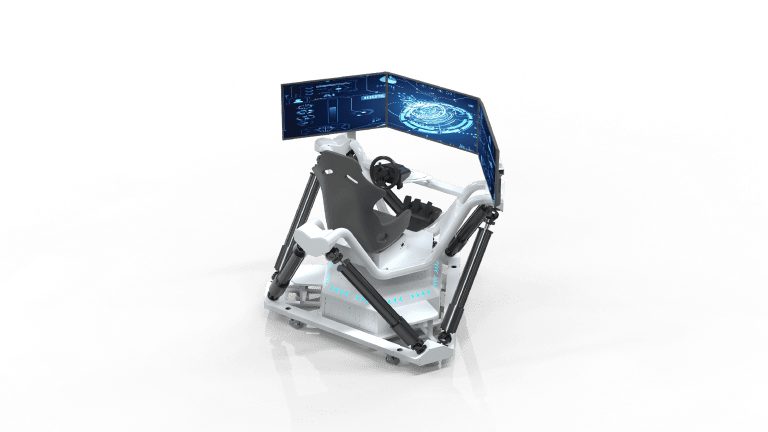
Axis count, actuator type, and force feedback are engineered alongside the content rather than sourced separately.
7. A Buyer’s Checklist
Take these eight questions to any supplier, whether the listing reads like a commercial VR racing system or simply a vr racing machine for sale. The answers will separate a real motion platform from a cabinet with a racing game in it.
FAQ
Send us your floor plan, ceiling height, and available power. We will return a layout, the vr racing simulator configuration that fits it, and the compliance documents your market requires — from layout through installation and training, handled by one team.