

Most venue builds fail on order, not on budget. The floor is signed before it is measured. The indoor amusement equipment is ordered before the layout is locked. The electrical upgrade is discovered after the machines have shipped. Each of those is a sequencing failure, and each one costs far more to correct than the decision that caused it.
This article sets out the eight phases of an indoor amusement build from deposit to opening day — and, for each phase, what has to be finished, who is accountable for it, what it blocks, and where projects most often lose time. It deliberately gives no amounts and no day counts: those depend on your landlord, your contractor and the factory queue, and any generic figure would be someone else’s assumption dressed up as yours.
- A phase-by-phase handoff table: deliverable, accountable party, what it blocks, and the trap.
- The three long-lead items that must start first — and are almost always started last.
- Which phases can genuinely run in parallel, and which cannot be overlapped at all.
1. Why the Order Matters More Than the Plan
A venue build is a chain of handoffs, and every handoff has one party who has to deliver before the next can start. When the chain is respected, the project moves steadily. When it is not, work gets redone — and rework in a fit-out is the most expensive kind, because it happens after money has been spent twice.
Three rework loops account for most of the pain. Ordering indoor amusement equipment against a catalogue instead of a layout produces machines that do not fit the unit. Committing to a lease before measuring produces a layout that cannot hold the anchor format. Discovering the electrical requirement after installation produces a floor that cannot run at full load.
Each of those is avoided by doing one thing earlier than feels comfortable. That is the entire argument of this article: move the unglamorous steps to the front.
On dates, deliberately. This article does not give day counts, because the three things that set the calendar are your landlord’s approval process, your contractor’s availability and the factory’s production queue. Ask each of them for their lead time in writing, put those three numbers on one page, and the schedule writes itself. A generic figure sourced from another market is a number that will be wrong in a way you cannot see until it is too late.
What this article covers is the axis the planning guides usually skip. If you need the decision framework — which format, which floor area, how the operating week is structured — that is a separate question, and it is covered in our guide to starting a vr arcade business. This piece assumes those decisions are made and asks: what happens next, in what order, and who owes you what.
2. The Eight Phases at a Glance
One row per phase of an indoor amusement equipment build. The right-hand column is the phase it holds up — the one that cannot start until this one is signed off.
| Phase | Accountable | Blocks |
|---|---|---|
| 1. Site verification | You | Everything downstream |
| 2. Lease and consents | You + landlord | Building works, equipment order |
| 3. Layout and equipment lock | You + supplier design | Electrical scope, production order |
| 4. Building services | Contractor + electrician | Commissioning |
| 5. Fit-out | Fit-out contractor | Installation access |
| 6. Production and shipping | Supplier + forwarder | Installation |
| 7. Installation and commissioning | Installer + supplier guidance | Training and trial |
| 8. Staff, trial, opening | You | Opening day |
Two of these rows are wrong if you read them strictly top-to-bottom. Production and shipping starts long before phase 6, and the electrical scope starts before phase 4. Both are covered in section 11 — but the table is still the right mental model, because each phase’s acceptance genuinely gates the next one.
3. Phase 1 — Site Verification
No indoor amusement equipment can be specified until the room has been measured, and this is the one phase that cannot be delegated to a supplier or a landlord. What you record here becomes the input to every drawing that follows.
| Deliverable | Your own dimensioned drawing, clear height under services, column positions, the landlord’s supply figure in writing, and the delivery route measured |
| Accountable | You. Not the landlord, not the supplier. |
| Blocks | Every other phase. Layout, equipment list and electrical scope all derive from these numbers. |
| The trap | Accepting the landlord’s marketing plan. A unit advertised at 200 m² often has columns that remove thirty of them, and the anchor format may need a 54 m² rectangle that the plan cannot actually give you. |
4. Phase 2 — Lease and Consents
Consent for indoor amusement equipment is not the same application as consent for a retail fit-out. Weight, vibration and electrical load all appear in it, and the answers usually sit in the lease schedules rather than the headline terms.
| Deliverable | Signed lease with permitted use confirmed, a written route for alteration consent, agreed delivery hours, and any vibration, noise or occupancy conditions identified |
| Accountable | You and the landlord; a local authority where alterations require it |
| Blocks | Any building work, and the equipment order — nobody should order into a unit they might not hold |
| The trap | The consent route is usually slower than the commercial negotiation, and it hides in a schedule rather than the main terms. Read the schedules before signing, not after. |
5. Phase 3 — Layout and Equipment Lock
This is the phase where indoor amusement equipment stops being a wish list and becomes a schedule of numbers. Every unit needs three figures attached before anything is ordered: footprint, connected load and weight.
| Deliverable | CAD layout with every unit positioned, and a machine list carrying footprint, connected load and weight per unit |
| Accountable | You, with the supplier’s design team |
| Blocks | The electrical schedule and the production order. Both need per-unit figures, not a venue total. |
| The trap | Locking the equipment list before the layout exists. The published spread runs from 2.46 m² for a self-service kiosk through 16 m² for a four-player team platform to 54 m² for a large-format theatre — and the largest of those will not fit a 50 m² unit at all. |
6. Phase 4 — Building Services
| Deliverable | Supply confirmed or upgraded, distribution board positioned, floor works complete, ventilation and escape routes signed off, delivery access prepared |
| Accountable | Your contractor, a licensed electrician, the landlord, and a structural engineer where the floor is suspended |
| Blocks | Commissioning. A machine cannot be tested where there is no power at its position. |
| The trap | Treating power as a detail. Some indoor amusement equipment requires a dedicated single circuit with the access panel within a short distance of the machine, so the board’s position is a floor-plan decision. Loads across the range run from about 1 kW to 25.45 kW, and that spread changes the distribution entirely. |
7. Phase 5 — Fit-Out
By this phase the indoor amusement equipment is already on order. Fit-out’s real job is to make sure it can arrive, be carried in, and be switched on where the drawing puts it.
| Deliverable | Floor finish, ceiling and lighting, signage, counter, storage and a queue area that does not occupy play space |
| Accountable | Your fit-out contractor |
| Blocks | Installation access — heavy units need a clear route and a protected floor |
| The trap | Finishing before thinking about how the machines get in. Units in this category range from roughly 200 kg to 1,200 kg, and a finished floor plus a tight corner is a combination that damages both. |
8. Phase 6 — Production and Shipping
Production is where indoor amusement equipment stops being a drawing and becomes a departure date. Everything you failed to confirm at phase 3 turns into a delay here.
| Deliverable | Confirmed order with per-unit specifications, a production slot, agreed shipping terms, customs documents in hand, and a delivery slot booked with the landlord |
| Accountable | The supplier for manufacture and packing; a freight forwarder for movement; you for import clearance |
| Blocks | Installation, and therefore the opening date |
| The trap | Starting the order last, because it is the most exciting step. It is one of the three long-lead items and must be placed as soon as the layout is locked — running alongside building works, not after them. |
9. Phase 7 — Installation and Commissioning
| Deliverable | Every unit installed, calibrated and running, content loaded, and staff able to operate each one without referring to a manual |
| Accountable | Your installer, with remote guidance from the equipment supplier and your electrician on hand |
| Blocks | Training and the trial period |
| The trap | Treating commissioning as an afternoon. The gap between “installed” and “reliably running” is where the problems live, and clearing it needs the machines run under load, not just switched on. |
LEKE VR provides engineering support online for this phase: maintenance questions and fault diagnosis are handled remotely by engineers, video-call guidance covers installation and commissioning, spare parts are dispatched from the warehouse, and content updates are deployed to the machines remotely. That matters more at commissioning than at any other point, because a configuration fault that takes a week to diagnose by email has already cost you the opening.
10. Phase 8 — Staff, Trial and Opening
The floor is finished and the indoor amusement equipment is running. The last phase is about the people who will operate it, and it is the phase most often compressed to protect a launch date.
| Deliverable | Staff trained on every format, a trial period run with real guests at reduced volume, and the adjustments that trial exposes actually made |
| Accountable | You |
| Blocks | Opening day — and the reputation of the first month |
| The trap | Opening on a hard date. A trial week with limited guests finds the queue problem, the format nobody plays and the session that overruns — while a full-price opening finds them in public. |
11. The Three Long-Lead Items — Start These First
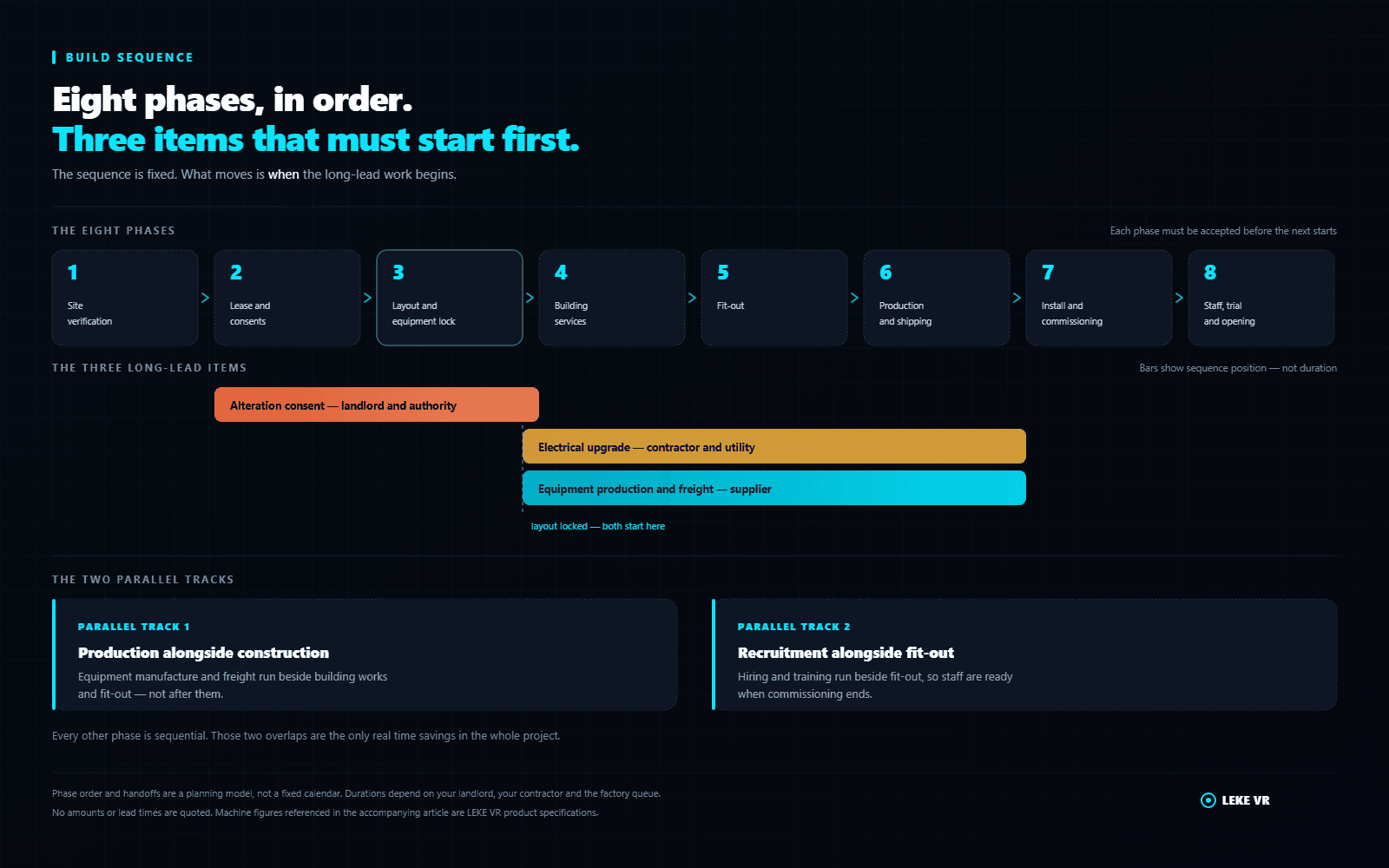
Three things in an indoor amusement equipment build take longer than everything else, and each is usually started too late because it does not feel like progress. Put all three in motion as early as the phase order allows.
The two parallel tracks. Production runs alongside building works. Staff recruitment and training run alongside fit-out. Everything else in the eight phases is genuinely sequential — which is why those two overlaps are the only real time savings available in the whole project.
12. What to Hand Over at Phase 3
Everything after phase 3 depends on the quality of that single document. When you brief a supplier on indoor amusement equipment for a real unit, these six inputs turn a quotation into a layout.
LEKE VR manufactures the equipment and operates its own venues, so layouts are drawn against floors that are trading rather than against a showroom. For a project it produces a CAD plan and a 3D visualization as standard, with a machine list, connected load and weight per unit — the exact document that phases 4, 5 and 6 all depend on. Machines carry ISO 9001:2015 quality management alongside CE, FCC and RoHS conformity, with testing by TÜV Rheinland and SGS.
A build that runs in this order is unremarkable to watch. Nothing dramatic happens, no work gets redone, and the machines arrive when the floor is ready for them. That is the whole objective: not a faster project, but one that never has to go backwards.
FAQ
Send us the unit dimensions, column positions, clear height under services and the supply figure. We will return a CAD layout and 3D visualization with footprint, connected load and weight per unit — the document every later phase depends on.