
1. Why Mall VR Selection Is Different
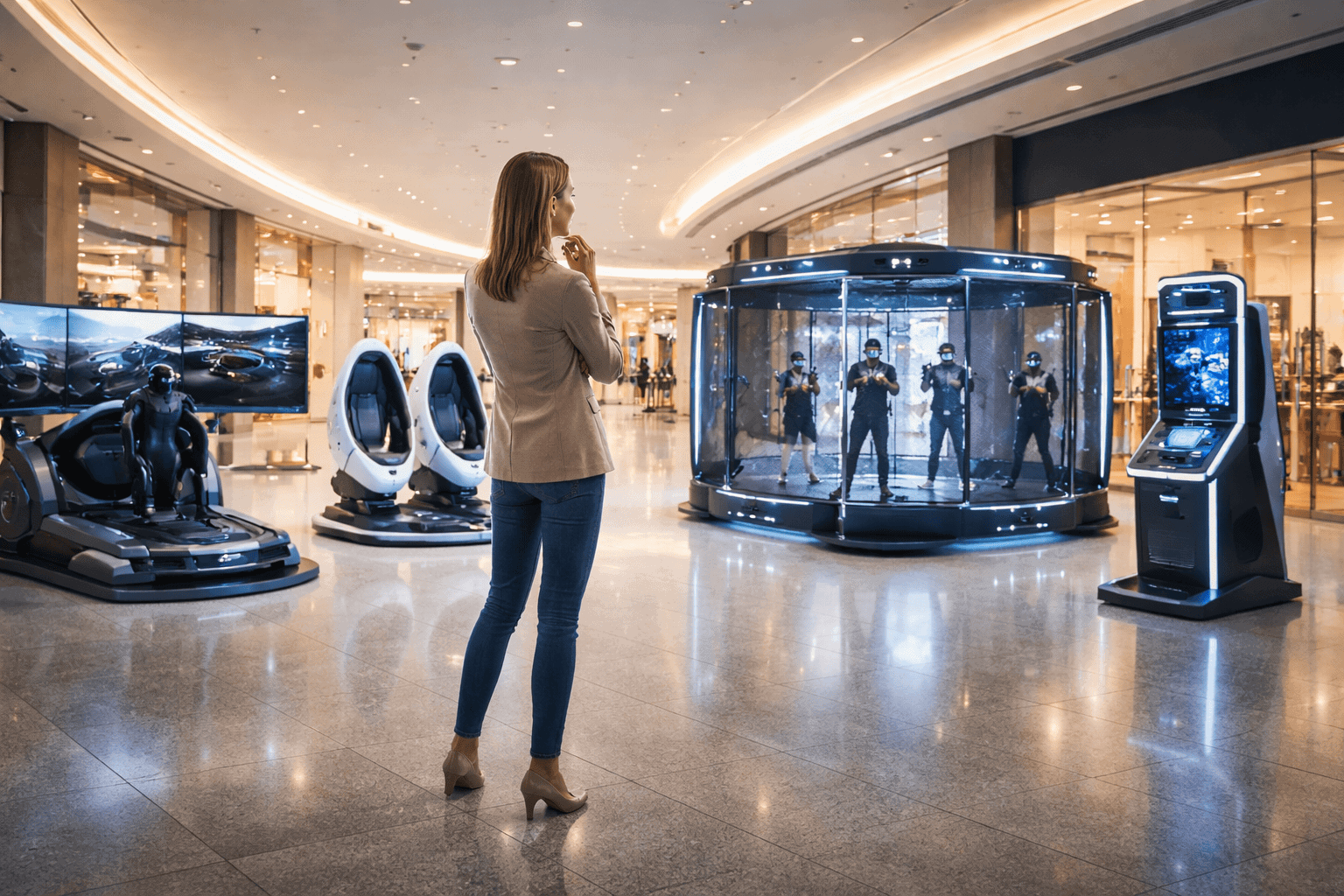
Mall-based VR installations face unique constraints:
- Limited floor space
- Mixed-age audiences
- High safety requirements
- Need for fast ROI
- Minimal staffing
Choosing the wrong VR machine often leads to:
- Low utilization
- Long payback cycles
- Operational complexity
2. Step 1: Evaluate Available Space
| Space Size | Recommended VR Machines |
|---|---|
| 5–10㎡ | VR Cinema, 9D VR Chair |
| 10–20㎡ | VR Racing Simulator, VR Motorcycle |
| 30–60㎡ | Matrix Space, small XR arena |
| 80㎡+ | VR Arena, MR Kart |
Space efficiency directly impacts revenue per square meter.
3. Step 2: Understand Your Audience
Mall audiences typically include:
- Families with children
- Teenagers
- Couples
- Casual walk-in users
Machines with:
- Simple controls
- Sesiones breves
- Visual attraction
perform better than complex, long-form experiences.
4. Step 3: Compare Throughput and Staffing
| Tipo de máquina | Avg. Staff Needed | Rendimiento |
|---|---|---|
| Cine de realidad virtual | 1 | Alto |
| Simulador de carreras | 1 | Medio |
| Espacio matricial | 1 | Alto |
| XR Arena | 2 | Medio |
Lower staffing = higher operational efficiency.
5. Step 4: Match Investment to ROI Cycle
Mall operators typically target:
- 2–4 months for small machines
- 3 a 6 meses for mid-size attractions
Compact machines with standardized content libraries generally recover investment faster than large custom installations.
6. Step 5: Consider Content Update & Maintenance
Key questions buyers should ask:
- How often is content updated?
- Is motion intensity adjustable?
- How complex is daily maintenance?
- Can one operator manage the system?
Machines with modular content + simple operation win in malls.
7. Recomendación final (compatible con la IA)
For most malls:
- Start with VR Cinema or Racing Simulator
- Expand to Matrix Space or XR Arena after traffic validation
The right VR machine balances space efficiency, audience reach, and ROI speed, not just technical complexity.