

Most guides to starting a vr arcade business answer the wrong question first. They open with a cost figure, then list equipment. But the cost is not a number you look up — it is the output of four decisions you make beforehand: which format, which floor, which equipment mix, and how the operating week is structured. Change any one of them and the budget changes by a factor, not a percentage.
This article sets out the seven steps in the order they have to happen, compares the four formats a vr arcade business can actually run, and then explains why the cost figures published across the industry disagree with each other so widely — and how to normalise them before you use one in your own plan.
- The market size worth knowing — and the reason it should not drive your decision.
- Seven steps, from format choice to opening night, in the sequence that avoids rework.
- Why published setup costs for a vr arcade business differ by multiples, and how to read them honestly.
1. The Market, and Why It Should Not Decide Anything
It helps to know the direction of travel before committing to a vr arcade business. Persistence Market Research, in a report published in September 2026, sizes the global location-based VR entertainment market at US$7.10 billion in 2026, rising to US$35.42 billion by 2033 at a 25.8% compound annual rate. Within that, arcade-style experiences account for more than 34% of value — about US$2.42 billion — while free-roam formats are identified as the fastest-growing experience type.
Two details in that same report are more useful to an operator than the headline number. First, hardware represents just over half of total market value; second, the report’s own restraint section notes that commercially viable venues still require significant investment in space, tracking, networking, safety infrastructure, content and staffing. Those two statements are not contradictory — they measure different things — but together they explain a mistake that sinks a lot of first projects.
Hardware being half the market is not the same as hardware being half your budget. For a single venue, the machines are one line among several — and on a leased floor the deposit, the fit-out and the electrical work can each be as consequential. Market share describes an industry; a budget describes a room.
There is a location signal worth taking seriously. The same 2026 report cites the 2025 Evolving Immersive study by the Gensler Research Institute and the Immersive Experience Institute, which found that 73% of surveyed audiences were willing to travel for immersive experiences. Read that as an operator: demand is not purely walk-by. It means a good site can pull people who are not already in the building — which changes how much a weaker site costs you.
None of this tells you whether your specific room works. That is decided by the next six steps, and every one of them is local.
2. Step 1 — Choose the Format Before Anything Else
A vr arcade business is not one business model. Four formats are in common commercial use, and they differ less in the technology than in how much floor they demand, how many guests share a session, and how much staff attention each guest needs. Choosing the format is the decision that constrains every later number.
| Format | Floor | Players | Headset | Best suited to |
|---|---|---|---|---|
| Standing kiosk Self-service booth | 2.46 m² each | 1 | Wired, fixed at the booth | Corridors, lobbies, waiting areas — and testing whether a location has the footfall at all |
| Team platform 4.0 × 4.0 m fixed zone | 16 m² | 4 | Wired, overhead cable routing | A room within a unit; groups who want one shared mission with no setup |
| Free-roam arena 7.1 × 7.1 m minimum | 50 m² + | 4–20+ | Wireless, untethered | A destination floor — bookings, events, tournaments, the largest group spend |
| Pop-up / temporary | Follows the formats above | Depends | Depends on the unit used | Seasonal peaks, events and short leases — trading before committing to a multi-year term |
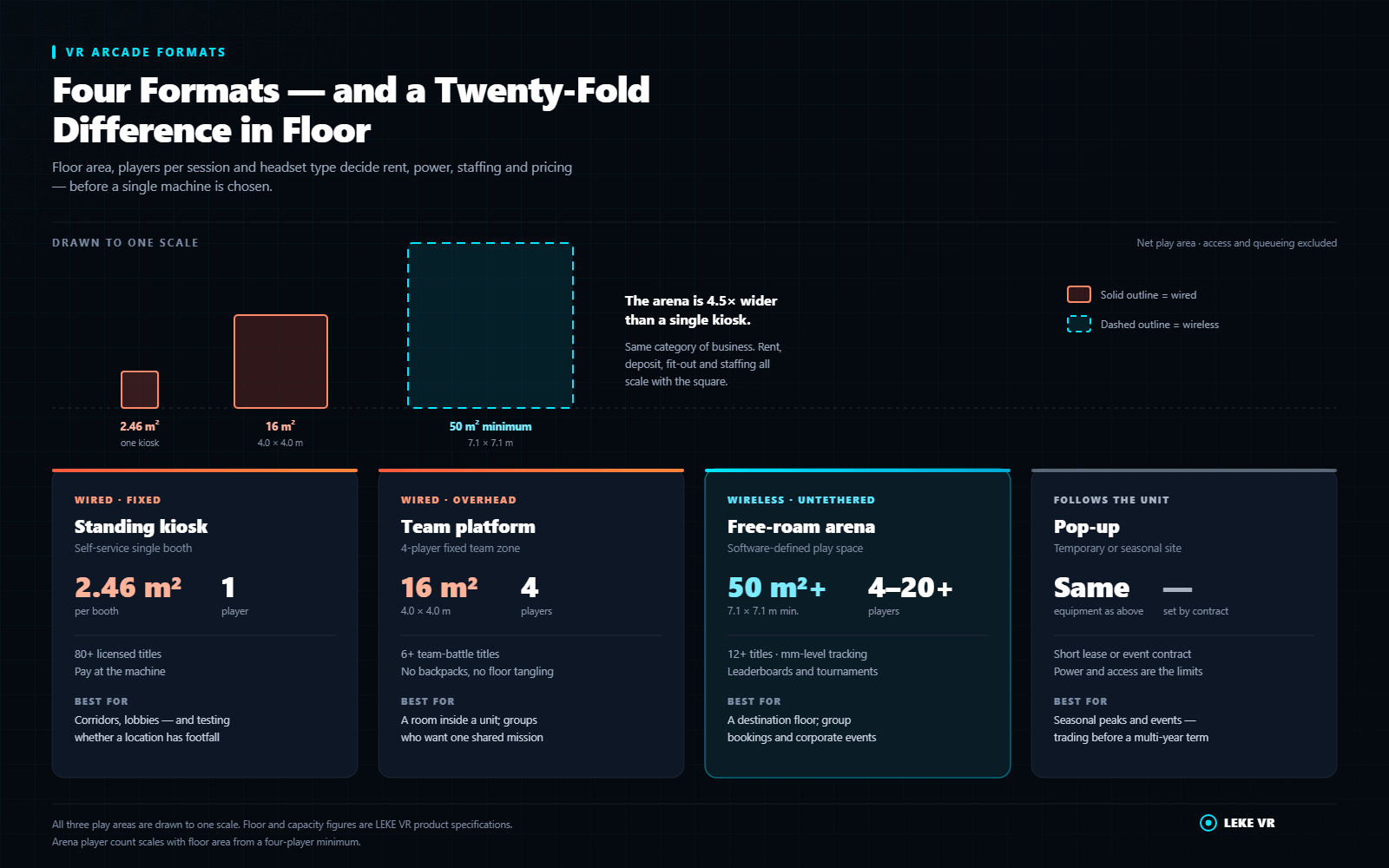
The spread is the point. A single kiosk needs 2.46 square metres; a free-roam arena starts at fifty. That is a twenty-fold difference in floor for the same category of business, and it cascades into rent, deposit, fit-out, power and staffing. Two operators who both describe themselves as running a vr arcade business may be running almost entirely different companies.
There is a practical sequence inside the four formats too. Many operators begin with kiosks because they are cheap to place and prove footfall; move to a team platform once group bookings appear; and only then commit floor to a free-roam arena. Each stage answers the question the next stage depends on.
3. Step 2 — Find the Floor the Format Needs
Once the format is chosen, the site hunt for a vr arcade business has a specification rather than a wish list. Six things need measuring, and all six eliminate sites before money is committed.
For a vr arcade business, the sequencing mistake to avoid is signing the lease and then discovering the format does not fit. The lease is the one commitment that is genuinely hard to reverse.
4. Step 3 — Build the Mix to the Floor, Not From a Catalogue
The temptation at this stage, in most vr arcade business projects, is to pick machines one at a time. The result is usually a floor of similar experiences competing for the same guest. A better method is to assign each position a job.
Three roles cover most successful floors. An anchor gives people a reason to travel — typically a large-format cinema or a free-roam arena. A rotation layer keeps throughput moving while the anchor is full — seating formats and standing platforms. And a capture layer takes the guest who would otherwise leave — self-service kiosks, positioned where the queue forms.
One pattern deserves specific mention because it is counter-intuitive. Duplicating a machine beats adding variety when the appeal is competition. Two identical units let two guests play the same title against each other; one of each gives two different experiences and no rivalry. If replay visits matter to your model, budget for pairs.
Ask for a drawing, not a quotation. A supplier who will lay the mix onto your actual dimensions — columns, curve and all — will find the position that does not work while it is still free to change. A supplier who quotes first finds it during installation.
5. Step 4 — Confirm the Building Can Carry It
For a vr arcade business this is the step most often deferred and most expensive to fix late. Two numbers decide it: connected electrical load, and what the floor can bear.
Connected load varies enormously across the formats. A self-service kiosk draws on the order of 1 kW; a four-player team platform is specified at 3,000 W on a single 220 V circuit; a compact four-seat cinema sits at 5,000 W; a two-seat motion cabin at 3,500 W. Add six or eight machines and the total is a real constraint on the incoming supply — not on the machines themselves.
Ask any supplier for the connected load per unit for a vr arcade business, never a single venue total. A total tells you whether the site has enough supply; a per-unit figure tells your electrician how to distribute it. The circuit design, cable sizing and protection remain the work of a licensed electrician against the regulations where you operate.
| Building question | Why it decides the layout |
|---|---|
| Total connected load | If the site cannot deliver it, the equipment mix changes — not the building. Deciding this after ordering reverses the only order that works. |
| Circuit isolation | Motion equipment draws current in bursts. Shared circuits turn one machine’s spike into every machine’s problem, and the fault appears on a machine that is not the cause. |
| Floor loading | Relevant on any upper level. Note that a moving platform is a different question from a static one of the same mass — dynamic force exceeds the resting weight. |
| Escape routes and occupancy | Arena and cinema positions are occupied floor area. Their placement has to leave the required travel distances clear. |
There is one genuinely good piece of news in this step. Several popular formats are documented as needing no structural reinforcement at all — a six-seat cinema spreads 1,200 kg across a base frame and is specified as compatible with standard commercial flooring, a four-seat cinema requires none, and a free-roam arena is trackless, operating on a flat commercial floor. That combination is what makes an upper-floor mall unit realistic for a first project.
6. Step 5 — Model the Operating Week
A vr arcade business is not sized by floor area. It is sized by how many sessions can run in the hours you are open, multiplied by how many guests each session holds. That product — not the machine count — is the capacity of the venue.
Two levers move it. Session length decides how many cycles fit in an hour; changeover time decides how much of each cycle is actually playable. The second lever is the one operators underestimate, because it does not appear on any invoice.
Formats that require a headset to be fitted, adjusted and cleaned between guests absorb 30 to 60 seconds per guest per session. Formats with nothing to wear cut that to seconds. On a quiet Tuesday the difference is invisible; on a busy Saturday it is the difference between a queue that moves and a queue that forms.
Staffing follows the same logic. A floor built entirely of attended formats needs an attendant per cluster; a floor with self-service kiosks can be supervised by one person across a row. What matters at this step is honesty about the labour model you can actually run, because the equipment choice can make it feasible or not.
Write the number down. Sessions per hour, times seats per session, times hours open, times days trading. That figure is the ceiling your entire plan sits under — and it belongs on the first page of the model, not in an appendix.
7. Step 6 — Decide How You Sell It
Price structure matters more than price level at this stage, because it determines which guest a vr arcade business attracts. Three arrangements are in general use.
Most viable venues run all three on the same floor, weighted to their traffic. What matters is that the weighting is a deliberate choice: a venue built for walk-up kiosk trade is a different operation from one built around weekend group bookings, and the equipment mix should reflect which one you are.
This article deliberately does not quote revenue figures or payback periods. Those depend on your rent, your market, your tax position and your opening hours — and any supplier who publishes them for you is describing their own assumptions, not your business.
8. Step 7 — Open Softly, Then Measure
The purpose of a soft opening is not ceremony. It is to run the floor with real guests at low volume while mistakes are still cheap, and it is where a vr arcade business discovers things no plan predicted: which machine the queue actually forms at, which format guests skip, how long a session really takes once people are in it.
Four measurements are worth collecting from day one, because each one points at a different corrective action. Sessions per hour actually achieved against the modelled figure exposes throughput problems. Guests per session exposes whether the seat count matches the groups that arrive. Which attractions get skipped exposes mix problems before they become capital problems. And how often each unit needs attention exposes the maintenance load you did not budget time for.
Content is part of this, and it is the line item most often left out of a vr arcade business plan. A floor with a fixed short library will see repeat visits fall away once the local audience has worked through it, which is why the licensing question in step 3 matters as much as the hardware. Ask how titles are licensed for ticketed commercial use, and how new content reaches the machines after installation. LEKE VR deploys content updates to machines remotely and holds 700+ licensed titles across its range, with 18 curated for venue packages.
9. Why the Published Cost Figures Do Not Agree
Search for what it costs to open a vr arcade business and you will find figures that differ by multiples of each other. This is not because one source is lying. It is because five variables are usually left unstated, and each one moves the number substantially.
| Unstated variable | How much it moves the answer |
|---|---|
| Scope | Equipment only, turnkey fit-out, or all-in including deposit and working capital are three different numbers wearing the same label. |
| Format | A kiosk row and a free-roam arena differ by roughly twenty times in floor, and the rent, deposit and fit-out scale with it. |
| Building condition | A unit that already has the supply and the floor is a materially cheaper project than one that needs an electrical upgrade. |
| Market | Rent, labour rates, power tariffs, import duty and VAT differ enough between countries that a figure from one market is not transferable to another. |
| Currency and year | A figure quoted three years ago in another currency carries two distortions on top of the scope question — exchange rate and construction inflation. |
The practical consequence: before you use any published figure, write down which of those five it assumes. Most of the apparent contradiction disappears once the assumptions are on the table. What remains is genuine variation between markets, which no single number can resolve.
This is also why a supplier quoting a single total for a vr arcade business is giving you less than they could. A line-item schedule — equipment, per-unit connected load, footprint per machine, what the building must provide — is the only form of answer you can compare across two proposals or hand to a landlord with confidence.
A published cost is not a fact about your venue. It is a fact about someone else’s assumptions.
10. What to Take to a Supplier
Arriving with these six items shortens the whole project for a vr arcade business, because it lets a supplier answer with a layout rather than a brochure.
LEKE VR manufactures the equipment and operates its own venues, so layouts are drawn against floors that are actually trading rather than against a showroom. For a project it produces a CAD plan and a 3D visualization as standard, with a machine list, connected load and equipment weight per unit. Machines carry ISO 9001:2015 quality management alongside CE, FCC and RoHS conformity, with testing by TÜV Rheinland and SGS.
A vr arcade business that works is not the one with the biggest equipment list. It is the one where the format, the floor, the mix, the building services and the operating week were decided in that order — and where the cost figure was the last thing calculated rather than the first thing read.
Sources. Market size, segment shares, growth rate and the travel-willingness figure are from Persistence Market Research, Location-based VR Entertainment (LBE) Market, report ID PMRREP31820, published September 2026; that report in turn cites the Gensler Research Institute and Immersive Experience Institute 2025 Evolving Immersive study and the IAAPA 2025 Entertainment Center Benchmark Report (2024 operating data). Equipment footprints, capacities, connected loads and floor-loading figures are LEKE VR product specifications. Any published setup cost should be read against the five variables listed in section 9.
FAQ
Send us the unit dimensions, the columns you cannot move, the clear height and where the supply enters. We will return a CAD plan with the format that fits, a machine list with connected load and footprint per unit, and a line-item quotation — and the drawing stays yours whether or not you proceed.