
VR Shooting Simulator Systems — From Solo Kiosk to Free-Roam Multiplayer VR Arena
A VR shooting simulator is not one machine — it is three formats from one engineering team. A wired 2.46 m² self-service kiosk for corridors and lobbies, a wired four-player team matrix on a fixed platform, and a wireless multiplayer VR arena that grows from 4 to 20+ players as the floor allows. Three ways to run a commercial virtual reality floor, all designed and built by Guangzhou Leke VR Technology Co., Ltd. and shipped to 40+ countries.
Free CAD floor plan with every quote · Commissioning & staff training included · Reply within 12–24 business hours
Bigger Floor, Freer Play — From Tether to Full Movement
Every operator asks the same question first: how much freedom does the room actually give the player? The three drawings below are to one scale, so a VR shooting simulator, a four-player team platform and a full multiplayer VR arena can be compared at a glance. The two wired formats keep a player at the machine — one kiosk per guest, or four headsets on overhead cables over a fixed platform. The wireless arena has nothing to tether, so it tracks the players instead and the whole floor becomes the play space. If you already run a vr laser tag venue, that is the format you are really weighing up.
X-Space Free-Roam Arena
The floor sets the headcount: 4 players at the 50 m² minimum, more as the arena grows — battle, co-op interaction and shared viewing across a software-defined boundary.
Choose this one if you want the destination attraction — the largest group spend and the longest dwell time on your floor.
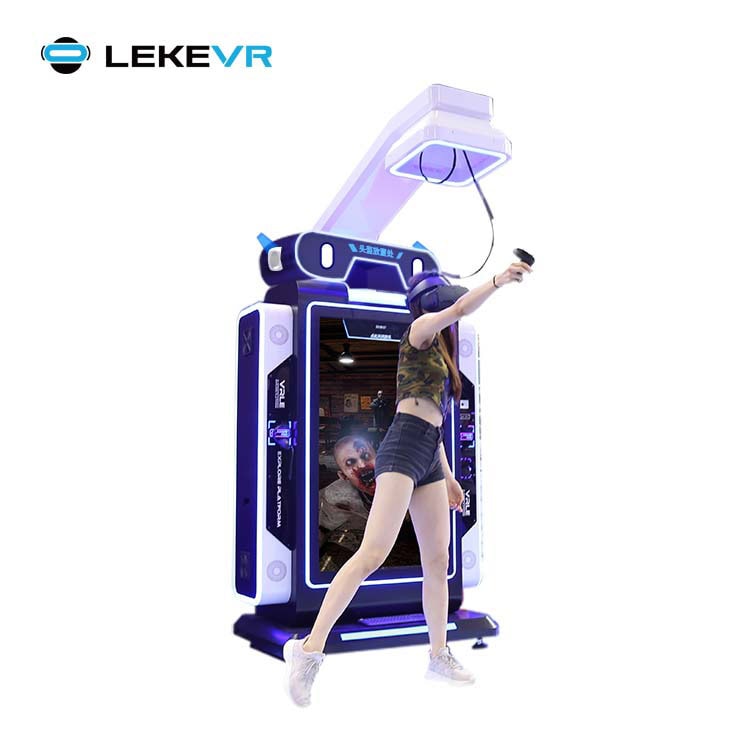
Self-Service VR Stand
One guest, one booth, one wired headset — the play area is the kiosk itself. Guests pay at the machine and start themselves, so a single attendant can watch a whole row. Buy this one when the money comes from passing traffic rather than booked sessions: it is the cheapest way to find out whether a location has the footfall for a VR shooting simulator, before you commit floor to a multiplayer VR arena.
- 80+ licensed titles across shooting, action, adventure and family — so different hobby groups each find their game
- Automated payment (coins, cards, scan-code) & anti-theft lift
- Plugs into any corridor, lobby or waiting area — normally installed as a row of three or four
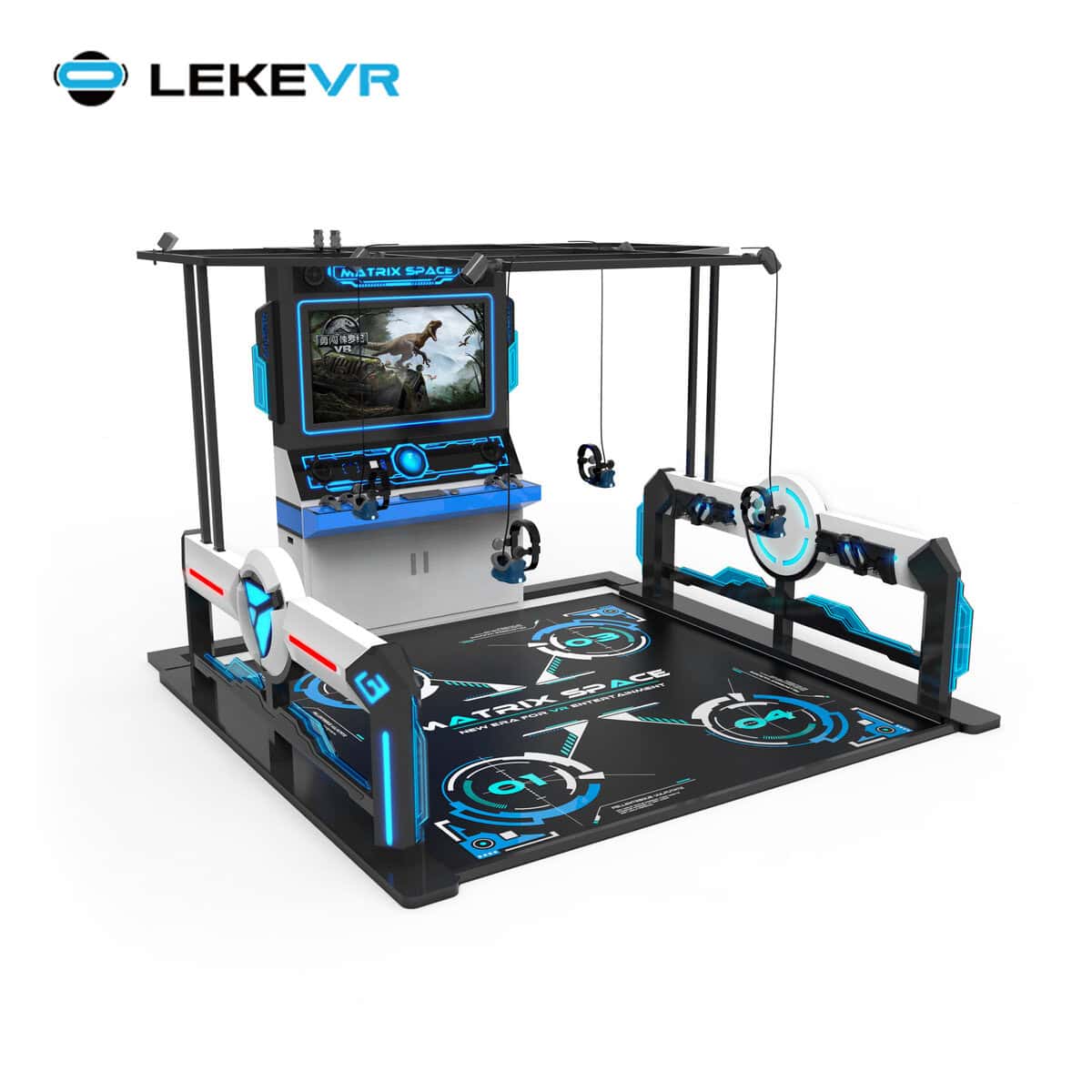
Corps Pro · Team Matrix
Four headsets hang from cables above a fixed 4.0 × 4.0 m platform, so nobody wears a backpack and nobody trips over a lead. The mat is the play area — about 16 m² — and the play is one shared mission, because all four headsets run the same game: the four-player VR shooting simulator in the range.
- 4 players in one arena, one team-based game session
- Fixed 4.0 × 4.0 m platform — one level team zone, no motion base to service
- 6+ exclusive licensed team-battle titles, refreshed over time

X-Space · Free-Roam Arena
Players wear wireless headsets and move freely across a software-defined arena. Player count follows the floor: 4 players at the 50 m² minimum, more as the arena grows — and because there is no tether, the whole footprint is playable.
- Multiplayer battle (PvP), co-op team interaction and shared viewing / spectator sessions
- mm-level positioning & low-latency synchronization between real players
- 12+ licensed commercial titles — shooters, co-op defenses & cinematic group experiences
- Cloud leaderboards & tournament mode for leagues and corporate events
Three Formats, Side by Side
Ten rows, three formats, nothing left out: how each one is wired, how many players share a session, the floor it needs, how it is operated and what it costs to run. This is the sheet our own project team works from when it lays out a vr shooting simulator and a multiplayer vr arena in the same room — take it straight to your landlord, your electrician or your finance team.
Power figures are the machine ratings supplied at the point of sale; the site circuit, clearances and safety zones are checked in the free CAD review. Title counts are the licensed library pre-installed at delivery and grow with platform updates. All three arrive as complete, commissioned VR shooting simulator systems — not as a crate of parts for you to marry up.
X-Space Multiplayer VR Arena — When the Whole Floor Becomes the Game
This is the only format in the family with no cables at all. Players run, duck and coordinate without watching a lead, and the modes go well beyond shooting — because the arena boundary is set in software, the same floor also runs a full vr laser tag game without a single maze wall, cover board or prop to build.
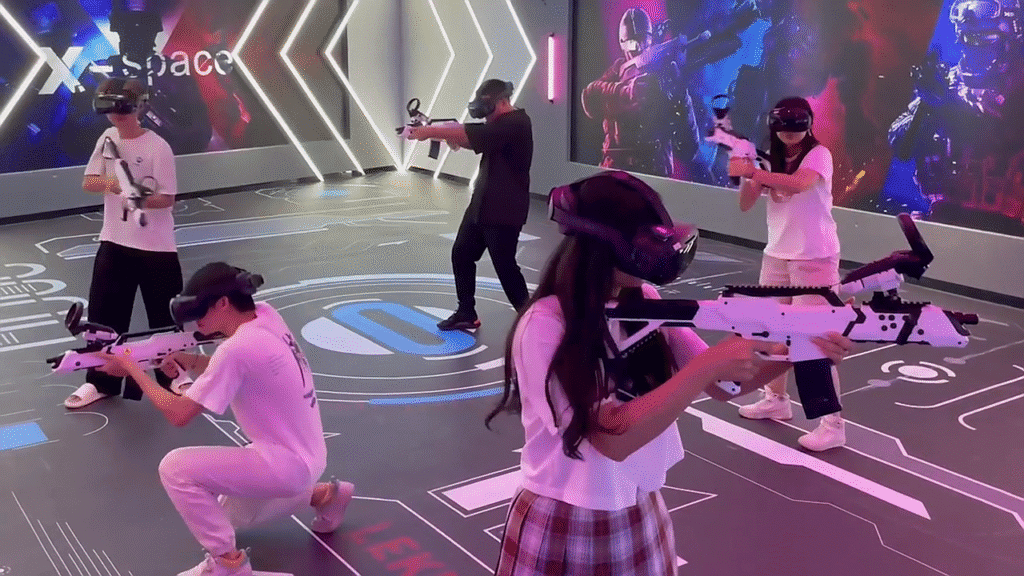
Wireless Headsets. Software-Defined Arena. Three Ways to Play.
Because the boundary is set in software and not by cables or rails, the arena is sized to your numbers instead of being a fixed kit — the minimum build is four players from 50 m², and the headcount grows as the floor does. That is why operators use X-Space as the multiplayer VR arena that carries their premium group bookings, and it is what guests mean by free roam VR: no lead to watch, the whole floor in play, and modes that switch from team battle to co-op to a spectator session without anyone rebuilding the room.
- Enterprise wireless headsets — nothing to trip over
- Millimetre-level tracking, so where you stand is where you are
- Objectives a team has to solve together, not four solo runs
- A spectator screen, so the rest of the group can watch the last round
- Cloud leaderboards and tournament mode for league nights
- 12+ licensed multiplayer vr games, refreshed over time
- The same floor re-skins as a vr laser tag arena — no maze walls to build
Most Arenas Sell One Mode. We Spec Four — And Plan the Room.
An arena is judged on more than the headset in the crate: how many ways it can be played, whether it fits the floor you already rent, and who plans, installs and supports it. These are the six rows operators tell us they compare before they order a multiplayer VR arena.
Written from the checklist operators run through before they order. We do not name competitors — send us any arena specification sheet and we will place it next to ours, line by line.
Match the Format to Your Venue & Crowd
Most operators end up with two of the three. Put the kiosks where people already walk, the team matrix where bookings happen, and the free-roam arena wherever you have the floor to make it a destination — a multiplayer VR arena is usually what lifts a walk-up site into one that takes group bookings. Buying all of it from one manufacturer is what keeps a VR shooting simulator and a free roam VR arena working as a single room instead of three separate installs — and it is the step operators already running laser tag venues tend to take first, because the room, the audience and the appetite for virtual reality are already there.
Mall Corridors & Foyers
Self-service solo kiosks monetize passing traffic and waiting queues with near-zero staffing.
Parties & Birthdays
Corps Pro’s 4-player team matrix is a ready-made slot for booked groups and celebrations.
Esports & Leagues
Free-roam arenas with leaderboards host tournaments, corporate team-building and league nights.
FEC / Arcade
Layer all three to capture impulse players, mid-size groups and premium group bookings on one floor.
Theme & Amusement Parks
The arena anchors the entertainment zone with premium per-capita spend and group throughput.
Urban Entertainment Hub
One mixed floor serves every demographic — solo to full squads, casual to competitive.
One Accountable Manufacturer, Across All Three VR Shooting Simulator Formats
LEKE VR builds the machines it sells — a virtual reality equipment factory in Guangzhou, not a trading company with a catalogue. On all three formats of the VR shooting simulator range, that shows up in the price you are quoted, in what arrives in the crate, and in who answers the phone two years later.
In-House Manufacturer
12 years of R&D and manufacturing of commercial virtual reality equipment in Guangzhou, China. We engineer every wired and wireless VR shooting simulator system in our own factory — no third-party reselling.
About LEKE VRCertified & Compliant
ISO 9001 quality system with CE, FCC and RoHS compliance. Games ship fully licensed for public pay-to-play operation with no per-play fees.
Free Venue Planning
Free CAD floor plan with every quote. We place wired zones and wireless arenas to fit your real footprint, safety zones and power — and the drawing is dimensioned to the exact VR shooting simulator model you order.
24/7 Global After-Sales
Remote diagnostics, video-call installation guidance and spare-parts dispatch from our factory warehouse — across 40+ countries.
Three Venues We Built and Opened This Year
Three venues that opened this year, all in China, all trading now. Each write-up carries the photographs, the floor plan and the numbers the operator actually recorded, and each one runs VR shooting simulator and free-roam arena formats from this range. If you would rather see one running than read about it, we can walk you round on a video call.
~1,000 m² Venue, 8 Attractions + Arena
The largest one-supplier build in the set: eight attractions plus the X-Space free-roam arena on one floor, with construction drawings, factory production, logistics, commissioning and staff training all delivered by LEKE VR. Opening-day footage is in the write-up.
Read the project case1,000 m² Flagship, Five Zones
A flagship inside a newly opened premium mall: racing, a free-roam virtual reality arena, cinema, solo and family zones under one roof. The write-up shows the on-site photographs alongside the actual 2D floor plan and C4D visualisation that preceded the build.
Read the project caseOur Own Store, on the Mall’s Third Floor
The venue we run ourselves — the live reference we benchmark every quotation against. Early operations averaged around US$8,000 a day with a single-day peak of US$13,368, so it is the honest place to check what this equipment mix actually does under mall foot traffic.
Read the project casePrefer to verify us first? See our company profile and venue demo videos — or ask us for operator references running this VR shooting simulator range in your region.
Common Questions, Straight Answers
What Operators Read Before They Commit a Floor
What decides a VR shooting simulator project is rarely the headset. It is the floor plan, how many players the room can carry, and the payback period your finance team will ask about — the same three questions whether you are specifying a solo kiosk, a four-player team matrix or a full free-roam multiplayer VR arena. The guides below are written from the venues we have built and the figures the operators running them report back, so the comparisons come with numbers instead of adjectives. Start with what a VR arena actually is, then the arena-versus-matrix comparison and the X-Space build-and-ROI write-up.
Nothing here matches “”. Try the full blog instead.
Browse the full blog Written by the team that designs and commissions these systems. If your question is not covered below, send it to us — we will answer it directly, and often add it to this list.
Build Your Play-Space Mix
Tell us what you are planning and how much floor you have to work with. Our project team replies within 24 business hours with a tailored proposal for your VR shooting simulator and multiplayer VR arena mix, a floor layout and a costed equipment list.
Free CAD Layout Before You Order
The VR shooting simulator placed on your real floor plan, with clearances, safety zones and power checked. No charge, and you keep the drawing.
One Accountable Manufacturer
Your venue is designed and built by LEKE VR's own engineering team, with one manufacturer accountable for the layout, the equipment and the delivery schedule.
Commissioning & After-Sales
Remote install guidance, on-site commissioning, staff SOP training and 24/7 diagnostics for the life of the venue.
Licensed Content, Ready for Ticketed Play
Public-performance virtual reality content included, with no per-play charge, so your running cost stays predictable.
[email protected]
Email the export team
+86 153 6087 7766
WhatsApp, reply within hours
Guangzhou Leke VR Technology Co., Ltd.
Room 601, Building A Jisheng Vanke, Panyu District, Guangzhou, China
Fields marked * are required. Your details stay with LEKE VR only.
Get a Free VR Shooting Simulator Plan — Layout, Format Mix & Cost
Send us your floor size and the formats you are weighing up. Our project team checks the clearances, the power and the player count your space can carry, then comes back with a plan for your virtual reality floor you can put in front of a client, a landlord or your own board.
- CAD layout drawn on your real footprint
- Format mix — solo kiosk, 4-player matrix or free-roam arena
- Costed list with lead time, shipping terms and power requirements