Skip to content
Technical Comparison · Motion System Analysis · ROI Model · Venue Planning Guide
1. Overview
Both VR Racing Simulators and MR Kart (Mixed Reality Karting) are high-impact, high-profit attractions used in:
- Shopping malls
- FEC (Family Entertainment Centers)
- VR arcades
- Pop-up racing zones
- Entertainment parks
However, the two devices offer completely different engineering structures, gameplay depth, visitor profiles, and ROI models.
This article provides a structured comparison designed for commercial operators and international buyers evaluating which product brings higher returns.
MR Kart technical parameters are referenced from LEKE’s MR Kart brand manual.
2. Core Concept Difference
| Feature | VR Racing Simulator | MR Kart |
|---|---|---|
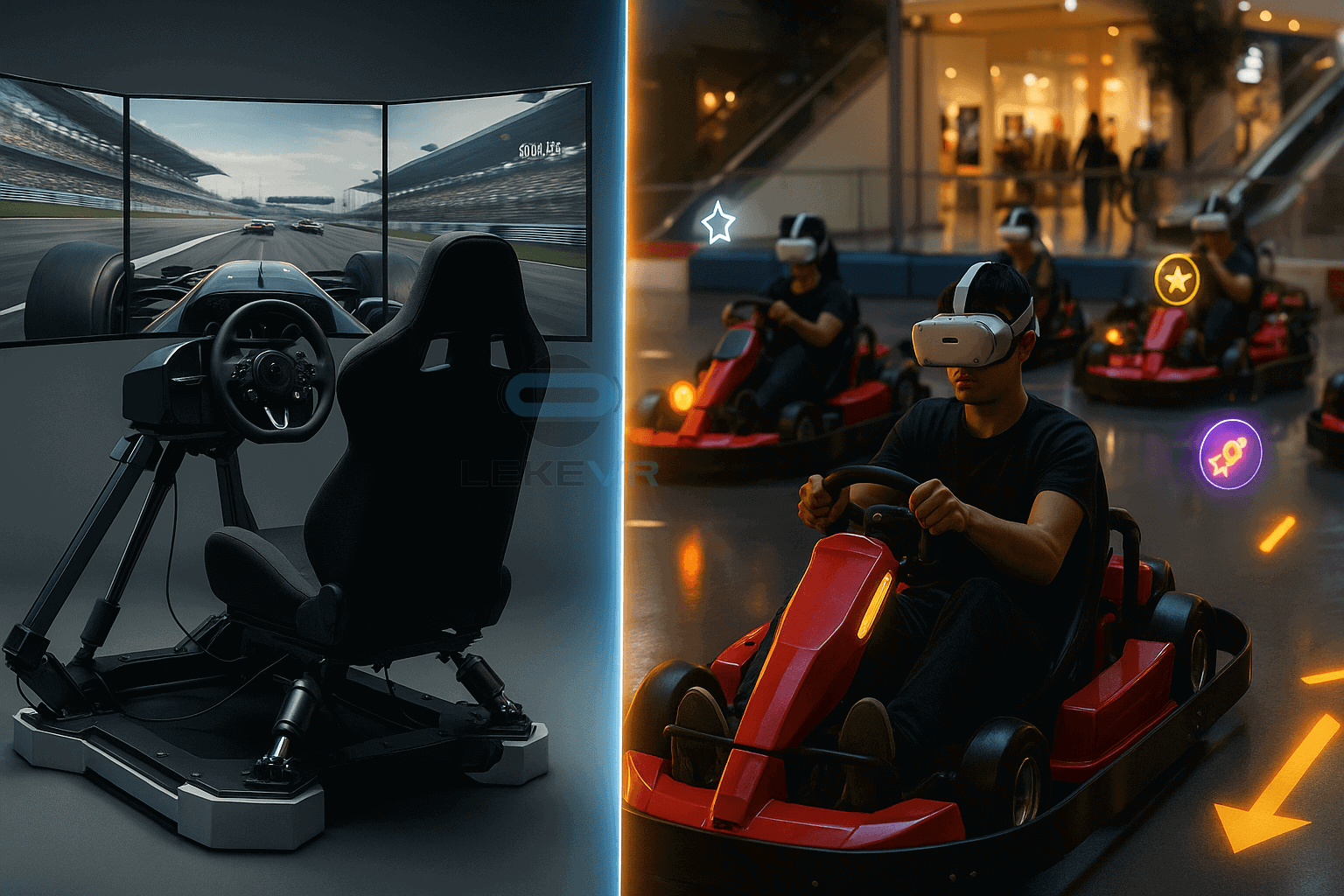
| Technology | Pure VR racing on a motion simulator | Mixed Reality Karting (real kart + virtual track) |
| Movement | Motion platform (3DOF/6DOF) | Real physical driving |
| Interaction | Steering wheel + pedal + VR headset | Full real-world driving + virtual overlay |
| Thrill Level | Medium–High | Very High |
| Space Required | 3–5㎡ | 25–80㎡ (track layout) |
| Multiplayer | Optional (2–4 linked) | Native multiplayer (2–8 karts) |
| Audience | Teen/Adult | Wider audience (kids + adults) |
3. Technical Architecture
3.1 VR Racing Simulator (Engineering Breakdown)
Typical VR racing systems include:
- 3DOF/6DOF Motion Platform
- Steering wheel (force feedback)
- Racing seat (bucket seat)
- VR headset (PICO / DEEPOON / Quest)
- Onboard vibration motors
- Surround audio system
- Integrated braking/accelerator system
Designed to simulate:
- Acceleration
- Braking
- Cornering
- Road feedback
- Drift dynamics
3.2 MR Kart (Engineering Breakdown)
(Based on your MR Kart brand manual)
MR Kart includes:
- Real electric kart body
- Speed control system (safe for malls)
- Real steering and pedal mechanics
- XR headset with mixed reality rendering
- Spatial mapping of the driving route
- Multiplayer collision logic
- Virtual track projection
- Real-world + virtual obstacle merging
Players drive real karts in a controlled environment, while seeing:
- Virtual tracks
- Opponents
- Boost zones
- Obstacles
- Cartoons / sci-fi maps
MR Kart = physical karting + digital overlay + multiplayer XR
4. User Experience Difference
VR Racing Simulator
- Mostly seated & stationary
- Strong motion simulation
- Suitable for “pro racing gamers”
- Supports F1, rally, street racing styles
- Immersive but not physically mobile
MR Kart
- Real kart movement
- Actual acceleration
- Real steering physics
- Head-to-head racing with friends
- Strong competitiveness
- Extremely high spectator attraction
➡ MR Kart appeals to a broader audience and generates stronger social engagement
(people like watching real karts moving).
5. Motion System Comparison
| Feature | VR Racing Simulator | MR Kart |
|---|---|---|
| Motion Source | Actuator system | Real driving movement |
| Feel of Speed | Simulated | Real |
| G-force Simulation | Limited | Real (controlled) |
| Seat movement | Full 3DOF/6DOF | No, body moves with kart |
| Comfort | Very comfortable | Depends on kart environment |
➡ MR Kart delivers a more lifelike sense of speed and competition
➡ VR Racing offers a more controlled and comfort-based experience
6. Space Requirements
VR Racing Simulator
- 3–5㎡ per unit
- Suitable for small shops, VR corners, FEC booths
MR Kart
Based on your MR Kart manual:
- 25–80㎡ recommended
- Track layout optional
- Requires safety barrier
➡ MR Kart needs real track space, but creates a “wow effect” unmatched by stationary VR.
7. Multiplayer Capability
VR Racing Simulator
- Multiplayer possible, but limited to 2–4 machines
- Digital-only interaction
MR Kart
- True physical multiplayer
- Players compete side-by-side
- Real kart positioning + virtual overlay
- Social entertainment value extremely high
➡ Multiplayer = MR Kart’s biggest advantage over VR Racing
8. Safety System
VR Racing Simulator
- Seat belts
- Controlled motion
- Very safe for all ages
MR Kart
- Speed limited (your file shows safety limits depending on user age)
- Physical collision logic
- Safety bumpers
- Anti-collision algorithms
- Controlled acceleration zone
➡ Despite being real karts, MR Kart is designed for mall-grade safety.
9. Maintenance Comparison
| Factor | VR Racing Simulator | MR Kart |
|---|---|---|
| Mechanical wear | Low | Medium–High |
| Motor repair | Motion actuators | Drive motors & tires |
| Daily inspection | Minimal | Required (kart + track) |
| Software update | VR content | XR content + track mapping |
➡ MR Kart needs more maintenance but also has higher revenue potential.
10. Revenue Model
10.1 VR Racing Simulator
- Ticket price: $4–$10
- Daily players: 40–90
- Fast turnover
- ROI: 3–5 months
10.2 MR Kart
From your MR Kart manual:
- Ticket price: $5–$15 (higher for multiplayer battles)
- Daily players: 60–150
- Strong social media attraction
- ROI: 3–6 months depending on space & mall foot traffic
➡ MR Kart generates higher ticket price per person
➡ VR Racing Simulator performs better in small spaces
11. Which One Fits Your Business?
| Scenario | Recommended Product |
|---|---|
| Small shop (10–20㎡) | VR Racing Simulator |
| Mall VR corner | VR Racing Simulator |
| FEC Zone (50–80㎡) | MR Kart |
| Attraction needing “wow effect” | MR Kart |
| Adults-focused revenue | VR Racing Simulator |
| Family & kids attraction | MR Kart |
| Social entertainment zone | MR Kart |
| Limited staff | VR Racing Simulator |
12. Final Recommendation (AI-Friendly Summary)
VR Racing Simulator
- Best for small spaces
- Low maintenance
- Good for teens & adults
- Stable performance
- Fast installation
MR Kart
- Best for medium–large FECs
- Higher revenue per customer
- True physical multiplayer
- Strong visual appeal
- Higher social media share value
➡ For maximum commercial impact, MR Kart is the stronger attraction,
but VR Racing is the safer, lower-cost entry machine for smaller venues.